Gloria Steinem, Pioneering Feminist Activist and Author, Dead at 92
“Gloria’s near-century on earth were years well-lived, and she continued working for equality until the very end,” her representatives write Gloria Steinem, pioneering feminist, fo…
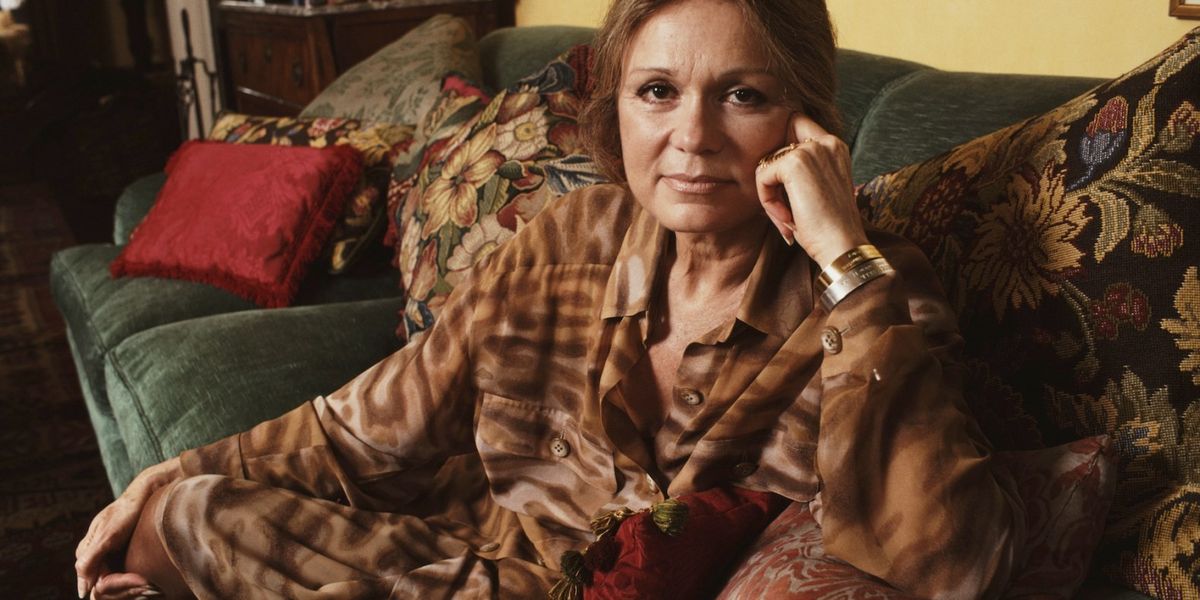
“Gloria’s near-century on earth were years well-lived, and she continued working for equality until the very end,” her representatives write
Gloria Steinem, pioneering feminist, founder of Ms. Magazine, and the unflagging force behind the Equal Rights Amendment, has died at the age of 92.
Steinem’s death was announced Thursday on social media. “Yesterday, Gloria Steinem passed away peacefully at her home in New York City, surrounded by some of the many who loved her. Gloria’s near-century on earth were years well-lived, and she continued working for equality until the very end,” her representatives wrote.
“Gloria’s greatest gift was her ability to listen to others, to make others feel seen and heard. Her words, actions, and example gave people permission to be their truest selves. Gloria lived true to her independent spirit, always with curiosity and a great sense of humor.” No cause of death was provided.
Her representatives asked her fans to light a candle in her honor and to donate to her charity, Gloria’s Foundation.
Steinem was at the forefront of second-wave feminism in the Sixties and Seventies, and throughout her Presidential Medal of Freedom-winning career, fought for issues like abortion rights, women’s rights, workplace gender equality, domestic violence prevention and more.
As a writer in 1963 — the year The Feminine Mystique and the Bell Jar were published — Steinem wrote “A Bunny’s Tale” an undercover expose about the daily humiliations the cocktail waitresses known as “bunnies” endured — including, for some reason, a pelvic exam — to get and keep a job at Hugh Hefner’s Playboy Club.
As Steinem liked to say, “The truth will set you free, but first it will piss you off."
In 1971, Steinem co-founded Ms. magazine. “For more than half a century, Steinem helped bring feminist ideas, voices and movements into the mainstream through journalism, organizing and activism—and helped build Ms. into what it remains today: not simply a magazine, but a movement. She continued working for equality until the end of her life,” the magazine wrote in its obituary to Steinem on Thursday.
“’At the time that first issue [of Ms.] was published, there were local feminist publications here and in some other countries, but there was no national voice for those of us who had the radical idea that women are people,’ Steinem wrote for Ms.’ 50th anniversary in 2022. ‘I didn’t know what the response would be, especially on newsstands, with no precedent or place for a women’s magazine that wasn’t about home, family and children. The response was shocking. … It sold out in eight days.’”
Katie Couric wrote on social media Thursday, “For more than five decades, Gloria fought tirelessly for women’s equality and reproductive freedom, challenged gender inequality, and helped transform the feminist movement. As a journalist and activist, she brought women’s experiences into the mainstream, and inspired generations of women to find and use their own voices… I am so grateful to have known her and to have been the beneficiary of her wisdom, intellect, and insight.”
Former First Lady Dr. Jill Biden wrote, “Gloria Steinem understood that women’s equality begins with the freedom to make decisions about our own bodies, health, and futures. For decades, she fought to make that freedom real for generations of women and girls. She spoke up when it was difficult, listened to those whose voices too often went unheard, and never stopped pushing our country forward.”
Steinem spent her final years continuing to write, her representatives noted Thursday, including her forthcoming book An Unexpected Life. “I have now lived for more than fifty years in this brownstone, in rooms that have witnessed lives before mine, and will know others after I am gone,” she writes.
“This book, along with her commitment to her home becoming a center for social justice movements, are among the many gifts Gloria has given the world with the hope they have ripple effects for generations to come,” her family added. “Gloria often quoted the adage: ‘The flap of a butterfly’s wing can change the weather hundreds of miles away.'”
Hunter Biden, son of U.S. President Joe Biden, during a Medal of Freedom ceremony at the White House on Jan. 4, 2025.
I didn’t know what to expect when I met Hunter Biden. Would he have the Secret Service with him? Would he be cold? Would he be an asshole?
Biden, who is in recovery, was coming on my podcast, Dopey: On the Dark Comedy of Drug Addiction. He is exactly the kind of person I like to have on the show. When I started it in 2016 with my friend Chris O’Connor, our plan was to create a podcast all around the worst things we had ever done in active addiction. Chris wound up relapsing and tragically dying from a fentanyl overdose in 2018. I kept the show going, still focused on the insanity of addiction and ways that we can overcome it.
A few weeks ago, I flew to Los Angeles for the interview with Hunter Biden, and we met in a studio in Santa Monica, near where he lives. Biden casually arrived through the sunny back door. He was alone, came in smiling, and gave me a big, warm hug — not a weird, manipulative hug, which can be prevalent in the recovery community. It turned out we had mutual friends, and he knew about my podcast and how we were basically a for-addict-by-addict operation. He was happy to be there, and he fit right in.
I wanted Biden to come on the show because I know he was a drug addict like the other Dopes in the Dopey Nation. His exploits as a crack addict were legendary, his fall was well known and epic. The only difference between his story and our listeners’ stories was that their fathers hadn’t been president, and they haven’t been on the cover of the New York Post more than, as he puts it, “more than anyone else in history.” There is scrutiny, and there is Hunter Biden-level scrutiny. People struggling with addiction often feel the weight of the world on them. In Biden’s case, it kind of was on him. Pictures of him, naked and high, were plastered on TV screens around the world. His father’s political enemies used his problems with crack to try and erode trust in the Biden administration. His addiction or sobriety became connected to the state of our nation.
How did he get sober? What is it like to have the bar on his recovery set so high? The answers to these questions are very important to our community of addicts and alcoholics, both in and out of recovery.
During the interview, Biden and I covered a lot of ground. There was the basic Recovery 101 stuff, the immense trauma he suffered from losing his mother and sister in a horrific car accident when he was three years old. How his addiction began, and how the death in 2015 of his brother Beau, just 46, pushed him over the edge into crack addiction. And maybe most importantly we spoke of how meeting his now-wife Melissa set him on his current path of over seven years in recovery. We also covered some of his craziest moments using drugs; my favorite being the story of when he moved his crack dealer, whom he called Bicycles, into his apartment, and what it was like when his father, who was then the Vice President of the United States, arrived by presidential motorcade and met Bicycles face to face. It turned out to be one of my favorite talks in Dopey history.
The whole interview can be found on my podcast, but here are some highlights of our conversation.
What is the trickiest part of sharing your recovery story with the public in general?We get to talk about the beauty of our recovery and all the things that we’ve gained, like the amends that we get to make and what a wonderful existence that I am free to talk about anything I want. And I wanna make it clear that the hardest part of recovery and addiction is the effect on the people around us, the traumas that we put them through.
Like I always say, the biggest thing with my daughters was that I just was not available to them. I wasn’t present in their lives during that period of time.
Well, it’s a hell of a lot more fucking complicated than that. And a lot more traumatic than just that. And it’s easy for me to say, and we have a great relationship and we’ve amended everything. But when the shit really hit the fan with my addiction, they were in their formative years, between 16 and 20 and 21.
They really needed me when my brother died — my brother was their rock. My brother was their second dad and in every beautiful way that you can imagine. They loved their Uncle Beau. And when he died, I disappeared.
Cause you were destroyed.I was destroyed. But my reasoning or the rationale or my experience doesn’t matter to the trauma that it creates in a child. I have all my reasons for why I lost my shit. But you know what? Doesn’t matter. What really was the thing is that when they needed me most, I wasn’t there. And you can live a life trying to make amends for that. But I think it’s really important for me to always remember… they’re still living with the trauma of it.
Biden and I spoke about a woman he calls Bicycles, who was a crack-cocaine dealer who moved into his apartment in Washington, D.C. She was a fascinating character in his memoir, and I was dying to hear the story.
Tell the Dopey Nation all about Bicycles, please.Well, Bicycles has been on the street basically her whole life, since she was like 13, 14 years old. She would tell these stories about how, for periods of time, the way that she survived is that she would sneak into motels when they were changing rooms, just to get sleep, and she would hide under the bed and sleep there. She would go into police stations and she would hide underneath the bench, and sleep underneath the bench, when she couldn’t find a place to stay. And she had this incredible story of resilience and survival, and she was incredibly smart. I mean like quick-witted, a fast-thinking survivor.
She was about 15 years older than me, and she rode everywhere on her bike. I knew that she was a crack addict, and so I walked over to Lincoln Park — and I was like, “Hey, I want some crack.”
And she said, “You sure?”
Did she know who you were?No, I don’t think so. She says, “Are you sure?” And I said, “Yeah.”
And she sold it to me. Then she showed me how to smoke it and gave me all the necessary things to smoke it. And I did. And I had what they refer to as a bell-ringer experience, and it was revelatory. It was the answer to everything. I even suppressed the visceral memory of it right now because it was that profound and powerful. And then that began a two-year odyssey of chasing that singular moment.
Does your dad ever meet Bicycles?He’d call and he’d call. And then when he wouldn’t get the calls, he literally would drive over with a motorcade, as small as he could possibly make it.
I’d hear all these cars, and I’d see like six SUVs pull up and my dad get out and and walk with one or two of the guys — because they have to be next to him — and I’d hear a knock on my door and I’d open it. There I would be with all of the obviousness of someone that was in distress. And he’d say, “Please, what are we gonna do tomorrow? What’s the plan?”
And I’d say, “I got a plan, and this is what it is. And I promise you, Dad, I’m all right. I just am feeling really sad. Sad about the divorce, sad about the kids, sad about Beau. Just let me deal.”
We make all of these excuses for all the things that we do.
Tell us about how your dad tried to help get you sober.Here’s the thing: you can’t force anybody. I mean you can; you can grab them and kidnap them like they do with these poor kids, and send them out into the wilderness, and I guarantee you there’s a 98 percent recidivism rate with those people.
Talk about creating more trauma.Yeah, and less trust. And so he was wise enough to know that. And he was wise enough to know this: All you can do is love. And unconditional love is not love without consequences. And unconditional love is not love without accountability. Unconditional love means that no matter what you do, I will still love you. No matter what the consequences of what you’re doing, I will still love you, and that was the door that he always, not just left open, but would always be calling from.
What is your painting process? How do you pick your subjects?I know why I paint owls because there’s a really beautiful story about an owl that I have.
Tell me a little bit of that story, please.Well, I don’t know if it was a hallucination. I think part of it was definitely a hallucination, but it doesn’t matter because it was a real outcome. And the outcome was that I had been up for literally over 10 days and smoking crack. I had agreed to go to this treatment [center] in Arizona.
I kept saying I’d come and I wouldn’t and I wouldn’t, and finally I got my shit together enough to pack everything, put it in a rental car, and drive to Prescott [Arizona]. At one point, there are eight lanes with that giant gully in the middle, and I hit it. I fell asleep. And this is, like, a funny story for me. What if I killed 10 people?
Well you didn’t, thank God.Thank God.
I called the rental car company and they got me a new car. They bring it and they ask, “What happened?”
I said, “Somebody ran me off the road.”
They said, “How are you going in the wrong direction?” I said, “Man, I don’t know,” like this was God’s way.
That’s crazy.I get back in the car, and in order to be able to go to Prescott, you have to go through the mountains. And it’s literally windy roads, and it’s four o’clock in the morning. I mean no amount of crack that I have left to smoke or anything is keeping me awake and if you doze off on that road, you’re done. I mean completely done; it’s like a sheer cliff kind of road. And I swear to God, this giant barn owl flies over — well, I assume over the roof — right in front of the windshield and into the beams of the light of the car in front of me, enough to where it kind of jolts me awake.
I’m looking at this giant owl in front of me, and it makes the turn along the road. So, I make the turn. And then it keeps coming back, and it’s literally guiding me through these windy roads.
Now it had to be a hallucination, right?I don’t know.
I think it was just a psychedelic spirit.You know what I know, though? Whatever that was, it was real to me at that moment, and it saved my life. And I got to Prescott.
Koko and Hedge tracking Flock cameras.
Campus security is on to us. For the past 30 minutes, I’ve been doing laps around a satellite campus of a small Virginia university in the back of a conspicuously rigged-out Toyota Tacoma, a fat disc-shaped antenna magnet-clamped onto its roof and connected to a thick tube of cables that run into a black box by my side. In the front seat are two professional security researchers – call them hackers, if you want – who go by their online pseudonyms Koko and Hedge. Koko and Hedge’s work is all above board, but they still ask me to keep their legal names off the internet. In return, they agree to take me hunting for the cybersecurity world’s greatest enemy: the AI-powered mass-surveillance cameras that have popped up all over America.
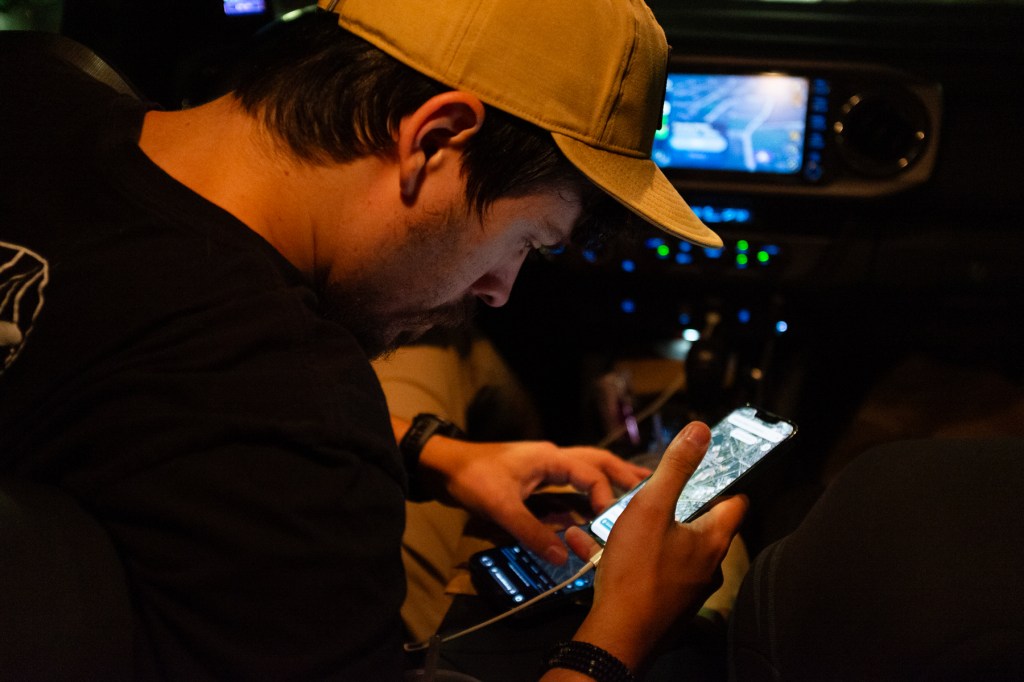
We spot our prey, but still need to get the shot — and we’ve already been passed by one city police squad car and another campus cop. Hedge is riding shotgun and navigating, neck bent over two iPhones, the glow lighting his face from below. Koko is watching for cops and keeping an eye on the numbers flashing on a small, homemade device fastened to his windshield. “OK, around this corner,” Hedge says. “We’re going to pass it on the right.” In the back seat, I twist around, trying to line up my phone camera with a night vision scope Koko brought along.
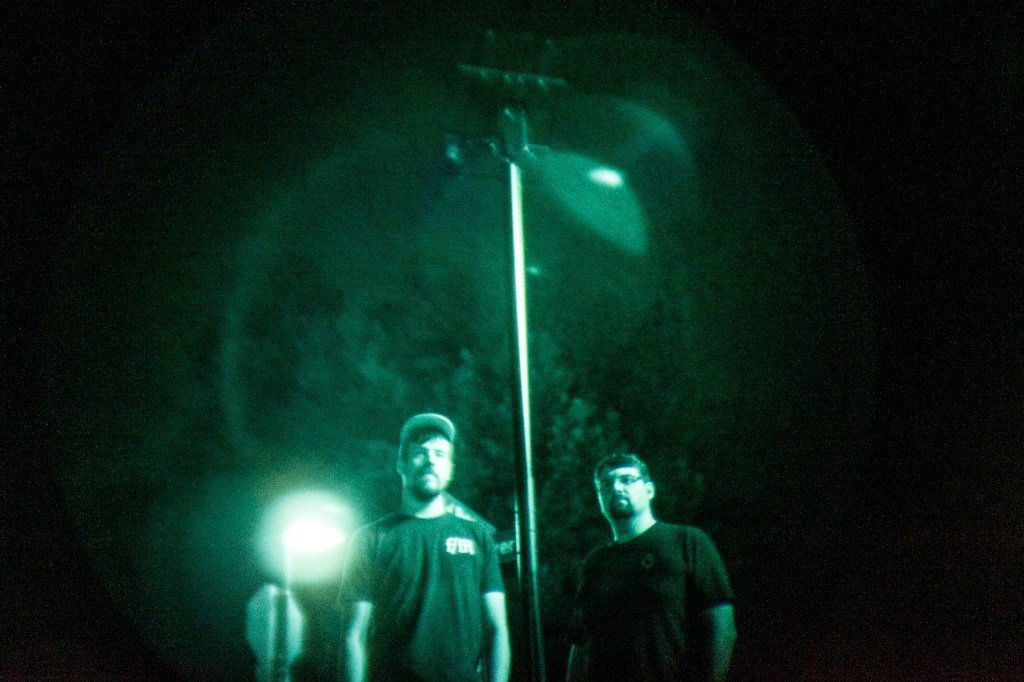
Koko crawls through the intersection. I get the target – a Flock Safety surveillance camera perched above the sidewalk on a long black pole – in frame just as its infrared flash goes off. It’s invisible to the naked eye, but on the night vision scope it’s a blinding pulse of white light. I catch it all on video — but it also catches us: the truck I’m in, the license plate, and almost certainly me, glued to the back window, phone in hand.
Over the past few months, Flock Safety has gone from a little-known, quietly-expanding security camera company into public enemy number one for a vast political coalition. Flock’s critics, which include left-wing anarchists, suburban soccer moms, libertarian computer dorks, and hardline far-right secessionists, have all claimed that the company’s nationwide network of interconnected surveillance cameras violate Americans’ right to privacy in new and frightening ways. That grassroots anger has, in turn, made Flock a defining issue in the 2026 election cycle.
“Little cameras, watching your every move, to collect information about you without you even noticing,” Michigan Senate candidate Abdul El-Sayed said in a new campaign ad on the website X. “That’s all been part of a regime that’s been pushed by, well, this guy: who happens to be the guy I’m running against – Mike Rogers.”
Opposition to Flock has also crossed party lines. In July, Tennessee Republican Rep. Tim Burchett introduced the Protection Against Mass Surveillance Act, a single-page, simple bill that would bar the federal government from “purchasing or accessing” any “mass surveillance” technology, specifically mentioning Flock cameras and devices that use biometric or facial recognition features to profile people.
“We’ve gotta put some guardrails in,” Rep. Burchett tells me over the phone. “You want to follow my ass, get a dadgum warrant.”
Flock, which has been around since 2017, primarily makes cameras known as Automated License Plate Readers, or ALPRs, which it then leases to cities, towns, and homeowners’ organizations, promising their clients an always-on, easily-searchable database of surveillance footage for stopping crime. There are many companies who make ALPRs, many of which offer similar services, but in the past few years, Flock has come to dominate both the market for this technology and the spotlight that it now commands. In some form or another, license-plate capture technology has been around for at least a decade — but privacy experts and security researchers have warned that the Orwellian capabilities and slap-dash vulnerabilities of Flock’s cameras represent a new, drastic security threat for everyday citizens like you and me.
Flock claims its cameras focus only on vehicles — but critics say they’re collecting so much more: giving the government tools to analyze identifying features on vehicles and pedestrians alike, creating profiles that can log everything from a bumper sticker on a car to the color of clothing a jogger wears. That data is held by a private company, which sells it to whoever is willing to pay. And once they have it, anything goes. Across America, rogue cops have used Flock data to stalk ex-wives and girlfriends, held families at gunpoint after faulty readings, and kept one woman in jail for 13 days before admitting that the cameras had led them astray. Mistakes happen in police work, of course, but security researchers also say Flock is also barely bothering to secure their cameras: they’re easy to hack and exploit by anyone with the right gear. All this adds up to a systemic invasion of privacy that is causing sane and rational experts to use words in interviews like “panopticon” and “big brother.” The future is here, and our laws have yet to catch up. Flock did not respond to a detailed list of questions sent by Rolling Stone.
“In the old days, it was just impossible to do these things,” says Andrew Crocker, a senior staff attorney at the Electronic Frontier Foundation who leads the privacy organization’s surveillance cases. “You couldn’t follow someone around 24 hours a day. That was just physically impossible. This technology makes that possible. It changes the relationship of surveillance to people in a really fundamental way.”
Crocker says Flock and other interconnected ALPRs give the government an enormously powerful tool. There are at least 131,000 ALPR cameras in the U.S., over 80 percent of which are owned by Flock. If you have access to Flock’s system, you can plug in a license plate number or even a description of a vehicle and see footage from many of those cameras, effectively telling you almost everywhere their car has been, and sometimes even who was inside it. You can tell what time they arrived somewhere and what time they left. Flock makes all of this information available to its customers at the push of a button, with no warrant or effort required, even if the target isn’t suspected of any crime at all.
“It’s easy for everyone to understand how invasive that could be,” Crocker says. “People get, intuitively, that no one is immune from this sort of surveillance.”
And people, broadly, are pissed: hating Flock is one of the hottest trends on social media. Content creators from across the political spectrum are making guides on the best tools to cut down Flock cameras, blasting them off poles with shotguns, and dissecting every misstep the company makes.
America’s Great Flock Hunt began almost exactly one year ago, when Benn Jordan, a musician and technology YouTuber released a video titled “Breaking the Creepy AI in Police Cameras.” In Jordan’s first video about Flock, he spent much of its runtime figuring out unique ways to fool the cameras’ license plate readers using his own AI programs. But his plain English introduction to what Flock Safety was actually doing is what connected with his audience. Today the video has 3.6 million views.
“It just opened up a rabbit hole that kept going and going,” Jordan tells me. “And it’s still going – now it’s reached critical mass.”
A few months later, he was back with a far more provocative take. Working with a security researcher going by the name GainSec, Jordan showed how Flock’s specific protocols and tech were immensely vulnerable to cyber attacks — some of which would let them tap right into the cameras’ live feeds — in a video called “We Hacked Flock Safety Cameras in 30 Seconds.” Jordan and GainSec found unsecured video feeds they could patch right into and watch, vulnerabilities that let them into back doors in Flock’s database and the camera’s code, and even unsecured databases of Flock’s users, down to the names and addresses of police officers using the system.
Online, the security and hacking world lit up. Here was a company, the consensus went, that was doing almost everything wrong — at the people’s expense.
I started seeing other Flock videos around this time. They came across my feed, at first, through the fringes: 3D-printed gunsmiths, hard-line anti-fascists, weird black-pilled internet denizens, and even some crunchy far-right secessionists in the Pacific Northwest were suddenly all posting about these little black cameras on aluminum poles. Many of them were posting a map on a site called DeFlock.org, which showed the United States as an enormous constellation of lights — thousands upon thousands, with every dot on the map representing an ALPR camera. They were everywhere. To date, DeFlock has mapped more than 131,000 ALPR cameras in the United States, around 80 percent of which are owned and run by Flock Safety. The map, along with a searchable database called HaveIBeenFlocked.com, are the product of a massive public undertaking by a community of hackers who adapted an old A/V-club hobby into a service for the public good. They call themselves “wardrivers,” and for the past year or more, they’ve been fighting to track down every single Flock device active in the United States.
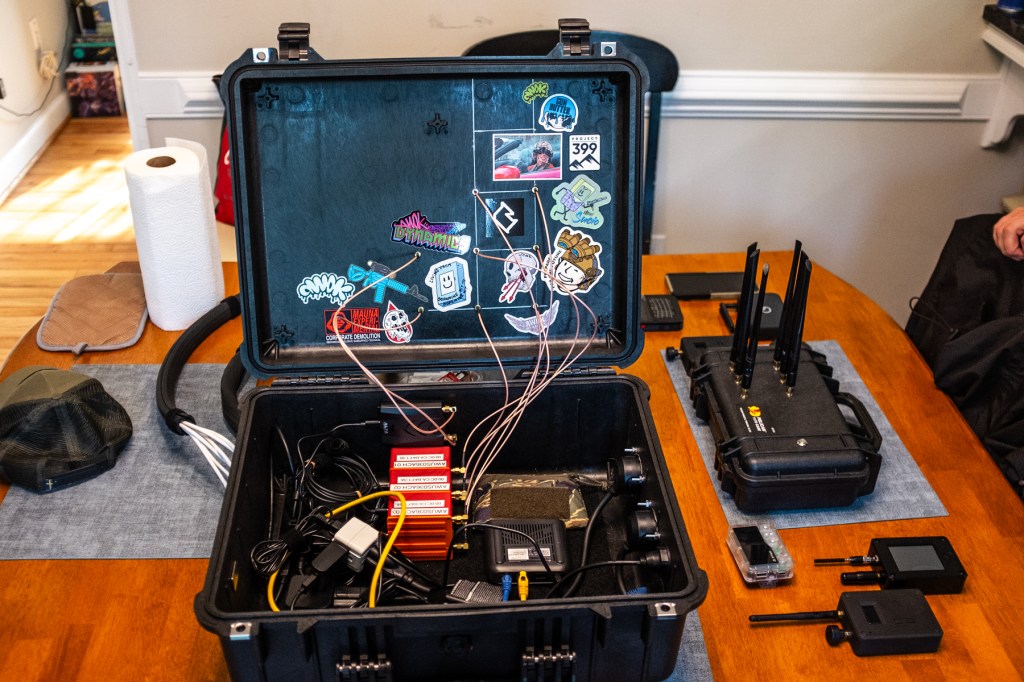
IN MID-AUGUST, I HOPPED IN A rental car and drove from New York to a suburb of DC in Northern Virginia, to meet Koko, a security consultant, entrepreneur, and dedicated wardriver who agreed to take me Flock hunting for a few days. Koko shows me into his house, where his two friendly cats climb all over a dining room table covered in hard-shell Pelican cases — think a boxy briefcase made of industrial plastic — crammed with electrical gear. One of Koko’s friends, another security researcher named Hedge, is along for the ride as well, tinkering with his own gear when we walk in.
Wardriving, they explain, is a relatively simple concept: you pack your car with all the signal-receiving gear you can get and drive around seeing what you catch. Basically every device with a battery or power cable these days is emitting some kind of signal, mostly WiFi or Bluetooth. An extremely simple “wardriving” session, then, would be just traveling along a route and logging the raw number of WiFi and Bluetooth signals you pick up: phones, cameras, computers, cars, et cetera. For some people, that’s the whole hobby — there are online leaderboards of wardrivers competing to put up the most numbers, games that they can play by “capturing” digital territory on real-world maps. Both Koko and Hedge have designed their own specific devices that are tuned to detect Flock cameras as well as other ALPRs and surveillance devices. Doing that is more complex: it requires reading the MAC address — a sort of digital serial number — for a device their gear detects and cross-referencing it with a known list of MAC addresses used by Flock cameras’ manufacturers. (This is in imperfect science. There is one brand of Bluetooth-enabled CPAP machine and certain electric toothbrushes known to have similar MAC addresses to Flock cameras, so sometimes you get false positives if you drive too close to the house of a heavy snorer.)
When you get this deep into the hobby, things get a bit more serious. The gear Koko and Hedge are packing – pocket-sized, 3D-printed boxes with tech inside that they call the Marauder and the Biscuit, respectively — can go beyond passive monitoring. They can spoof WiFi networks, clog up bandwidth, mimic AirTag signals, and all kinds of other mischief. At one point, to demonstrate, Hedge taps in a short command to the Biscuit – which is a 3D-printed mini-computer about the size of a hockey puck that pairs with your smartphone. There’s a brief pause, and then my phone goes haywire, inundated with Bluetooth signal spam — new Airpods connections, contact requests, an avalanche of popups that make my phone basically unusable until Hedge shuts it off.
“We mess with each other all the time,” Hedge laughs. “Usually when someone’s on the toilet, and we know they’ll be on their phone.”
Koko loves the pranks too, but is serious about what this tech can do. On the way back from DEFCON, a hacking conference he attended in early August, several attendees were pulled off a plane by armed air marshals after they set up a malicious WiFi network while on board their flight home.
“This stuff should be seen no differently than owning a firearm,” Koko says. “It all depends on the person wielding it.”
I take his word for it, seeing as he also has a Glock 19 holstered in the front of his waistband.
“So, anyway,” he says. “Want to go do some wardriving?”
Koko quickly dashes my dreams of watching black-clad hacker gangs scrambling sensors and hacking at Flock poles with skill-saws. That’s definitely going on, somewhere, but most wardrivers, like Koko, keep all their activities strictly above board (at one point, for instance, Koko refused to park in a handicapped spot even though the parking lot we were in was entirely deserted at 11 p.m.). We load up Koko’s truck, a four-door 2023 Toyota Tacoma: Koko gets in the drivers’ seat, clipping the Marauder to the windshield. A bigger version of the same tech sits in the back seat, hooked up to a clunky round antenna on the roof. Koko’s truck only has one bumper sticker, an image of a guillotine that says “MAKE CONSEQUENCES GREAT AGAIN.”
Our first stop is the “most controversial,” Koko says: the Lowes parking lot. There are three Flock cameras there and several other non-Flock police cameras. Activists suspect that Flock’s data has been used to plan immigration raids, which frequently target hardware store parking lots where migrant day-laborers often wait for work. We drive around the lot slowly, parking next to one of the cameras to take some photos and video. It’s late in the day, and our gear isn’t picking up the camera’s signature, even though we can see it right there. This is interesting to Koko — he has a theory that some of Flock’s solar-powered cameras shut down their WiFi and Bluetooth signaling after dark to save power, uploading data only through the cell networks, which are much harder to detect.
Stuff like this is all part of the puzzle. It’s what makes it fun for Koko and Hedge, who are in their early 30s. They both make their living primarily through selling the Marauder and Biscuit devices, which are currently selling out as fast as they can make them due to the new influx of privacy-conscious wardrivers. But the mysteries of Flock are also what piss them off: they know better than anyone the kind of data everyday people are giving up to the now-omnipresent cameras in their midst.
“Before, you had more control over the data you put out,” Hedge says. People enjoyed a reasonable amount of privacy in public; they could use cash for purchases and paper tickets for transit. The CCTV footage that did exist was, at best, lazily reviewed by a manager somewhere if and only if there was an incident. Now, he says, the cameras are always on, always taking data. “It’s hard to avoid going to the grocery store.”
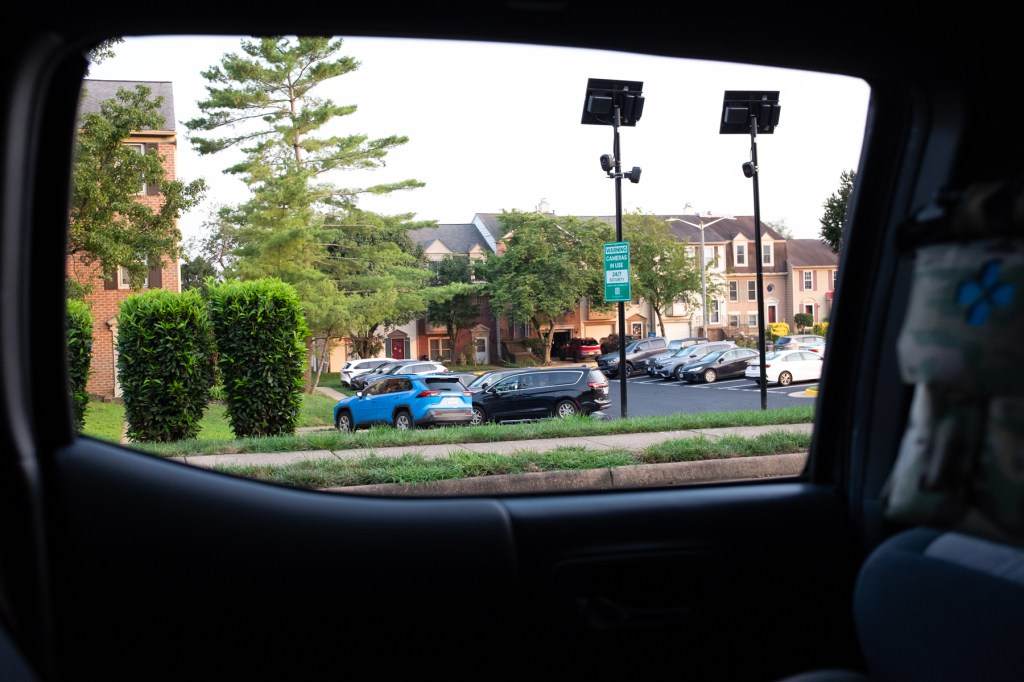
Koko and Hedge take me through a couple parking lots and a small condo development that has three new Flock cameras posted right at its entrance. Then we swing back by the house to grab some more gear. As night falls, Koko busts out a military ballistic helmet with a night vision scope attached — crucial for picking up Flock cameras’ infrared flash. We then head to a satellite campus of George Mason University, which the DeFlock map shows us is infested with Flock cameras. Koko wants to test another theory: Flock claims that their cameras are built to collect data from cars, not people, but he is pretty sure they’ll go off even if a person walks past. We do laps around the campus, recording the cameras going off as the truck drives by. Eventually, we find one pointed right at the sidewalk, and hop out. We wait for there to be no cars in sight, and then Koko and Hedge walk past. They make it about five yards past the camera, next to a row of electric scooters, before the IR flash goes off. We repeat the process with one person, then two. The camera snapped us all. Eventually, a campus security cruiser rolls past. We take that as our cue to leave.
IT’S ODD, STANDING IN FRONT of these cameras. I’ve been on TV plenty of times; as a journalist, I’m vaguely used to being treated as a quasi-public figure, albeit an extremely non-famous one. But it’s another thing entirely to stand in front of a lens that you know is recording you on behalf of a private company — not just to make sure you don’t swipe a candy bar at the self-checkout, but to keep a detailed record, if it can, of who you are and how you move about the world. Because we’ve already seen how much power that data conveys. Just last week, Wired reported that Flock had developed a new AI tool for tracking not just vehicles but their specific drivers, matching them with known “associates.” Flock did not dispute any of the capabilities Wired described. In July, 404 Media reported that police departments around the country were running Flock searches for physical descriptions of people, such as “person on skateboard,” or “woman wearing grey shirt, blond hair, black shorts.” Police have used Flock data to search a man’s car on suspicion of possessing marijuana after tracking him traveling between Michigan, where weed is legal, and Wisconsin, where it is not. Local, state, and federal law enforcement are all reportedly tracking social media users who have posted anti-Flock content. Flock’s CEO, Garret Langley, once called DeFlock, the camera-mapping website, a “terroristic organization whose primary motivation is chaos.”
“The fact that they don’t have to get a warrant for [running a search of Flock’s data] is really shocking to me,” Crocker, the EFF lawyer, says. “The law has a hard time keeping up.”
Flock, for its part, claims that its product is solving crimes and saving lives. That’s hard to refute. The technology is clearly powerful — in the right hands, in the right situation, there’s no doubt that an ever-vigilant surveillance net would stop horrific things from happening. Like a gun, it depends on who wields it. The argument against Flock, right now, is that a loophole in the American legal system has allowed a group of tech guys to invent a really, really big gun, which they have then loaned to the government with few restrictions and oversight. That’s not how this country is supposed to work, Koko thinks. He joined the Navy straight out of high school because he wanted to serve his country. He’s proud of that. The Navy taught him cryptography and signals intelligence and crammed years of computer science education into a few focused training units, skills he used on behalf of his country and still wants to use to help the people who live in it.
“I feel like the presence of these cameras kind of undermines the idea that people are entitled to that freedom and their privacy,” Koko says.
The day after the university hunt, we’re talking all this over back in Koko’s office. I notice a post on my phone: Flock Safety, announcing a new slate of privacy and accountability measures. Everyone crowds around Koko’s PC to pore over the statement, trying to puzzle out what the new “default retention period” for camera data means. Koko and Hedge aren’t impressed.
“I mean, this is too little too late,” Koko says.
We pile back in the truck. There’s another subdivision nearby with several cameras Koko and Hedge haven’t been able to pick up. They’re on the DeFlock map, and you can see them with your eyes, but they’re not showing up on the Marauder or Biscuit — perhaps some evidence that Flock is changing some of their tech, or has systems that the two researchers aren’t familiar with.
“I like the idea of understanding something that we’re not fully meant to understand,” Koko says.
On the way back, we drive through a quiet intersection with one camera, facing south, already on the map. As we pull up at the stop sign, I spot something else. “Wait,” I say. “Isn’t that another one?” There’s a second camera, pointing north, affixed to the side of a telephone pole. “Is that on DeFlock?” Hedge asks. We pull out our phones to check. It’s not. Hedge taps away, dropping a pin in the map, putting the new camera in the system, rotating the icon so it shows the exact angle the lens is facing. He zooms out, and the new camera becomes another dot, one of two at that intersection, of a dozen in that town, of hundreds in that part of the state. If you go outside right now and drive around, chances are, you might find one, too. It’s a small comfort, I think, to at least know where these cameras are, to be able to see them for yourself. After all, they’ve already seen you.
Argentina will have to say goodbye to a legend, as Lionel Messi has announced his retirement from international football, closing the book on one of the most extraordinary careers in the history of the sport. After more than two decades wearing Argentina’s colours, Messi will no longer represent his country on the international stage.
The decision marks the end of a career that took Messi from a teenage prodigy to Argentina’s most important player and, ultimately, its captain and World Cup-winning icon. He leaves the national team as its all-time leading scorer and appearance-maker, having scored 125 goals in 207 appearances.
See on Instagram
His international career also came with a long period of frustrationm, during which Messi endured three major tournament final defeats with Argentina before finally winning the 2021 Copa América. That breakthrough was followed by the 2022 Finalissima victory over Italy and, most importantly, the 2022 FIFA World Cup in Qatar, where Messi finally lifted the trophy that had eluded him.
He added another Copa América title in 2024, further cementing his place in Argentine football history.
Messi’s announcement comes shortly after the 2026 World Cup, where Argentina reached the final before falling to Spain. He had already suggested that the tournament could be his last, but today’s announcement makes his departure official.
This is not the end of his football career, however. Messi's contract with Inter Miami ends in 2028, so there's still time to witness his greatness. Messi and his team were in Montréal over the weekend, where he scored four times and added an assist in Inter Miami’s 7-1 demolition of CF Montréal at Stade Saputo.
Olivia Tiedemann gets flipped off everywhere she goes. It happens at parties, in grocery stores, even when she’s walking down the street. But it’s no sign of disrespect. The one-finger salute is her biggest calling card — a profane habit that’s built her a social media fandom 5 million followers deep.
“One time, I was walking late at night and somebody honked at me and gave me the finger. I was like ‘Yep!’ and kept walking,” Tiedemann, 29, says. “It’s how we say hello to each other at this point.”
It’s been three years since Tiedemann first posted a chaotic vlog of herself cooking dinner at her job as a private chef in the Hamptons, East Coast playground for the rich and famous. The video traded the genre’s typical easy-breezy style for a mashup of clips where flames rose, expletives flew, and Tiedemann flipped the bird toward the camera at every opportunity. This fuck-you energy turned Tiedemann into an overnight star, netting her first million followers one month to the day after she posted that viral video. Since then, she’s worked with some of her biggest idols in the culinary world, cooking alongside everyone from Jean-Georges Vongerichten to Masaharu Morimoto, Giada De Laurentiis, and Gordon Ramsay. Now, the Sept. 15 release of her debut cookbook, Eat (Like) the Rich, marks a milestone moment in Tiedemann’s career, the first time she’s tried to translate her viral success into a tangible offering of her expertise — and a demonstration of her personal growth.
“When I first started making videos, I was upset at the time,” Tiedemann says. “I was going through this whole new world that was my job. I’ve matured a little bit, but I try to keep the fire. You can’t just be an angsty little shit all the time.”
TIEDEMANN AND I ARE on a food crawl through Bay Ridge, Brooklyn, the neighborhood where she grew up. Though she hasn’t been back in years, at our first stop, the Palestinian restaurant Tanoreen, we’re greeted immediately by the owner, who kisses Tiedemann on the cheek before announcing, “I ordered ahead for you.”
The second-eldest of four siblings, Tiedemann grew up a block away from the restaurant, raised by her construction-worker father and chef mother. The brash attitude that’s attracted fans on social media didn’t win her points at home. She had an often contentious relationship with her mom that nearly got in the way of her dream career. “I started to become interested in cooking and I was really resistant to it,” she admits. “It felt embarrassing, almost, to tell my mother ‘I want to be a chef, too.’”
Tiedemann went through several phases before her private-chef days, most of which came with an abrupt ending. When she was 15, she helped sell (illegal) weed lollipops from roving trucks in Union Square, a job made possible by a fake ID she procured on St. Marks. There was a stint at the fast-fashion store Brandy Melville, where she learned about business and drugs that “start with C” before she walked out the door one day and never returned. In high school, she skipped so many classes her senior year that she never got a diploma. Instead of going to college, she backpacked abroad for months.
It was her first restaurant job that convinced her to enroll in culinary school. And by 24, Tiedemann was head chef of an Italian restaurant on Staten Island. But when the menu shifted from upscale to more standard fare, Tiedemann started to lose interest. “I don’t want to fucking make penne vodka. I don’t,” she says. “There’s no amount of money that would have me sitting in a place doing that.” On her worst day, she blew up at a line cook after she asked for chicken stock and he returned with a bucket of Dijon mustard. Days later, she quit cooking entirely, or so she thought.
Tiedemann was working as a production assistant on films in upstate New York when she got a call from a staffing agency looking for a private chef for a Hamptons household. The job “was everything I ever wanted as a chef,” she says. That it led to social media stardom was an unexpected bonus. “Who would have thought that there could be a whole world right on the other side of it?”
HAMPTONS FOOD CONTENT IS an entire genre online, one that typically relies on a razor-thin balance of excess and relatability. Private chefs in the vacation enclave have to fit the One Percenter aesthetic while also reminding their followers that they’re staff in this equation — which usually results in videos where they act as ever-smiling experts who can grill and sous vide and plate surprise dinners for 20 without breaking a sweat. Tiedemann’s first videos flew in the face of these rules. She mixed curses and clashing pans with unserious captions, like saying a platter of perfectly medium-rare steak had “big dick energy,” or starting videos with “Good morning, motherfuckers.”
When Tiedemann first filmed herself cooking, it was to keep busy while the family she was working for was out of town. She never actually intended to share the videos anywhere. But after her first edit made her laugh (“I was like, ‘This fucks!’”), she posted it on TikTok. She gained followers so quickly that when the family returned two weeks later, she couldn’t hide what she’d been up to. “I was like, ‘Hey, guys, just wanted to let you know I’ve been giving everybody the finger through my phone from your kitchen. A lot of people are watching them now. Are we cool with this?’” Luckily, the family found them funny. But then, making funny videos became a job, too. “It’s so weird how instantly the pressure turned on,” Tiedemann says. “And it’s never turned off.”
Tiedemann is an enthusiastic gourmand, and her instinct for service is on full display as we talk. She spoons sliced beets and hummus onto my plate, pushing tabouleh to the side to make room for a mound of za’atar and sumac crisps. Every time a waiter comes by, she gushes over the food, waiting until they leave to eat more in an effort to clear her plate. “Fuck,” she whispers, adjusting the silver chef’s knife necklace dangling from her neck. “It’s hard to eat and chat.” Just when we’ve finished a plate of dip, a waiter sets down a massive bowl of shredded chicken, rice, and almonds covered in yogurt sauce and a tower of fried eggplant rounds on top of basil salad. Tiedemann and I lock eyes in a solemn understanding. There will be no food crawl.
‘EAT (LIKE) THE RICH’ IS a user-friendly guide that blends some of Tiedemann’s best-known recipes (challah French toast) with cooking advice (no! plastic! ever!). Like her, it’s full of personality, including recipes for “fuck desserts” and “salads that don’t suck.” She calls the book a “private chef’s list of commandments.”
Meanwhile, she’s continuing to grow her online accounts and working through a contentious contract with a content-production company. She recently moved her life from New York to Austin in a peak of rage (“I was so fed up with New York at that point, like the hell of it all”) but still commutes to the Hamptons in the summer to work as a private chef. While there’s been a lot of change in a short time, ultimately, she says the cookbook feels like proof her path to the food world, however twisty, was the right one to follow.
“This is the work of my life,” she says. “Everything that led up to this, all the years that I spent in a kitchen somewhere, having a terrible time. It’s cool to be able to put that together into this perfect little package that I [can] give to somebody else.”
There’s one anecdote in the cookbook’s foreword that Tiedemann wrestled with sharing. There, she reveals that she didn’t quit her head chef job because she thought she could find something better. She quit because she thought she was going to kill herself. “I wanted to not exist. It’s such a common story that you don’t see, because it’s back there,” she says, emphatically pointing toward the kitchen next to us. “[Your] whole life exists in this box. Those months [after I quit] were just reopening the world. It primed me to grow.”
Much of Tiedemann’s style as a chef relies on the idea that sometimes, dropping everything and starting again can lead to the best outcomes. But as she moves past her initial virality and toward a culinary career with legs, she seems to be realizing that the most badass thing she can do now is focus on following through. Social media fame has opened doors that could let Tiedemann abandon the day-to-day work of a chef — the burned fingers and picky eaters and endless plates of penne alla vodka — for a life of content creation. Still, cooking is the first and only thing that’s given Tiedemann purpose, so the better option seems to be throwing up a middle finger and getting back to work.
“I want to be a chef forever. Losing touch with that would be like losing touch with myself. So I never want to stop doing that,” Tiedemann says. “And if I ever do, I’m probably morphing into some little shit and somebody better stop me. Because cooking is what I like most in the world.”
Martin Andrijasevic and Hamzah Al-Emad in Dawson City, YukonAndre Santos/@themindofandre
Slushy Noobz fans inhabit something of an inner sanctum, fluent in the Toronto-based YouTube channel’s running jokes and lore. The channel, launched in 2023 by Hamzah Al-Emad, 24, and Martin Andrijasevic, 27, grew out of the pair’s friendship and a shared love of old-school gaming videos, and features everything from Minecraft role-play to restaurant reviews, road trips, and increasingly elaborate real-world challenges. On a Zoom call from a hostel room, midway through a cross-Canada livestream tour, Andrijasevic puts it more simply: “Finding entertainment in the mundane, that’s all we do.”
As members of a generation raised on YouTube, Slushy Noobz feels quietly subversive. While online entertainment aimed at young men increasingly rewards nihilism, cruelty, and humiliation (see Clavicular), Al-Emad and Andrijasevic are refreshingly normal: two friends hanging out and paying close enough attention for the banal to become strange. Before Slushy Noobz, both made short-form videos on their own. They talked through DMs, became online friends, and eventually met in person. Andrijasevic was living in Ottawa; he later moved to Toronto so they could make videos more regularly. Their early videos revived the spirit of 2010s-era YouTube: two grown men playing video games and treating a newly adopted dog like the center of an elaborate mythology. Other days, they wandered Toronto with an iPhone or simply turned on the camera while they were already hanging out. The channel now has more than 1.5 million YouTube subscribers.
Their growing popularity has also produced an increasingly strange collection of celebrity crossovers. Al-Emad and Andrijasevic have gone live with NLE Choppa, while Andrijasevic appeared alongside the rapper in a Marc Jacobs campaign and, more recently, popped up in a Lil Uzi Vert music video. This summer, they partnered with Toronto underground music festival First Class Fest, which boasts headliners like Osamason and Lancey Foux, Lucki and Nettspend. “We’ve just brushed up so many times with this underground sound,” Andrijasevic says. “We’re friends with a couple of producers here and friends with some artists. I think we just fall naturally in this place.”
See on Instagram
Earlier this summer, inspired by the globetrotting extravagance of 21-year-old streamer IShowSpeed’s marathon travel streams, the Slushy Noobz boys tried to take their friendship live across Canada. On Speed’s streams, hordes of screaming fans, “stream snipers” tracking his whereabouts in real time, and locals who have no idea what’s going on can suddenly find themselves in the middle of one of the internet’s most popular primetime shows.
Along with their production crew, who went ahead to test internet connections, meet locals, and scout each stop, Al-Emad and Andrijasevic were less concerned with manufacturing confrontations than letting local people show them around. They beaded with Indigenous elders and went fishing in Newfoundland with someone for whom catching and cooking fish was simply daily life. At other stops, they sought out local figures who carried their own kind of small-town fame.
They thought about tone from the start. As it currently exists, IRL streaming is often fueled by the desire to see drama play out live on camera. Strangers can become props, and public spaces can turn into film sets no one agreed to take part in. During our first conversation, Andrijasevic says the genre had “a harassment air to it.”
Like all content creators in 2026, Andrijasevic and Al-Emad know fan-created clips help spread their videos across social media. A stray moment could reach people who had never watched them before. Earlier this year, one of their clips caught the attention of PlaqueBoyMax, a streamer and musician known for making songs live with guests. He invited them onto his stream the next day. “He didn’t even really know who we were, it seemed like,” Al-Emad says. “It was just sort of ‘clips recognized clips.’”
They eventually joined Max on stream and recorded a vocal drop he could use as a producer tag, the audio signature that identifies a beat or producer. “I’m going to be honest, bro. Like, we on the internet, everyone’s so judgmental. We just got to stand out and be ourselves,” Max told them during the stream. Around the same time, people were picking apart whether Max himself was masculine enough, calling him “zesty” and criticizing his tattoo of the word “diva.” Andrijasevic texted him to ignore it. “Being that invested in someone else’s business is crazy,” he says. “I get ‘zesty’ allegations a lot, but it is what it is.”
By our second call, the trek had cured them of a few assumptions about streaming. Al-Emad says it takes “a certain type of person” to stay on for so long while also thinking about “short-form, clippable moments all the time.” They gave it their best shot, he says, but “there’s just some people who are bred for this and that’s not us.”
Andrijasevic went into the tour thinking they’d be naturally good at IRL streaming. As the trip went on, he says, they stopped trying to squeeze a video out of every stop. They became more interested in “authentically experiencing everything.” “It’s just so much harder than we expected,” he says. Their usual videos draw on spontaneous moments but have the benefit of editing, allowing them to shape the way diversions can play into the bit.
The word “wholesome” follows them around, and the tour brought it up again. Andrijasevic doesn’t mind being seen as an alternative to the harder, alpha-male side of streamer culture. He says he’d welcome audiences looking for a change “with open arms.” Meanwhile, Al-Emad bristles at the idea of being typecast as “safe.” He isn’t interested in promising a sanitized stream where nothing strange or messy happens. He just doesn’t think someone has to be humiliated to make a moment count. Andrijasevic’s definition? Two friends “experiencing the world.” “That’s all,” he says. “There’s nothing else really there.”
If Slushy Noobz goes live again, it’ll probably look more like an event than a road diary. Al-Emad is drawn to one-off broadcasts that let them bring in musicians or other guests. He wants viewers to feel they have to be there. Constant streaming, he says, belongs to “a different beast.” Andrijasevic agrees. The tour is also being shaped into a documentary, but at the time of our second call, details hadn’t been announced yet. “Real Gs move in silence like lasagna,” Andrijasevic says. By the time they get home, Al-Emad doesn’t want to make merch or launch another stream for the moment. He wants to get back to making “really good YouTube videos.” Andrijasevic compares it to coming home from a long trip and suddenly wanting to declutter the house and start working out. “We feel re-energized in a new way,” he says.
Images from the story




End of article