Hayden Panettiere’s Cause of Death Revealed
The actress' death was ruled an accident caused by "toxic effects" of fentanyl and other drugs Hayden Panettiere Hayden Panettiere died from the toxic effects of fentanyl and other…

The actress' death was ruled an accident caused by "toxic effects" of fentanyl and other drugs
Hayden Panettiere
Hayden Panettiere died from the toxic effects of fentanyl and other drugs, with the Greenville County Coroner’s Office also ruling the actress’ death an accident.
Along with fentanyl, the coroner found traces of Alprazolam (more commonly known as Xanax), the muscle relaxant Methocarbamol, and Quetiapine, which is mainly used to treat schizophrenia and bipolar disorder, but can be used to treat depression. The statement from the coroner’s office — released over a month after Panettiere died unexpectedly at the age of 36 — reiterated that an autopsy found no signs of trauma that would have contributed to her death.
At the time of her death, police confirmed that they responded to a Greenville, South Carolina residence on August 16 after reports of “an unresponsive female.†“Upon arrival, medical assistance was administered; however, the individual, later identified as Hayden Panettiere, was pronounced deceased at the scene.†In dispatch audio obtained by People, officials on the call were heard discussing an “overdose†and “cardiac arrest.â€
An investigation into Panettiere’s death was opened, though police said, “a preliminary investigation has not indicated any signs of foul play or suspicious circumstances.â€
While the coroner’s statement provides new details about Panettiere’s death, the official investigation into it remains ongoing. The Greenville Police Department has been leading the ongoing investigation, reportedly with assistance from the Drug Enforcement Administration. A spokesperson for the Greenville Police Department did not immediately return a request for comment on the status of the case.
“It is with profound sadness that we share the tragic passing of our beloved Hayden. She was an incredible light and a force of nature who brought immeasurable love and joy to all who knew her — and to the millions who watched her onscreen,†said her father, Skip Panettiere, in a statement to Rolling Stone provided by the actress’ representative. “We ask for privacy as our family takes time to process this unimaginable loss.â€
Panettiere was known for her broad-ranging film and television roles in Remember the Titans, Raising Helen, Scream 4, Ice Princess, and I Love You, Beth Cooper. Her true breakout role came in 2006, when she played cheerleader Claire Bennet on the NBC sci-fi series Heroes for four seasons, but her star hit an all-time high as Juliette Barnes in the series Nashville from 2012 to 2018.
During that period, Panettiere admitted that she struggled with postpartum depression after the birth of her daughter Kaya Evdokia Klitschko, her only child with Ukrainian champion boxer Wladimir Klitschko, in 2014. She later revealed that she suffered from severe postpartum depression, substance abuse, and anxiety.
In her 2026 memoir This Is Me: A Reckoning, she admitted to drinking heavily in order to cope. She recalled waking up shaking and would need either a bottle of alcohol to get through the day or opioids to help her not drink. She wrote that a doctor told her she’d “be dead within five years†if she didn’t stop drinking. “The first thing I’d thought of when I woke up was alcohol,†she wrote. “Not my child, not my job, and not the rest of my life. I needed a drink to function — at 6 a.m.â€
Hudson Williams as Shane Hollander in ‘Heated Rivalry.’
Hudson Williams spent Thursday at the Toronto International Film Festival confronting the strange reality of returning to Heated Rivalry after the series became a global phenomenon.
During TIFF’s “Making Waves With… Hudson Williams†conversation, Williams opened up about the difficulty of stepping back into Shane Hollander for Season 2, admitting that he and Connor Storrie were initially unsure whether they could simply slip back into their characters.
After Storrie began filming, Williams said he started questioning his own performance before even stepping onto the set.
When Williams eventually began filming, he encountered a similar uncertainty. “Am I doing a Shane impression?†Williams says of the first days of filming. “I was like, ‘Oh I’m losing you, I’m losing you.'â€Fortunately, the familiarity of the production helped settle him back into Shane. “It came back, thankfully,†he said.
Williams also described the experience as “surreal,†particularly because the cast and crew were returning to a world that had changed dramatically since Season 1. The first season's success, he explained, had made their memories of making the show inseparable from the enormous reaction that followed. “Our memory isn’t ours, it’s everyone’s,†Williams said.
The actor's TIFF appearance came as he also premiered Yaga, Crave’s supernatural mystery series, alongside Carrie-Anne Moss, Noah Reid and Clark Backo. Meanwhile, production on Heated Rivalry Season 2 is underway in Canada, with Williams and Storrie reprising their roles as Shane and Ilya. The new season is expected to arrive on Crave and HBO Max in 2027.
Austin Abrams in 'Resident Evil.'
You don’t need to have logged in countless hours playing Resident Evil — or its legion of sequels, spin-offs, first-person or third-person iterations — to immediately sense that Zach Cregger‘s addition to the video-game-turned-multimedia-franchise’s legacy is different. Yes, the Weapons director’s movie jettisons a metastasizing mythology that’s infected both the popular PlayStation title and those woeful big-screen adaptations, and which mutated what was once a industry-changing survivalist horror shooter into just another intellectual property plagued by diminishing returns. Reboots gonna reboot, although simply restarting things from scratch and/or throwing canon out the window is no guarantee of an upgrade. The good folks behind the series tried this once already, and, well… we apologize for bringing it up. Please go back to forgetting it existed.
What makes this a fresh take on an old warhorse isn’t just a back-to-basics approach, although it does have that: One central character, trudging from location to location, solving puzzles and slaying monstrosities. You expect the film to stop and ask if you want to save your progress at certain junctures. Rather, it’s that Cregger isn’t simply taking the raw materials of a beloved I.P., the fan-favorite protagonists and the wink-nudge references, and then throwing them into a blockbuster blender and hitting purée. He’s asking: Why do those games work so well? What is it about the gameplay that’s made it a classic? How do you channel the frights, the fun, the feel of spending hours shooting the virtual damned and undead, and translate that in a way that works as a horror movie?
To say Cregger’s cracked that cheat code would be an understatement. His Resident Evil is, hands down, one of the single best video-game screen adaptations to date, yet works in a way that doesn’t feel like an adaptation, doesn’t rely on fan service and Easter-egg hunts to pay homage, and doesn’t skimp on the dynamics that made the game so endlessly playable. The destination of our hapless hero, a courier (Austin Abrams, absolutely awesome) who must transport an important package between medical facilities, is indeed the game’s residentially evil homebase of Racoon City. The “Umbrella Corporation†get namechecked. Things will definitely go down inside a biohazard lab. But past that, the movie focuses its eyes on a bigger prize: melding the dual sensations of playing a survivalist shooter and being immersed in an unpredictable genre flick. This is how you do it.
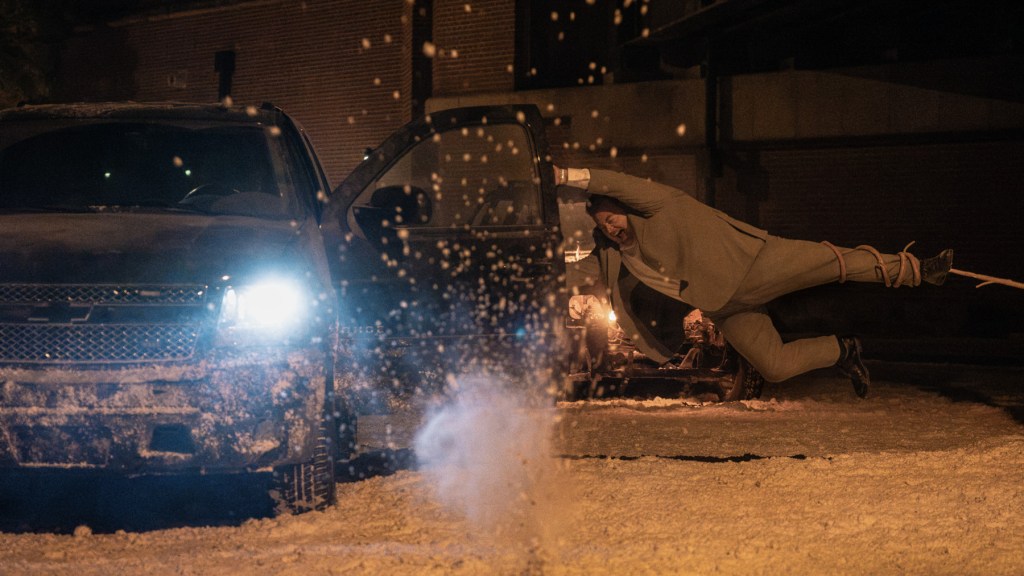
If anything, the filmmaker’s wild, gory redo owes as much to John Carpenter’s remake of The Thing as it does to the namesake series. Everything seems like business as usual at first, with Abrams’ “glorified Postmates†delivery guy running across a woman in a snowy, desolate forest who seems a little “sick.†His Good Samaritan instincts do not pay off. Soon, people are jumping out of the shadows and getting a little too bitey for comfort. Cregger takes his time between action beats and jump scares; as with 2022’s surprise hit Barbarian and last year’s Weapons, this Resident Evil benefits from an expert use of the frame, a sleight-of-hand approach to making the rug underneath you suddenly disappear, and the ability to use humor to escalate tension as much as relieve it. His now-established “brand†of horror storytelling is as much a selling point as the title, and he deploys it here with gusto — and literal guts.
Then an encounter with a dog who, shall we say, is more than he appears to be starts to introduce elements of truly unsettling and straight-up Lovecraftian transformations. Let’s put it this way: Just because you shoot, stab, or bludgeon something doesn’t mean whatever is squirming around inside of it can’t reassemble in a new hybrid form. If the urban-legend concept of the “king rat†makes you queasy, you may want to avoid this movie at all costs.
Potential allies and people to be saved come and go, some of whom will seem familiar — here comes True Detective: Night Country‘s Kali Reis as a traditional Resident Evil commando type, there goes I, Tonya‘s Paul Walter Hauser as a whiny, weaselly corporate executive — and others who simply start sprouting tentacles out of their faces. Essentially, however, you’re just following Abrams as he goes from one mission-like set piece to the next, occasionally hovering behind him like he’s an RPG avatar. Get to that creepy house in the middle of nowhere. Get out of that creepy RV, the one with the conspicuous sounds of a crying child. Get through the creepy sewer tunnel filled with zombie rats. Get to the creepy hospital’s 48th floor, where a laboratory may be able to fashion a cure for this viral outbreak turning people into the walking, running, jumping, chomping dead.
Most videogames work their way up to a boss battle. This cinéma du gaming landmark has its own brilliant variation on that trope, and like the underage rampage that characterized the climax of Cregger’s previous movie, it uses a cartoonish momentum to keep gaining velocity. Everything ends on such a high that you start to get the equivalent of the Sunday scaries over a possible sequel — the fear that, like so many franchises before it, this new and vastly improved version will simply run itself into the ground and piss away any good will. Hopefully, the lessons learned here will be used to level up other projects and possible continuations. For now, everyone behind this superior subgenre entry should take a victory lap. They’ve just made the best horror-reboot of the year.
Tom Cruise and Jimmy Fallon on 'The Tonight Show'
Tom Cruise stopped by The Tonight Show to promote his new movie, Digger. But soon host Jimmy Fallon‘s hard-hitting journalism led to a conversation about Cruise joining Taylor Swift at the Chiefs opening game on Monday.
“When the biggest movie star in the world is sitting next to the biggest artist in the world, what do you talk about?†Fallon asked.
“She was schooling me on football,†Cruise replied. “For real. She was bringing the football. First of all, she’s a genius. I’ve been following her since she was a kid. Everybody there, all their friends—they’re a beautiful couple and magical in their own right.â€
He added, “I hadn’t been to a football game since pre-Covid, where I was working and everything. So to get to hang out there and have that moment, it was a lot. But she knows her stuff.â€
Cruise and Fallon acknowledged that Swift, by her own admission, knew nothing about football when she met her husband Travis Kelce, who plays for the Chiefs. “She said, ‘He’s so patient,'†Cruise said. “I said, ‘I’m sure he was.’ I think everybody would be very patient [with her].â€
During the game, Cruise said the pair also discussed music and movies. “She’s got such a great sense of humor,†Cruise praised Swift. “A brilliant writer also, by the way. Brilliant musician and director. Very skilled.â€
During his appearance on the show, Cruise also participated in the “Claw Machine Challenge†alongside Fallon. The segment involved the pair hanging from wires and attempting to secure prizes from a giant pit. The prizes were themed to Cruise’s movies, including Top Gun and Mission: Impossible.
Digger, directed by Alejandro González Iñárritu, is in theaters Oct. 2. There have been rumors that the film is a musical, based solely on the trailer, but that theory has been debunked. Cruise feigned surprise that anyone would think that was true, noting that he thought it was a “very good idea.â€
“I thik we should do Digger: The Musical,†he told Fallon. He added that the actual movie is “totally original. It’s audacious. It’s funny. It’s moving.â€
Hudson Williams and Carrie-Anne Moss in ‘Yaga.’
For a guy who was still waiting tables a few months ago with dreams of breaking out as an actor, Hudson Williams must feel pretty busy these days.
The Heated Rivalry phenom stars in YAGA, a new Crave Original that makes its world premiere at the Toronto International Film Festival today, before arriving on the streaming service next October 23. The eight-episode series comes from Canadian playwright and showrunner Kat Sandler, who adapted the project from her 2019 play of the same name.
Williams plays Henry Park, a young heir to a powerful fishing company whose disappearance draws an unlikely investigator to the small, fictional coastal town of Whittock. Noah Reid plays Rapp, an outsider private investigator tasked with finding Henry, while Clark Backo plays Carson, a local detective who becomes involved in the case.
See on Instagram
The investigation leads into a web of secret lives, suspicious characters and ancient magic, drawing from the mythology of Baba Yaga, the enigmatic figure from Slavic folklore who has been portrayed variously as a witch, healer, trickster and supernatural force.
Carrie-Anne Moss plays Katherine, a charismatic university professor whose connection to the investigation adds another layer of mystery. Sheila McCarthy, Megan Follows, Patrick Gilmore and Katharine Isabelle are also among the Canadian ensemble.
The series was filmed in British Columbia earlier this year, with Victoria doubling for its fictional coastal setting. YAGA premieres October 23 on Crave in Canada.
A scene from the doc ‘Neil Peart: No One’s Disciple.’
“Two fat fingers†— that’s how Geddy Lee describes it. The singer and bassist for Rush is sitting in a private room of a restaurant that doubles as a wine cellar, and he’s just pulled a few choice selections from the shelf. He uncorks one and serves Alex Lifeson, fellow founding member and guitarist, who deadpans, “Oh, I’ve stopped drinking… but I’ll just start again now.†Lee fills his glass from a second bottle, bantering away with his lifelong pal before picking up a third. It’s not vino but a rich, brown spirit. Macallan 25, to be exact. This was the poison of choice of Neil Peart, Rush’s drummer for over 40 years. Whenever they’d finish for the day in the studio, or when Lee or Lifeson would drop by Peart’s place for a visit, he’d usually break out the Scotch.
And then Lee puts his digits next to the bottom of a tumbler and pours out “two fat fingers'†worth of Macallan into it. The glass sits there, untouched and gleaming in the light. They toast their absent friend. “The missing wingman,†Lifeson says. “The chair that isn’t here,†adds Lee.
It’s less than five minutes into Neil Peart: No One’s Disciple, a new documentary on — let’s not mince words — the greatest rock drummer of all time, and you can already feel yourself tearing up. The laughter and spontaneous applause within the Princess of Wales Theatre (located, appropriately enough, on King St.), where the movie premiered at the Toronto International Film Festival last night, will be punctuated by audible sniffles for the rest of the screening. An extension of Sam Dunn and Scot McFadyen’s definitive 2010 portrait Rush: Beyond the Lighted Stage, this moving look back at Peart’s life and work is a proper farewell to a king behind the kit. But it’s also a belated wake, celebrating the life of a philosopher who provided the words and pulse for a power trio that continually pushed the boundaries of where a rock song could go and what it could say. Instead of mourning an absence, it provides you with a presence. For the next few hours, the missing wingman doesn’t feel like he’s missing at all. The chair is right there in front of you.
Lee admits early on in the doc that he’d long wanted to pay tribute to Peart, who died on Jan. 7, 2020, but the pandemic threw a wrench into any immediate plans for a large-scale goodbye. A concert, which would have been the logical way to honor the man and his music, was eventually ruled out in favor of a documentary by filmmakers that he and Lifeson knew would handle the subject with sensitivity. Performance had to be a part of the mix, however, and the surviving members of Rush came up with a conceptual way of making it happen. Peart had a fraternity of “drum brothers†he’d befriended over the years, musicians who would hang out with him on the regular. Lee and Lifeson invited a quartet of them to jam on classic Rush songs. All of these drummers knew the parts. More importantly, they all knew Peart personally, which meant they had a genuine sense of the guy who created them.
So, yeah: If you’ve ever wanted to see Stewart Copeland take on “New World Man,†or Tool’s Danny Carey rock those insane fills in “Tom Sawyer,†or the Red Hot Chili Peppers’ Chad Smith bash out “Working Man,†or King Crimson‘s Gavin Harrison dig into the Roll the Bones deep cut “Dreamline,†now’s your chance. It sounds gimmicky, until you see a) how ecstatic everyone, especially Geddy and Alex, is while playing, and b) how the music allows them to collectively memorialize their late comrade. You witness how humbling it is for these hall-of-famers to try mastering the odd time signatures, weird switch-ups, and endurance-testing tours around the rack toms; it takes Carey, someone who can fluently switch between a 5/8 and 7/8 beat in the same song, more than several tries to nail the opening to 2112‘s “Overture.†And you also hear everyone use these tracks as a way to reminisce about Peart’s generosity, his kindness, his wicked sense of humor, and his way of filtering his perspective on the world through polyrhythms.
That’s just one aspect of No One’s Disciple, mind you — Dunn and McFadyen may be lucky enough to capture some truly once-in-a-lifetime sessions, but the focus remains on chronicling Peart’s arc from gangly Hamilton kid to worldly rock god. Using a number of interviews they conducted with the drummer for Beyond the Lighted Stage and testimonials from Neil’s old friends and other drummers, the film goes deep on his work ethic, his literary preoccupations, how a decision to relocate to London in his early twenties broadened his horizons. Upon initially meeting their future bandmate, Lee and Lifeson immediately judged the skinny dude bounding out of a Pinto as “goofy†and not nearly hip enough to join their group. Then he started playing triplets, and guess who was suddenly really cool? Neither the guitarist or the singer was keen on being the resident wordsmith, so Lifeson recalled saying to Peart, “We’ve noticed you read six to seven books a day — how’d you feel about writing lyrics?†The result was “Anthem.†The rest is history, etc.
Numerous milestones, from Peart studying with jazz player Freddie Gruber and reinventing his playing style to writing Ghost Rider, a memoir about riding motorcycles and grieving the loss of his wife and daughter, are dotted along the way. Both Lee and Lifeson reminisce about the gent nicknamed “the Professor,†occasionally becoming choked up. Yet the mood is never maudlin or sentimental. Lifeson isn’t above doing a devastating impersonation of Peart reciting the lyrics to “Working Man†in a stilted, staccato lilt, and everyone talks about how notoriously prickly he could be regarding his relationship to fans and fame. (The dude wrote a banger of a song about it!) Peart was well-known for being intensely private and virtually unknowable to most of the general public, but everyone in the film shares the Peart they were lucky enough to bond with — someone who valued loyalty, friendship, and sharing a Scotch with those who loved and admired as much as his happy solitude.
That the Toronto crowd who showed up for the premiere was in the pocket for all of it was not surprising — when “The Spirit of Radio†played over the end credits, everyone immediately broke into the audience-clapping part that’s long been a staple of the concert version. But Neil Peart: No One’s Disciple isn’t out to court fan service. The doc simply wants to be the tribute that Lee and Lifeson wanted to throw for their friend, and the joyous look back on a life that Peart deserves. It might be sadder hearing them play Rush songs with an all-star rotation of famous guests were it not for the epilogue, which introduces Anika Nilles and reminds folks, as if anyone needed reminders, that their current Fifty Something Tour finds them in extraordinary form once again. (During a post-screening Q&A, the documentarians noted that they found out the band was going back on the road in the middle of filming, but had become suspicious when the songs sounded like the two had definitely logged in rehearsal time before the cameras started rolling.)
Everyone knows Peart is irreplaceable. No one’s trying to replace him. Hearing his friends play those songs in the film, and hearing Nilles recreate his parts onstage, you realize that they’re not just honoring the legacy but preserving it. Peart is no longer here, but he remains in those songs. And while those present at the premiere were reverent, it fell upon Lee and Lifeson to add levity to the proceedings and keep things from feeling funereal. After walking onstage to applause during the introduction, Lee introduced his childhood friend as recent Toronto visitor “Alex Lifesberg.†“I would just echo what Ged said, if I understood a word of it,†Lifeson wisecracked. Both thanked the filmmakers, and let Chad Smith, also present, say a few words of praise. Then they let the movie, and the music, do the talking. It felt like Peart was there in theater, nodding at the lack of pomp and circumstance. Hopefully he was sipping two fat fingers of Macallan as well.
Images from the story





End of article