On the Front Line of the Vaccine Wars
For decades, West Virginia has had a “halo†of protection around it, thanks to a compulsory-vaccine law. But now, there’s a case that could topple that law — and have major…
For decades, West Virginia has had a “halo†of protection around it, thanks to a compulsory-vaccine law. But now, there’s a case that could topple that law — and have major implications for the rest of the country
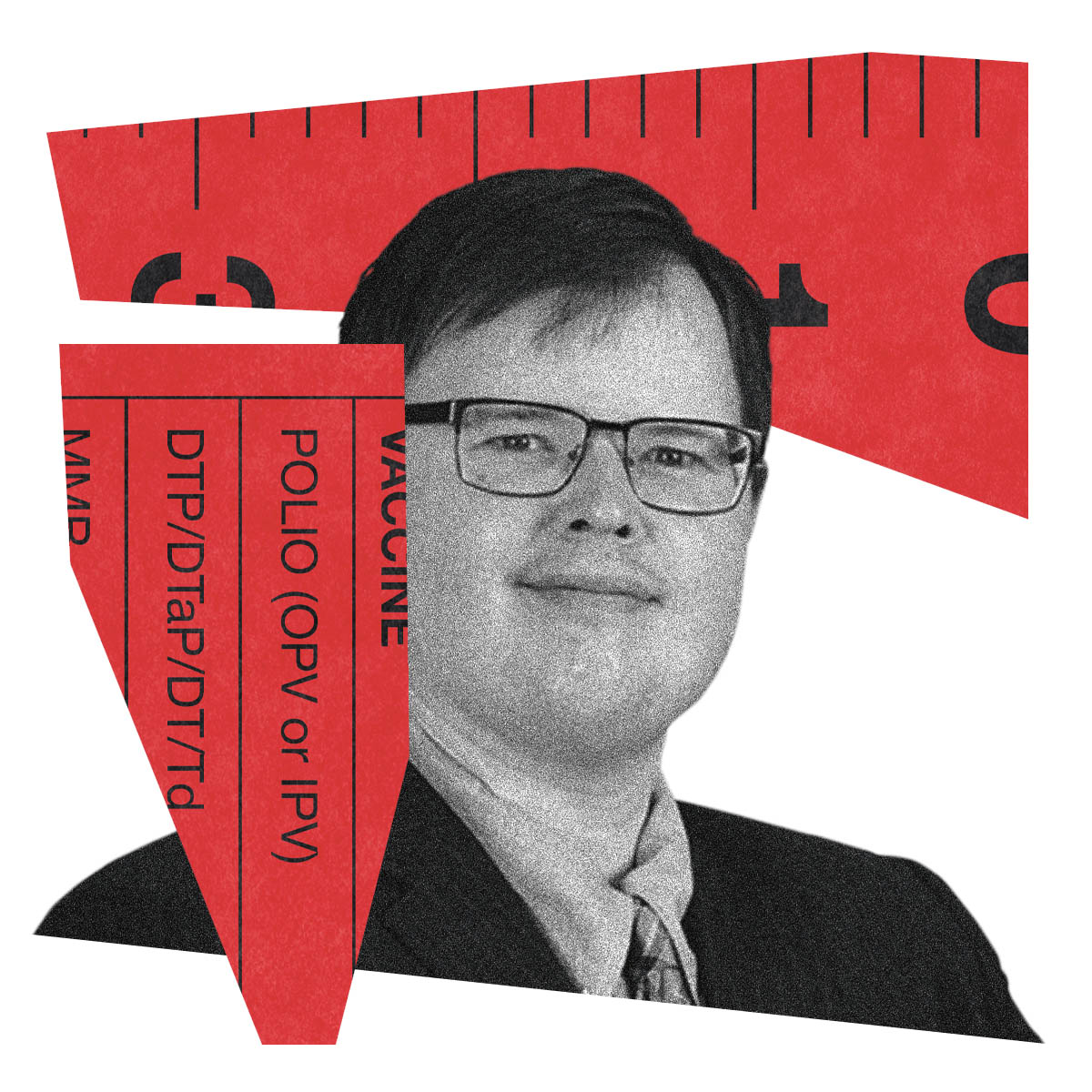
ON A CRISP DRY DAY in Beckley, West Virginia, last September, 35-year-old litigator Chris Smith wore his lucky purple tie to court. With a wry smile, round face, and piercing blue eyes behind metal-rimmed glasses, Smith enjoyed a hard fight. But as he slid into his seat for defense counsel in a courtroom crowded with lawyers, luck did not seem to be on his side.
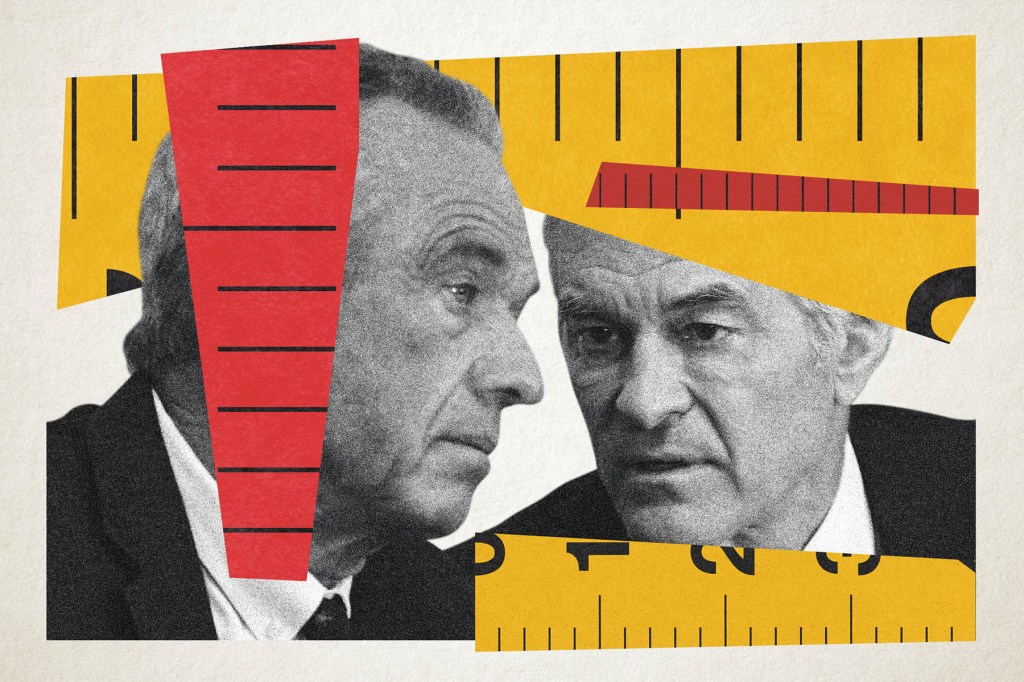
Smith’s client, the West Virginia Board of Education, faced an uphill battle to save the state’s compulsory-vaccination law, which for 89 years had helped thwart the spread of infectious diseases. The state’s ambitious Republican governor, Patrick Morrisey, was aiming to allow parents a religious exemption to school vaccinations. He had powerful outside allies in his fight, including Health Secretary Robert F. Kennedy Jr. and one of his close confidants, a lawyer now seated to Smith’s right, Aaron Siri.
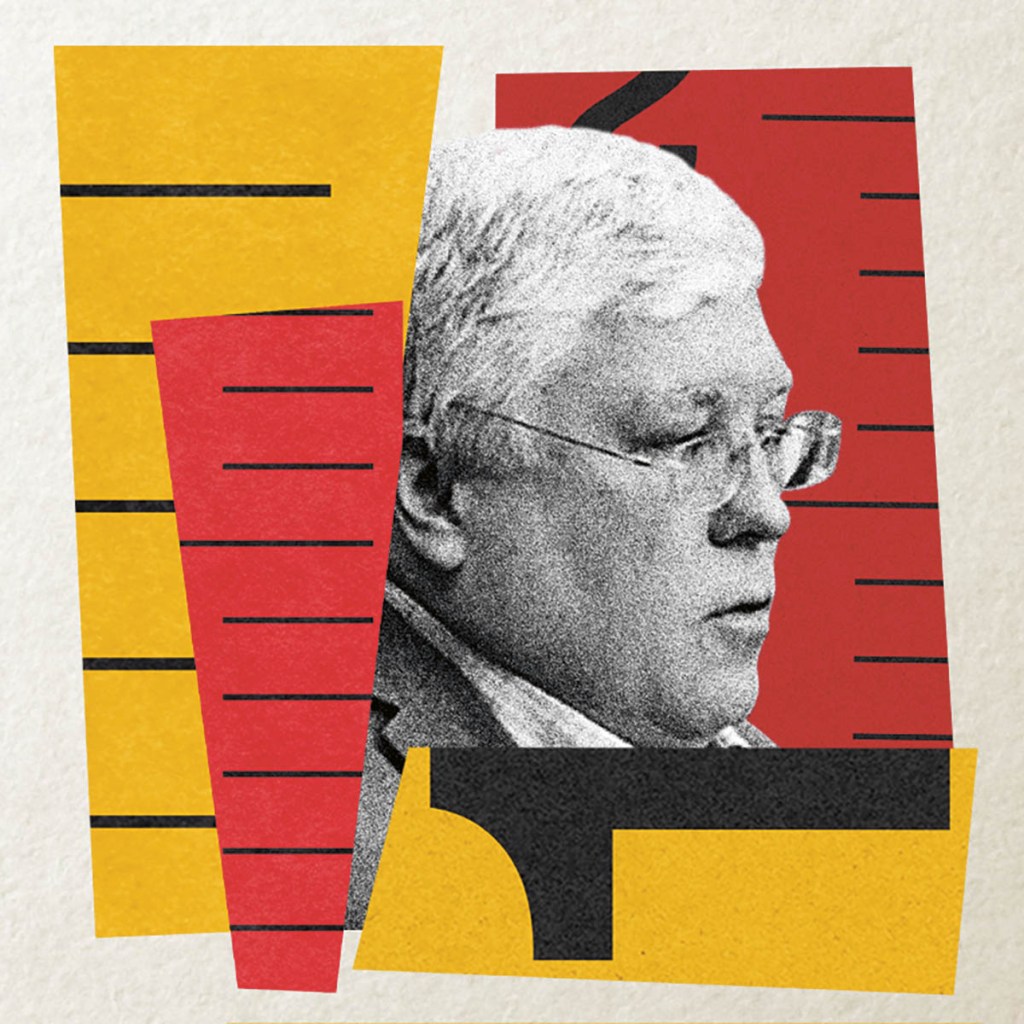
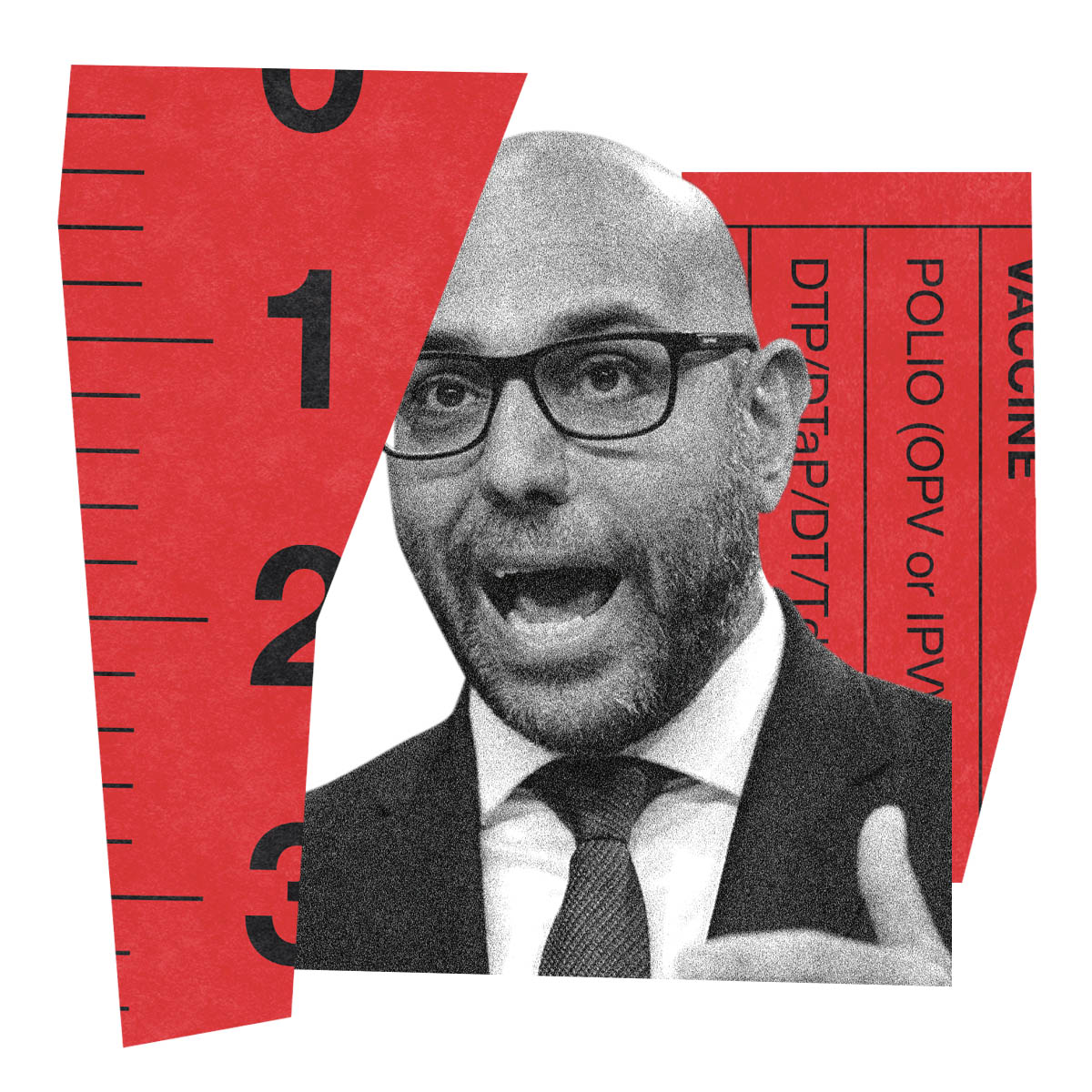
Siri, 48, bald and compact with lively dark eyes, looked ready to spar. While most of the lawyers in the courtroom were native West Virginians, Siri is a New York City plaintiff lawyer who’d relocated to Arizona and had spent more than a decade aiming to dismantle any law or regulation that mandated vaccination. As he’d put it in a 2022 tweet: “Mandates are the tool of bullies, criminals, and dictators.†His firm, Siri & Glimstad, has litigated state by state to loosen vaccine laws.
Schoolchildren in West Virginia can only skip required vaccines for medical reasons. In a state with roughly 235,000 kids in school, the health department issued only 203 full medical exemptions from 2015 to 2025. Siri was representing Miranda Guzman, a mother battling the education board so she could exempt her child from school vaccinations.
Siri now confronted Dr. Jacob Kilgore, the Raleigh County Board of Education’s expert witness, sitting placidly on the witness stand. Kilgore, medical director of the MarsÂhall Health Network – Hoops Family Children’s Hospital and one of only seven pediatric infectious-disease doctors in West Virginia, was so well-known to those present that even Judge Michael Froble had waived the need to establish his expert credentials. Kilgore was courteous and mild-mannered to a fault. The left side of his face bore a large hemangioma birthmark, a lifelong challenge that had partly inspired his commitment to medicine.
Siri ticked through diseases, asking Kilgore: In a less-densely populated state like West Virginia, would religious exemptions really impact the level of immunity to measles?
“I think it depends on what you mean by ‘densely populated,’†Kilgore responded.
“Well, how about West Virginia versus New York City?†Siri asked.
“What part of West Virginia?†Kilgore replied. “Name a city in West Virginia. Any.â€
“I don’t know,†Siri said, eliciting laughter in the courtroom.
“Just name a city in West Virginia.â€
“Sure,†Siri said. “The biggest city in Raleigh County.â€
“Can you name it for me?†Kilgore continued. The correct answer, which eluded Siri, was Beckley — the city they were in.
“You got me,†Siri acknowledged, telling the judge what was already obvious. “He got me, your honor.â€
Aubrey Sparks, legal director at the West Virginia ACLU, who was in the courtroom that day, says, “There’s a real assumption sometimes that bringing people in from out of state means more firepower or better attorneys.â€
But to her, the exchange encapsulated West Virginia’s unique go-it-alone ethos. “You might specialize in this type of case,†she says of Siri, “but you don’t specialize in West Virginia.â€
In an era of partisan rage over public-health mandates and growing antipathy to scientific expertise, vaccination in America is on a knife’s edge.
For almost a century, the public has largely agreed on a social compact: We should vaccinate our kids not only to prevent indiviÂdual harm, but to also shield the more vulnerable among us, whether the immune-compromised or infants too young to be vaccinated.
The public school system has stood at the center of that compact, with the requirement that children be vaccinated to attend, all but guaranteeing that our communities reach herd immunity, the level of protection that makes it harder for frightening infectious diseases — whether polio or measles — to take hold. A 1905 U.S. Supreme Court ruling, Jacobson v. Massachusetts, affirmed the right of states to require vaccination.
But fighting in the name of religious, medical, and personal freedom, an array of lawyers, state and federal officials, and President Donald Trump himself are seeking to break that compact. And though their progress has been slowed by federal courts, painstaking local resistance, and the sheer complication of dismantling existing vaccine policy, a change is clearly afoot.
Since Kennedy became the nation’s health secretary in February 2025, vaccination rates for kindergartners have dropped more than two percent, parental requests for religious or philosophical exemptions to vaccinations for school entry have climbed to four percent, and infectious diseases once vanquished have ticked up. Measles — declared eliminated in the U.S. in 2000 — has surged to more than 3,600 cases this year alone, more than a twelvefold increase from 2024. A widespread outbreak in Pennsylvania this year led recently to four deaths, including two infants, according to state officials. (HHS spokesperson Emily Hilliard says “attributing the measles resurgence to President Trump or Secretary Kennedy fundamentally misrepresents when and why†it began — “pandemic-era disruptions†to routine vaccination started “years before they took office.†She says HHS remains committed to an “effective public-health response while respecting informed choice, parental rights, and religious liberty.â€)
None of this is by accident. While Kennedy has sown parental doubt from his federal bully pulpit, it’s his legal confidant Siri, an expert in the circuitry of vaccine policy, with his hands on the motherboard, despite having no formal government role. Internal emails obtained by Rolling Stone show Kennedy offering to take departmental action to “be helpful†with certain private legal cases of the type Siri’s firm has pursued, and Siri advising Kennedy on departmental actions he can take to weaken liability protections for manufacturers without congressional approval. Siri says in an email to Rolling Stone, “I do not provide the secretary with legal or regulatory advice.â€
Says a former HHS official, “What gets Aaron Siri up in the morning is to try and figure out every possible, conceivable tool to make it harder to vaccinate people in America.â€
In the hydra-headed attack on vaccinations playing out across the country, only four states besides West Virginia — Connecticut, California, Maine, and New York — do not allow religious or philosophical exemptions. In August, Trump issued an executive order directing the U.S. attorney general to take legal action against them.
West Virginia is the only state among the five that has never permitted any exemption other than for medical reasons. Its compulsory-vaccination law has stood since 1937, an outgrowth of activism linked to coal-miner health and safety. “It’s hard to prevent the spread of pertussis in a coal mine,†says Dr. Joshua Hess, a pediatric hematologist-oncologist at Cabell Huntington Hospital.
Still, Siri had good reason to believe he could topple West Virginia’s vaccine law. In 2023, he prevailed in Mississippi, winning a lawsuit that allowed families to cite religious reasons to opt out of school-entry vaccinations. Since then, Mississippi’s vaccination rates have dropped by more than two percent, enough to allow a return of some infectious diseases. Last year, a baby there died of whooping cough for the first time in 13 years.
But in West Virginia, what began as a seemingly winnable campaign evolved into a complex legal showdown, with a number of intertwined court cases pitting West Virginia’s governor against the Department of Education, legislators within the Republican supermajority against one another, and locals against outsiders. The fight has even divided families, with one pediatrician testifying as a plaintiff to save the law, while his sister, a far-right state legislator, works to bring it down.
With Kennedy aiding his cause from inside HHS, Siri isn’t stopping there. Del Bigtree, the founder and chief executive officer of the anti-vaccine group Informed Consent Action Network (ICAN), which has funded Siri’s litigation in West Virginia and other states, says that bringing a case to the U.S. Supreme Court is “absolutely the goal.†He says they are looking for a “more modern decision†than in the 1905 Jacobson case.
If the U.S. Supreme Court takes a case on vaccinations for school entry, the decision could drastically impact public health. It could be “potentially as earthshaking as the reversal of Roe [v. Wade],†says Manhattan Borough President Brad Hoylman-Sigal, who in 2019 as a state senator helped tighten New York’s vaccination law to remove religious exemptions, after a widespread measles outbreak began in several under-vaccinated Orthodox Jewish communities.
Siri told me this summer, “The only position my firm takes on vaccines is that everybody should be free to get as many vaccines as they want, but at the same token, everybody should be free to be able to decline a vaccine.â€
In West Virginia, though, Siri’s opponents are fighting for a long-held value in their state, where getting a shot comes as second nature if it means protecting neighbors, even those you don’t know. West Virginia is the kind of place, as Kilgore later puts it, where “y’all means all.â€
The road to Smith’s faceoff against Siri began in the state capitol, a grand building with a gilded gold-leaf dome and taxidermied bears along the marble hallways.
Almost every year, some faction within the legislature has taken aim at the state’s vaccination requirements, only to meet with defeat. But on Jan. 14, 2025, the newly elected governor, Morrisey, a former pharmaceutical lobbyist who had aligned himself firmly with Trump and Kennedy’s Make America Healthy Again (MAHA) movement, issued an executive order on his second day in office. He directed the state health department to allow religious exemptions. In doing so, he leaned on a West Virginia law passed in 2023, the Equal Protection for Religion act, to claim that families could circumvent vaccine requirements if they didn’t align with their religious beliefs.
“It was really a philosophical exemption,†says Dr. Tom Takubo, a Republican state senator and pulmonary critical-care physician who is a vaccine defender and foe of the governor. “He called it a religious exemption, but all you had to do is write it on a napkin and have your child take it to school.â€
Morrisey’s move signaled a new kind of threat. “We’d never heard of executive orders in the state, except to lower the flag half-staff or give state employees a Christmas Eve ball,†says retired lawyer Robin Godfrey.
A spokesperson for Morrisey says, “The governor’s position remains that West Virginia can protect public health while respecting the religious-liberty protections provided under state law.â€
Godfrey formed the pro-vaccine volunteer group Stand for Kids, which now has coordinators in 44 of West Virginia’s 55 counties. By February, a handful of parents formed West Virginia Families for Immunizations, with backing from the national group American Families for Vaccines, which receives some funding from vaccine manufacturers.
With Republicans holding a supermajority in the West Virginia Legislature, Senate Bill 460 — which would have inscribed Morrisey’s executive order into law — seemed like a foregone conclusion.
A month after Morrisey’s executive order, the Senate Health and Human Resources Committee held a hearing. While three local pediatricians got about five minutes each, Siri was brought in virtually for nearly an hour. “West Virginia sits as an outlier in not respecting people’s individual and civil rights to be able to affirm their religious beliefs,†Siri testified.
“In one of the areas where we lead the country, people relied on a lawyer from out of town who came in on a Teams meeting,†says Joey Garcia, who sits on the health committee and is one of two Senate Democrats. “He kept talking and talking,†but the gist “didn’t make a whole bunch of sense for West Virginia.â€
The bill cleared the Senate and went to the House of Delegates, seemingly on a fast track to pass. But activists deluged legislators with calls, emails, and visits that flipped votes. Last March, the bill was defeated 56-42. “That’s the power of the advocate voice in West VirgiÂnia,†says Jessie Ice, co-director of West Virginia Families for Immunizations.
But the fight wasn’t over.
On April 24, 2025, in Lowell, Indiana, Liam Dahlberg came home from school with a headache so severe he was “crying in excruciating pain,†his mother, Ashlee, recalls. After a trip to the ER, the eight-year-old was transferred to a Chicago hospital, where he was treated for a rare bacterial infection, haemophilus influenzae type B (Hib).
Within two days, he went from delirious to sedated to life support, and died on April 28. Liam was fully vaccinated, and the Hib vaccine has reduced more than 99 percent of cases in the U.S. since its introduction in 1987.
But as Liam’s family came to learn, his use of a steroid inhaler for severe asthma had weakened his immune system. In a school where almost 10 percent of students have opted out of vaccination for religious reasons, he was likely exposed. In the county where the Dahlbergs live, only 44 percent of children are fully vaccinated.
“Indiana allows religious exemptions, and because of that, my son lost his life,†says Dahlberg, who has become an advocate for vaccination. In the absence of stronger state requirements, she is considering whether to homeschool her other two children, one of whom also has severe asthma.
Historically, children whose parents decide not to vaccinate them have been the ones homeschooled. But as vaccination rates drop across the country, more parents like the Dahlbergs weigh whether to homeÂschool their vaccinated but medically vulnerable children. This year alone, more than 200 measures to undermine vaccines were introduced in 34 states, with nine of them passing, according to a New York Times analysis.
As neighboring Ohio, Kentucky, and Pennsylvania have struggled to contain measles and other infectious-disease outbreaks, West Virginia resembles a “halo,†says Takubo. The last measles outbreak there, defined as three or more related cases, occurred in 1994.
Since 2009, there have been only two reported cases of measles in West Virginia, both in adults. Neither case turned into an outbreak. “Because of herd immunity, it didn’t spread like wildfire,†says former public-health officer Dr. Matthew Christiansen.
The resistance to weakening the state’s vaccination law springs not just from a sense of community, but from a practical accounting: the view that overwhelming rural poverty could greatly amplify the harms of an infectious-disease outbreak.
In the wake of the opioid epidemic, there are counties where close to half of the children are no longer being raised by their biological parents. Many of those children don’t even see a doctor until they’re five and must get vaccinations. The law has a transformative effect, says Takubo: “It gets these kids in front of a doctor for the first time.â€
Ask Chris Smith how he’s doing, and he’ll invariably say, “Livin’ the dream,†in a laconic drawl without a trace of optimism.
A partner at the Bailey & Glasser law firm, he works out of a storefront office on Capitol Street in downtown Charleston. The surrounding streets offer a mixed picture of espresso outposts and consignment stores.
Seated in an office conference room, Smith tells me his state is dying: “Every year we shrink. We’ve had sustained population loss. We’re one of the oldest states in the country†age-wise, “and they’re going to turn us all into a bunch of data centers and coal-slurry pits. We’re not going to be habitable much longer.â€
Despite his bleak outlook, Smith owes everything to West Virginia, where his father worked as an engineer for local power companies. In high school, he loved chemistry and wanted to be a pharmacist. A 12th-grade mock trial changed his life. He graduated from both undergrad and law school at West Virginia University.
In 2024, Smith ran as a Democrat for the West Virginia House of Delegates, but lost in the general election, leaving him to wonder how best to make a difference. Saving the vaccination law would soon become his top priority, and what kept him up at night.
In the wake of Morrisey’s January 2025 executive order, the West Virginia Department of Health began to issue religious exemptions, the number of requests climbing to more than 570 within nine months. But on June 11, the Board of Education voted 9-0 to enforce West Virginia’s law as written and refused to allow the exemptions.
Within two weeks, Siri’s firm brought a lawsuit against the Board of Education on behalf of Miranda Guzman, a widow and neonatal ICU nurse, and one of the many West Virginians who had been granted a religious exemption for her child by the health department, only to find it blocked by the education board. Citing ongoing litigation, Siri declined to make Guzman available for an interview. But the complaint describes her longstanding Christian faith and “profound religious objections.†It states, “When Plaintiff is under conviction from the Holy Spirit, she is careful to obey, knowing that to do otherwise will entail eternal consequences.â€
At a press conference announcing the lawsuit, Siri flanked Morrisey at the podium, as the governor declared there wasn’t “one shred of evidence†linking exemptions to negative public-health outcomes in other states. That very month, a measles outbreak in southwest Utah had been linked to the climbing number of religious exemptions, which had reached more than 25 percent in some counties. (A spokesperson for Morrisey says that Utah officials had identified unlinked cases at that time and were investigating.)
Siri says of his relationship with Morrisey: “As with many politicians, we share a common interest in protecting the religious liberty of all Americans.â€
Siri then took to the microphone, citing how “millions of pieces of cellular and DNA debris†from fetal cells linked to aborted fetuses in two of the required vaccines were an affront to his client’s religious beliefs.
Siri’s claim, though vivid, is misleading, according to the American Academy of Pediatrics and other infectious-disease experts. Both the cell line and the virus used in the rubella component of the measles-mumps-rubella vaccine were derived in the 1960s from aborted fetal tissue, but have been grown in a lab ever since. The finished vaccine is purified and contains no intact cells. Even the Vatican has stated that it can be used in good conscience.
The Guzman case was ultimately assigned to Froble, who ran for the judgeship on a platform of “In the beginning God.†He wore a tie with a cross on it while hearing the case. “I thought that was a little odd, when you’re the arbiter of a case where religion is central,†says Robin Godfrey of Stand for Kids.
Smith assumed loss was inevitable and shaped his strategy to create the “best record we could for appeal,†as he recalls, with the only outstanding question being how long the death march was going to be.
On Sept. 10, 2025, Dr. James Robert Neuenschwander took the witness stand in Froble’s courtroom, his manner confident, silver hair swept off his forehead.
Dr. Neu, as he was known, an integrative-medicine doctor from Michigan who sits on the board of the anti-vaccine group ICAN, was Siri’s first expert witness, and he’d submitted a report concluding that “a handful of religious exemptions†would present “no material risk†for vaccinated students.
Neu confidently posited that unvaccinated children would be likely to feel sicker, therefore be more likely to stay home when sick and, as a result, be less likely to spread disease. By contrast, vaccinated kids might pose the real threat, Neu testified, claiming that because they may remain asymptomatic, and because some vaccines do not block transmission, they could spread a disease like pertussis to unvaccinated students.
Siri then went further, asking if there are “any benefits†to children becoming infected.
“Yes. There’s some evidence,†Neu said, claiming that a study from Japan showed that getting measles and mumps reduced death from heart disease. Citing additional studies, he posited that high fevers from infectious diseases, particularly measles, could induce the remission of various cancers. “There does appear to be some benefit to actually having the disease itself,†he said, triggering scoffing in the courtroom.
Three infectious-disease experts say that Neu’s claims distort the truth: that infected children can spread disease long before they have symptoms, and that the risks of being infected far exceed any purported benefit. “In the 18th century, if people were sick, you quarantined,†says Dr. Yvonne Maldonado, the Taube Professor of Global Health and Infectious Diseases at Stanford University School of Medicine. “We don’t need to do that anymore because we have 17 diseases that we have essentially controlled†through vaccination.
When it came time to cross-examine Neu, Smith’s co-counsel, Benjamin Bailey, a former federal prosecutor and a founding partner of Bailey & Glasser, asked about his qualifications. Neu acknowledged he had failed to complete his surgical residency, was not board-certified in pediatrics, epidemiology, virology, or immunology, had no formal training in vaccines, and had never practiced in West Virginia. In 2004, he’d been hit with a $400,000 judgment after being accused of wrongfully prescribing medication that had caused a patient’s death. “I chose not to fight it,†he said, and settled it through a bankruptcy proceeding.
Then Bailey explained that the California Board of Medicine had rejected Neu’s expert testimony as not credible. He read aloud from the board’s 2021 judgment: “The court says, and I quote, ‘He does not believe any children should be vaccinated.’â€
Siri’s co-counsel jumped in: “Your honor, we’re beating a dead horse at this point.â€
Two days earlier, Smith and other lawyers had filed an unsuccessful motion to strike Neu’s testimony: He’d been disciplined in Michigan in 2015 for improper medical treatment of a cancer patient, and numerous medical boards and other courts had found his expert testimony unreliable.
“The studies he was citing are not accurate,†says Smith. “Take time to examine it, it all falls apart.†He adds that Siri’s message is “driven by a bunch of pseudoscience. It very much reminds me of a Nineties-style ransom note where we take apart newspaper clippings.â€
Reached by phone, Neu says his expertise lies in treating vaccine-injured patients: “I understand what’s going into the kids. I understand what the vaccines do. I understand how they can create the injuries we see.†He adds that he is not against all vaccinations. “We’re at a place right now that if we stopped vaccinating for measles, I think we’d be in big trouble.â€
Siri says in an email, “Dr. Neu was chosen as an expert witness because he has the moral and ethical fortitude to state what the evidence actually shows regarding vaccines, even in the face of what mainstream journalists will write about him, rather than parroting mantras about these products.â€
In 2011, at age 34, Siri left the prestige and long hours of the law firm Latham & Watkins to strike out on his own, boasting a CV that included a law degree from UC Berkeley and a clerkship at the Israeli Supreme Court. Among the few cases he inherited from former colleagues, he represented a nurse who’d become disabled after getting a flu shot.
The case was his first exposure to the Vaccine Injury Compensation Program, the specialized vaccine court first established in 1988, which lets plaintiffs seek damages for vaccine injuries, while shielding vaccine makers from the kind of liability claims that, if pursued in open court, could drive them from the market.
Siri bridled at the limits of the program, which pits plaintiffs against the Justice Department but does not allow for typical rules of procedure and discovery. For Siri, the case was the ultimate underdog fight.
In 2015, in a pro bono case, he successfully challenged New York City’s rule that required preschool children in city daycare programs to get an annual flu shot. Though his victory would later be reversed by the New York State Supreme Court, it got the attention of Del Bigtree, a television producer who was launching a national campaign to end vaccine mandates and needed a knowledgeable attorney. The two men joined forces.
Bigtree’s organization, ICAN, which he founded in 2016, became a mainstay client for Siri & Glimstad, paying the firm more than $28 million for its legal services over eight years.
The relationship also brought Siri into Kennedy’s orbit. In 2018, the two men served as co-counsel, representing ICAN in a lawsuit seeking federal vaccine safety records from HHS. Siri went on to serve as the lawyer for Kennedy’s presidential campaign.
As ICAN grew, so did Siri & Glimstad, which today employs some 70 lawyers, half of whom work on cases representing the vaccine-injured, the largest such practice in the country. Since 2015, the firm has filed more than 1,000 vaccine-related lawsuits, with over 208 of those on behalf of ICAN, according to Siri.
Before long, Siri was bombarding federal health agencies with Freedom of Information Act requests and citizen petitions, in search of proof that the federal government had willfully concealed vaccine dangers, and aiming to have the FDA pull vaccines long proven as safe from the market.
“He and his law firm were very aggressive in challenging almost any public statement suggesting a vaccine was safe,†says Sam Bagenstos, who served as HHS general counsel under President Biden. “We had this constant set of letters from [Siri], demanding that tweets, speeches, get taken down.â€
He adds, “He was behind such a massive set of FOIA requests and litigation, he was bringing lawsuits to grind FDA to a halt in service of anti-vax ideology.â€
Siri says of his efforts, “The civil rights work for our clients seeks to increase individual rights, vaccine safety, transparency, and accountability.â€
On Sept. 11, 2025, the second day of the Beckley trial, Siri took to the podium and tried to torpedo Smith’s expert witness, Dr. Catherine Slemp, a public-health expert who had served multiple roles in West Virginia government, including as health commissioner. From the witness box, she regarded Siri warily.
“Doctor, what is the federal Vaccine[s] for Children Program?†he began. The program helps states cover the costs of purchasing vaccines, a lifeline to immunize poor children.
Once Slemp described it, Siri then brandished a document that he had not yet entered into evidence. “Are you familiar with this letter?†he asked. The letter had been sent three weeks earlier by the director of HHS’ Office for Civil Rights to West Virginia’s health departments, and leveled a threat. It directed the state to allow a religious exemption for school vaccinations or risk losing its $1.3 billion in federal funding from the Vaccines for Children program.
Siri asked Slemp whether the prospect of losing that funding would lead her to change her testimony. The exchange troubled Slemp. Siri was “so definitive about what the letter meant,†she wondered, was he acting “as attorney in this case or as an adviser to HHS, either directly or indirectly?â€
It was a reasonable conjecture, given the close, almost decade-long association between Kennedy and Siri, one that had helped catapult him from an unknown sole practitioner to a key tactician behind the U.S. vaccination schedule’s deconstruction.
To knowledgeable observers, the conveniently-timed letter appeared to be the result of coordination between HHS and Siri — which Siri denies. Says former HHS general counsel Bagenstos, it is “extraordinary and irregular†to have “the federal government telling the state how to interpret its own laws†or pay the price.
On Nov. 5, 2024, 10 months before the Guzman trial began in West Virginia, at an election-night watch party at a Palm Beach, Florida, hotel, Siri laid out his vision for Kennedy’s tenure as health secretary, according to a person present, describing how lifting legal protections for vaccine makers could set up a cascade of consequences that might force them from the marketplace.
Siri was “ready to burn the place to the ground,†as the person puts it. Siri denies that he has “ever spoken toward any goal of forcing vaccine makers out of the marketplace.â€
As Kennedy prepared to become health secretary, Siri played a central if unofficial role helping to run the transition while working out of the Palm Beach home of Dr. Mehmet Oz, who would become the administrator of the U.S. Centers for Medicare and Medicaid Services. Siri tapped nominees for key staff posts, and grilled them about their positions on vaccines. Siri and his legal partner Elizabeth Brehm also screened potential members for the federal Advisory Committee on Immunization Practices (ACIP), which is supposed to be independent of HHS.
In an affidavit as part of an ongoing lawsuit against Kennedy by the American Academy of Pediatrics, Dr. Diana Zuckerman, president of the National Center for Health Research, stated that Siri’s law partner vetted her for a role on the ACIP committee, asking whether she would be comfortable saying that vaccine decisions should be made solely between parents and a doctor, without the intervention of an expert committee. After she disagreed, she did not hear further from Siri’s firm.
In December 2024, The New York Times reported that two years earlier, Siri had filed a citizen’s petition with the FDA to withdraw a critical polio vaccine from the market, and that Kennedy had privately expressed interest in his serving as the department’s general counsel. The blowback led Siri to go to ground for months. But he never went far.
Inside Health & Human Services, Siri has no formal role, but at times has functioned as a shadow senior adviser, say five current and former HHS officials and advisers familiar with the dynamic. Kennedy has consulted him by speakerphone during departmental meetings. He cites Siri “all the time,†says a former HHS official, so regularly sharing his legal advice that department lawyers joke “Wonder where that came from?â€
An HHS official says that Kennedy was advised as a matter of “optics†to maintain “distance and separation†from Siri, advice that has gone unheeded.
Additionally, Siri — who sues HHS with regularity — has gotten access to the agency’s top echelons. Last October, Siri and his law partner were able to schedule a video call with the agency’s most senior lawyers, according to a meeting record obtained by Rolling Stone. Says a former HHS official, “Bobby has turned the department over to Siri†seemingly to support their overlapping endeavors.
“Secretary Kennedy and HHS hear from a wide range of individuals and organizations who offer views, recommendations, and legal analysis on health policy. This does not mean these individuals or organizations direct or determine department policy,†says HHS spokesperson Hilliard. Siri says, “The work our firm has done, on behalf of our clients, for nearly a decade interacting with HHS and its agencies, including writing letters, petitions, and suing these agencies remains the same.â€
In March, three months after Trump affixed his name to the Kennedy Center and most of the performing artists fled, it was Siri who presented his case against vaccines from the Millenium Stage. “He likes the fame,†says a former Siri & Glimstad lawyer. “He has main-character energy.â€
But more importantly, says an attorney involved in a lawsuit against Kennedy, “he’s made it inside the castle walls.â€
On Oct. 8, 2025, the third day of trial, Dr. Joshua Hess took the witness stand, to testify not as an expert but as a dad. His immune-compromised daughter, a high school senior, suffers from congenital anemia and is exceptionally vulnerable to bacterial infections after having her spleen removed.
Hess and another parent with a medically fragile son had sued the West Virginia health department in May 2025, demanding it stop granting religious exemptions. Their case, brought by the West Virginia ACLU and Mountain State Justice, a legal advocacy organization, had been combined with Guzman’s.
Shortly after Hess filed his lawsuit, a far-right member of the House of Delegates denounced it in an editorial for a West Virginia news site, claiming that the ACLU and the Board of Education were “fighting tooth and nail to crush a parent’s right to decide what is best for their child.â€
Hess’ critic was his sister, Kathie Hess Crouse, first elected in 2022 on a platform of medical freedom, homeschooling, and Second Amendment rights. She had attended the Jan. 6, 2021, Stop the Steal rally at the U.S. Capitol, though denied she’d stormed the building. She did not respond to numerous interview requests.
On the day Hess testified, Froble made several key decisions that left some of the lawyers “agog,†says the ACLU’s Sparks.
He granted a motion from Siri’s team to certify all the families who’d sought religious exemptions as a class of plaintiffs, chose to limit the lawyers’ fact-finding process of discovery, and said he would consider issuing a statewide injunction against the Board of Education, even though it was murky as to whether he had that authority.
Says an attorney with knowledge of the case, it was “the lawyer version of just setting something on fire.†(A court spokesperson said the code of judicial conduct precluded Froble from commenting on the case.) Then, in late-November 2025, Froble issued a sweeping ruling against the education board that halted its efforts to block the religious exemptions issued by the health department.
The Supreme Court of Appeals of West Virginia paused the ruling based on a motion from Smith and other lawyers, and considered an appeal. But not before the Siri & Glimstad team filed its own response, denouncing the concerns of the Board of Education’s lawyers as “Chicken Little†in fear of the sky falling. “They called us Chicken Little,†Smith says. “We have a fairly collegial bar. That is kind of unhinged.â€
For months, Smith kept a nervous eye on West Virginia’s Supreme Court of Appeals, awaiting a verdict that would either shred or save the state vaccination law.
But on April 8, a different decision dropped. The U.S. Court of Appeals for the Fourth Circuit published its ruling in one of the other related court cases pitting West Virginia parents seeking religious exemptions against a county education board. The Fourth Circuit eviscerated the arguments of the Siri & Glimstad team and upheld the education board’s right to require vaccination, even in an online education program. Celebratory text messages flew among Smith and his colleagues. “It’s a loss for the Siri & Glimstad team, which brings great joy to my heart,†Smith says.
While the Fourth Circuit decision offered a glimmer of hope in the Guzman case, it was a different case entirely, brought by Siri in New York state, that loomed even larger for Smith.
In 2023, Siri filed a lawsuit against the New York State Department of Health on behalf of several Amish schools that had been fined for not requiring vaccination. A district court dismissed the case, and the Second Circuit Court of Appeals upheld the decision.
Legal experts believe the U.S. Supreme Court could end up taking the case. The prospect leaves Smith “scared to death,†he says. “Whatever we do down here in West Virginia ultimately may not matter if the justices write some opinion saying that the First Amendment protects your right to go to public school without a vaccination.†Meanwhile, he continues to fight his corner as the waiting phase of the Guzman case stretches on: “I am getting tired of these tourists coming down and telling us what our laws should and shouldn’t be.â€
For most pediatricians, evidence of vaccines’ success lies in graph after graph showing the rates of infectious diseases plummeting after the introduction of certain vaccines. The iron lung for polio sufferers is a distant memory, and most medical residents have never heard the high-pitched wheezing of a child with diphtheria.
“The starkest reminder of the success of vaccines is going to an old cemetery and looking at all the gravestones of kids one year old and less who died from vaccine-preventable diseases,†says Christiansen, West Virginia’s former public-health officer.
But in countless public forums, and in his book Vaccines, Amen: The Religion of Vaccines, which he self-published last year, Siri argues that unsafe and undertested vaccines have been foisted on us by vaccinologists who conceal harm, in part to protect their own Big Pharma paydays.
To try to better understand what motivates Siri, I exchange dozens of emails and several video calls with him before he agrees to an interview. On June 29, we sit down at the JW Marriott in Washington, D.C.
The hotel is just steps from the National Mall, where Siri will be presenting later that day at the Trump-endorsed Great American State Fair. He reiterates the ground rules over coffee: Our interview is on background unless otherwise specified, and he will not discuss anything personal.
Casually attired in black jeans and sweatshirt, Siri has a jocular affable mien. His fight, as he explains it, is for the “fundamental civil and individual right†for people to make their own medical decisions. “The government is free to encourage and promote vaccines, but the line has to stop at mandates.â€
While Siri insists his critique of vaccines is built on sound science and a forensic review of clinical-trial data, news breaks just weeks earlier that three studies Siri’s relied on to argue that vaccinated children face a greater risk of health problems than their unvaccinated peers have been “removed, retracted, or placed under investigation by the journals that published them,†The Guardian reports.
In response, Siri tells the newspaper the scrutiny is a “targeted assassination†and insists “the
claim vaccines are ‘safe and effective’ is not supported by available evidence.â€
Dr. Jake Scott, a clinical associate professor of infectious diseases at Stanford University School of Medicine, has spent nights and weekends working with colleagues on a spreadsheet of randomized controlled trials of vaccines — the gold standard for testing. The compendium contradicts Siri’s claim that the vaccines were never properly tested, says Scott: “I don’t tolerate bullshit, especially when it’s my wheelhouse.â€
As Scott has scrutinized Siri’s claims, one particular sleight of hand stands out to him: Siri’s weaponizing of the package insert, a regulatory document that accompanies every drug. In his book, Siri writes that the FDA approved Recombivax HB, a hepatitis B vaccine given as a birth dose to infants, after a clinical trial that only monitored safety for five days and with 147 infants and children, assailing the brevity and small number of subjects as “ludicrous and unbelievable.â€
But the active ingredient in the new vaccine had already been tested in at least eight randomized, double-blind placebo-controlled trials — two with more than 1,000 subjects — with follow-up from between one to over two years. “Siri is auditing the bridge,†Scott writes in a Substack post, “and ignoring the foundation it connects to.â€
Nonetheless, Kennedy is now HHS health secretary, and Siri is making his case on some of the nation’s biggest stages. But from where he sits, success remains elusive: No vaccines have been removed from the childhood vaccination schedule, though six of 17 have been moved to an optional category called “shared decision-making,†in which each family decides with their doctors. Even that shift has been frozen by a federal judge. “They should have just made all vaccines shared decision-making and left it at that,†Siri says.
As to the outcome in West Virginia, Siri expresses confidence that even if he loses, there remain plenty of paths — “through the legislature, different lawsuits, different approaches†— to a win. (As of press time, there is still no decision from the Supreme Court of Appeals of West Virginia.)
A few hours later, as I traverse the Great American State Fair on the National Mall, I hear Siri before I see him. “This is a package insert,†his voice echoes from the Freedom Stage, a few audience members dotting the otherwise desolate lawn.
Wearing a blue suit and yellow tie, he says, “Let’s read it together,†the image of a package insert for the Recombivax hepatitis B vaccine appearing on a jumbo screen, a section highlighted to show that 147 healthy infants and children were monitored for five days after each dose in three small studies.
“That is what the FDA relied upon to license this product before it unleashed it to injection into newborn babies in America,†he says. “To call this garbage would be an insult to garbage.†One woman in front of the stage is slumped forward, asleep. Organizers soon gather, gesturing to Siri to wrap it up. “Who knows someone injured by a Covid vaccine?†Siri asks. About six people raise their hands.
One woman, who identifies herself as Shannon, tells me that she’s been following Siri for years, and tried to persuade her daughter not to vaccinate her own children. She vaccinated one and came to regret it. The child had those “black circles†under her eyes, she tells me. “That means poison.â€
Watching Siri galvanize the few lone audience members in the withering heat, I recall our exchange at the JW Marriott that morning, when I asked him if he was a good lawyer.
The question made him pause quite a while. “A lot of times,†he finally said, a good lawyer is “the person that doesn’t give up.â€
Additional reporting by Kaitlin Sullivan and Julia Shanker
Québec has a new government, and the province was decidedly fed up with its previous regime.
The Parti Québécois won Monday’s provincial election with 59 seats, bringing the party back to power for the first time since 2014. But Paul St-Pierre Plamondon’s party fell five seats short of the 64 needed for a majority, leaving Québec with a minority government.
The result was also a stunning collapse for the Coalition Avenir Québec. The party had governed Québec since 2018, but was shut out of the National Assembly altogether in Monday’s vote. The CAQ’s defeat came after a campaign in which the cost of living, healthcare, housing and immigration were among the major issues facing voters.
The Parti Québécois won 27.9 per cent of the popular vote, while the Québec Liberal Party, Parti conservateur du Québec and Québec solidaire also captured seats. The fragmented vote allowed the PQ to form government without coming close to winning a majority of ballots cast.
The immediate challenge for PSPP, as he is known in the province, is governing with an opposition-controlled legislature. The PQ will need cooperation from at least one other party on legislation and confidence matters.
St-Pierre Plamondon also campaigned on holding another referendum on Québec independence. He has however said he would not hold one while U.S. President Donald Trump remains in office, citing the economic uncertainty surrounding the current Canada-U.S. relationship. Besides, support for sovereignty remains well below a majority, according to recent polling.
Prime Minister Mark Carney congratulated the new premier following the result and said Ottawa would work with the incoming Québec government. The relationship between the two who, coincidentally, both served as goaltenders for Oxford University's hockey team, will be interesting to follow, as PSPP pushes policies around French-language protection, immigration and Québec’s place within Canada.
Vladimir Putin addressing the audience during the Valdai Discussion Club meeting on Oct. 1
The war in Ukraine is becoming increasingly dangerous, with the risk of escalation spilling further into Europe. As Russia and European governments trade explicit warnings that the conflict is spreading, the United States is pursuing diplomacy aimed less at stopping the carnage than restoring ties with Moscow.
With the Russian military making little progress on the ground in eastern Ukraine despite nearly five years of war and more than a million casualties, the Kremlin is intensifying aerial attacks. Ukraine, which has been the target of Russian missiles and drones since the war began in February 2022, is now experiencing a sharp uptick in attacks on infrastructure and populated areas that threaten to plunge parts of the country into cold and darkness over the winter.
The aerial blitzkrieg is intended to destroy Ukraine’s morale, infrastructure, and economy, President Volodymyr Zelenskyy recently told the Financial Times, citing intelligence intercepted by his country’s security services.
Zelenskyy told the paper that Russian President Vladimir Putin, in discussions with top Kremlin officials, had removed constraints on the bombardment campaign: “He said there are no rules now.â€
U.S. disengagement from the conflict during Trump’s second term, coupled with the American president’s animosity toward Zelenskyy and Ukraine more generally, has only emboldened Putin. After promising he would stop the war “within 24 hours†after reelection, Trump’s tepid support for Ukraine and its European allies has increasingly convinced the Kremlin it has a chance to permanently rupture the NATO alliance.
At the Valdai Discussion Club on Thursday — an annual high-profile international summit in St. Petersburg — Putin said that continued European support for Ukraine was pushing the conflict toward a “fatal point of no return.â€
The Kremlin has long described the war as an extension of a confrontation with the collective West. With more than 1.5 million active service members in the Russian military, about 44 percent of Moscow’s budget for 2027 is dedicated to defense and security spending. Around 700,000 Russian soldiers are serving on the front lines in Ukraine, where casualties remain staggeringly high.
Meanwhile, Moscow is conducting a campaign of so-called “hybrid warfare†— with officials in multiple countries alleging that a series of drone attacks, arsons, and sabotage originated with Russian intelligence services. The Kremlin also continues to carry out targeted killings on European soil — and has even attempted to assassinate political dissidents in the United States, according to the FBI.
Russia’s belligerent activity has set alarm bells ringing across Europe.
Speaking at a NATO event on Thursday, German Chancellor Friedrich Merz said that the continent must brace for “severe hybrid attacks,†as Russia targets production facilities and logistics hubs by which Ukraine’s allies supply the beleaguered country with arms. Europe must be prepared to “respond quickly and very clearly†to Russian provocations, Merz said.
For its part, Moscow asserts that NATO is provoking conflict, citing recent unannounced military exercises near Kaliningrad — a Russian exclave on the Baltic coast. In a communiqué to NATO this week, Russian officials warned that action against Kaliningrad would initiate a serious response, “including nuclear weapons†in order to defend its territory, and “Russian strikes against decision-making centers in the alliance’s member states.â€
“This is a war that Europe is waging against us,†Russian Foreign Minister Sergey Lavrov told reporters at the Valdai forum. When asked about hybrid attacks outside Ukraine that European leaders have attributed to Russia, he said his country was only targeting support for what it dubs the “Nazi regime†in Kyiv.
As the sabers rattle louder, American engagement with Moscow and Kyiv comes in fits and starts, with no apparent overarching strategy.
Critics of the White House’s approach point to a recent trip by Trump’s friend and special envoy to the Middle East, real estate attorney Steve Witkoff, and son-in-law Jared Kushner, to Moscow and Kyiv. Their tour yielded headlines, but little progress toward negotiations between the warring parties — let alone toward ending the conflict.
“I hope they had a great discussion about opening a hotel or something,†one European official told Rolling Stone. “Because it was useless otherwise.â€
Diplomacy via haphazard tête-à -têtes with the president’s personal envoys is almost certainly viewed as a sign of weakness by Putin, who is well aware that Trump hopes to claim normalized ties between the United States and Russia as a crowning foreign policy achievement.
The White House is considering a range of unprecedented diplomatic deals that would help keep Russia’s economy functioning while doing little to benefit Ukraine.
These proposals reportedly include an easing of economic sanctions if Putin agrees to release some political prisoners, and a potential multibillion-dollar oil deal ostensibly aimed at stabilizing energy markets and reducing gas prices.
With gas prices rising amid the U.S.-Israeli war on Iran and midterm elections around the corner, Trump has made energy central to his Russia policy. Washington has called for an “energy ceasefire†— while Trump has blamed Kyiv for rising diesel prices in the United States.
While high oil prices are the result of a concatenation of crises, Ukraine has been targeting Russian oil refineries, producing fuel shortages and long queues for gasoline — in one of the world’s largest oil producers — over the summer.
Ukraine is also developing its own domestically produced tactical ballistic missiles. Ukrainian officials said Friday that one type of missile, the FP-7, had been successfully used in combat for the first time. But whether Kyiv can produce enough of them to create a meaningful deterrent is unclear.
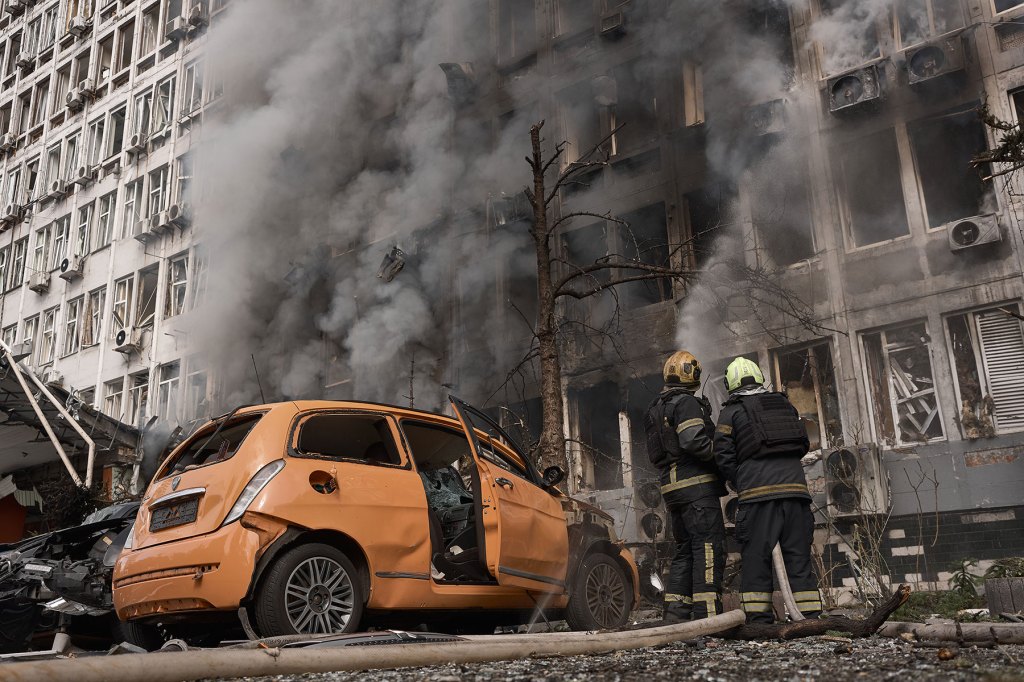
As winter nears, the outlook for Ukraine is bleak. A recent attack on Kyiv consisted of nearly a dozen ballistic missiles and hundreds of drones in a single night. That many munitions slip through highlights the dire situation faced by Ukrainian defenders, who are running out of advanced missile interceptors. They also struggle to shoot down drones that are becoming increasingly numerous, sophisticated, and effective as the war drags on.
In recent months, Russia has adopted widespread use of an advanced drone, the Geran-5 — a jet-powered drone that bears an uncanny resemblance to the V-1 “buzz bombs†used by the Nazis to bombard London toward the end of World War II.
As with the German V-1 campaign against London 80 years ago, the targets are often indiscriminate. Even before the ramping-up of attacks this fall, 2026 was on track to be the deadliest year for Ukrainian civilians since the early months of the full-scale war in 2022.
The proliferation of Russian attack drones and ballistic missiles means that cities like Kyiv now spend much of each day under air alert. Even aside from the human toll and physical damage that the weapons inflict, officials estimate that the disruptions to daily life are costing the country as much as $45 million per hour in lost economic activity.
Since Friday, a series of drone attacks has targeted two of Kyiv’s major bridges spanning the Dnieper River. The damage has disrupted traffic between the capital’s “Right Bank†— with its historic core and city center — and its “Left Bank,†with its sprawling Soviet-era industrial and residential developments.
Ukraine is already experiencing a severe financial squeeze. Prime Minister Sergii Koretskyi says the country is facing a $27 billion “funding gap†before the end of the year.
Ukrainian lawmakers warn the government could even run out of funds to pay soldiers. One serving member of the Ukrainian military, who spoke to Rolling Stone on background, said by the end of the summer, members of his unit had already begun experiencing “delays†in receiving their pay.
The Ministry of Defense disputes that soldier’s salaries could go unpaid, but acknowledges that “technical issues†had caused some delays.
Meanwhile, Zelenskyy is under pressure from corruption scandals and resignations involving members of his inner circle. Polls show him potentially losing hypothetical match-ups against rivals, including former Ukrainian Armed Forces commander Valerii Zaluzhny. The country’s “long-admired cohesion†has begun to crack — an outcome that aligns with Russia’s strategic objectives.
But after nearly five years of war, both combatants are showing signs of political and economic strain.
Russia’s regular military conscription process — 120,000 new recruits are expected over the next three months — barely offsets the grievous casualties its military is experiencing at the Ukrainian front, with high estimates exceeding 1,000 casualties per day.
Some analysts believe the Kremlin is considering a massive mobilization in the wake of parliamentary elections. But Putin so far has merely called for an increase in the total number of active-duty military members by a little more than 15,000. Russia’s president remains wary of generating a meaningful anti-war movement inside Russia, while also facing pressure from hard-line nationalists expecting him to deliver victory.
Across Europe, governments are no longer treating a direct confrontation with Russia as a remote possibility. They are preparing for worst-case scenarios, particularly in the Baltic states and other countries that experienced Russian rule under the Soviets. Meanwhile, NATO insists that all members — including the United States — have an “ironclad commitment†to collective defense.
In 1914, at the outset of the First World War, few leaders understood how faulty strategic assumptions, entangling alliances, and lethal technologies were pushing the continent toward cataclysm.
But some did. On the eve of war, U.K. Foreign Secretary Sir Edward Grey famously wrote that “The lamps are going out all over Europe.â€
Across Ukraine, darkness will again become a feature of daily wartime life amid rolling blackouts as a hard winter looms. And the shadows are lengthening, far beyond its borders.
But in America, the White House dithers as the president has his attention elsewhere. Perhaps Trump’s new ballroom, at least, should be well lit.
Pete Hegseth gestures after giving a State of the Force address at Marine Corps Base Quantico on Sept. 30, 2026 in Quantico, Va.
Pete Hegseth, to his credit, understands one truth about the world: the military’s job is to kill people.
Hegseth, the newly rebranded “Secretary of War,†is obsessed with showcasing clean-cut troops trained to do just that. He refers to it as “lethality,†a word that he used twice in his roughly hour-long State of the Force speech on Wednesday, which laid out his vision for this new, more-violent military: a force of fit, unified “warfighters,†unburdened by the bureaucracy and norms of the past.
“No more diversity quotas, no more gender pronouns, no more identity months,†Hegseth said, pacing back and forth on stage. “Only the warrior ethos.â€
If that wasn’t enough, he doubled down moments later.
“We are no longer the woke department or the weak department,†Hegseth said, stumbling over his words slightly. “No fanny, no fatties, no trannies, no beardos, no weirdos, no wimps, no radicals. Just warriors. Just tough, ready, committed troops.â€
To do this, Hegseth thinks, the military needs to work out. He wants every soldier doing physical training every day. He leads group workouts at the Pentagon, hops in on PT, does pullups and pushups and flexes his muscles. This is all, broadly, fine for a Defense Secretary to do. Go ahead, engage with your troops. (Less normal, perhaps, is his obsession with monitoring troops’ testosterone levels.) But Hegseth’s CrossFit crusade isn’t really about killing.
By any objective measurement, the U.S. military is plenty good at killing. We have more bombs and more planes and more ships and better-trained and equipped troops than any country in the world. The “warrior ethos†Hegseth is so obsessed with is the relic of recruitment videos from the peak of the War on Terror, the years of bearded operators with ropy muscle covered in Kevlar fabric, who kicked in doors and sniped off heads and got their hands dirty. Those guys still exist, of course. They haven’t gone away. If they’re needed again, they will be there.
But combat doesn’t look like that anymore.
On the same day that Hegseth delivered his speech, the U.S. formally withdrew from Iraq, one of America’s last active presences in the wars of occupation that defined the military for the past two decades. War is different now. It is fought with drones and cruise missiles from the decks of ships in the Persian Gulf and dusty air-bases outside of the glittering megacities of America’s Middle Eastern oil merchants. Does every soldier involved in this need a perfect waist-to-shoulder ratio? Does it physically impede America’s interests abroad to have diversity, equity, and inclusion policies? Has the existence of trans servicemembers ever stopped the U.S. military from killing even a single person that it wanted to kill, anywhere in the world, at any time?
Hegseth, I think, would say yes. He has a personal chip on his shoulder. The “woke†elements of Army bureaucracy once removed him from service at Joe Biden’s inauguration because he has a tattoo on his arm that reads “DEUS VULT,†a common rallying cry for a very particular kind of extremist Christian nationalism. But most rational observers, people who are clear-eyed about America’s unparalleled ability to Blow Shit Up, can recognize that all of these arguments are battles of cultural semantics that have basically nothing to do with the military’s ability to kill. With respect to “lethality,†the U.S. military is pretty much fine. If you doubt this, ask an Iraqi.
Hegseth’s relentless focus on violent language and imagery is largely a marketing tactic for what is a more holistic cultural and political shift. Hegseth does not want a military that is indicative of America’s cumbersome, bureaucratic state apparatus in the same way that Trump is relentlessly focused on cutting red tape and federal “waste.†There are certainly inefficiencies in the federal system, but much of that bureaucracy exists for precisely the reason that Hegseth and Trump want it gone: it is a check on unitary power. Hegseth wants a united, homogenous military of soldiers who share his cultural prejudices, who share his bloodthirsty ethos, and who share his religion. In the State of the Force speech and many other recent public appearances, Hegseth has quoted scripture and explicitly referenced his Christian faith, a tacit assumption that he expects the men and women in uniform below him to be Christian. He wants a force that, in his own words, does not buy into the “fake news†media’s “disingenuous headlines about deployment lengths, patently false claims of low troop morale or flat-out propaganda.â€
A more malleable military is also a better business opportunity. The Trump administration has been terribly effective at streamlining the process by which they can redistribute money to the oligarchs they choose. The so-called Department of War is no different. In his speech, Hegseth announced an initiative called “Project Meridian,†a sort of tech incubator for military contractors that will be run by Elon Musk, Palmer Luckey, and, bizarrely, Newt Gingrich, who Hegseth said would be joined by “hand-picked private sector leaders.â€
“Their work will be focused on discovering, developing and fielding the weapons and systems that our children and our grandchildren will need in their lifetimes without any creative limitations or restrictions,†Hegseth said. “On any future battlefield, from under the earth to beyond the moon, our American warriors will be armed with absolute technological superiority because we will have the foresight to prepare today for tomorrow.â€
That’s the window dressing. There’s truth there, of course: the military does have a lot of work to do to adapt to the new forms of warfare playing out in Ukraine. Battle has shifted. But what Project Meridian represents is a shift to a faster, less regulated version of the military industrial complex. There will be less oversight. The money will move where Trump and Hegseth want it to, delivered to the tech barons and traditional defense contractors who best curry favor with the administration. This is for the good of the soldier, regardless of what Hegseth says. It does not make us more deadly. It just makes a select few — some of whom aren’t even American — that much more rich.
After all, that’s the goal, right? A prosperous, united, Christian nation, led by titans of industry who bow only to a single leader who can reshape the world on a whim. No fatties, no weirdos, no radicals. No dissent, crucially. Dissent is traitorous. As soldiers, as civilians, even, all we should think about is how to kill. Hegseth and his hand-picked private sector will handle the rest.
First Lady Melania Trump waves after ringing the opening bell of the New York Stock Exchange on Sept. 23, 2026.
Roughly 70 percent of the country disapproves of President Donald Trump and his first two years of governance, but like an overindulgent mother, First Lady Melania Trump would like everyone to remember that her husband is trying his hardest.
“I think he’s doing the best he can,†Trump told the hosts of Fox & Friends on Wednesday morning when she was asked how she felt her husband was doing in comparison to his first term.
“He’s very focused, he has a lot on his plate,†she said. “It’s very different, what’s going on around the world now. But I think he’s doing the best that he can. He works nonstop, he has the most energy than anybody. He’s from morning until evening nonstop working.â€
Add that to the pile of Republican statements — many from the heart of the administration — insisting to voters that while gas might be expensive, groceries might cost more, and about one million more people are about to get kicked off their health care, they shouldn’t punish them at the ballot box.
Last week, Vice President JD Vance — sounding like the guy who forgot your birthday and your anniversary — pleaded with voters in an interview to “give us another chance.â€
“Even if you don’t agree with us on every issue, the other party is consumed by craziness,†he added.
The vice president made similar statements during his speech before the emergency midterm Republican National Convention, begging conservatives to “give us another chance, or give us another couple of years, to continue to work on the amazing things that we’ve been doing for the past two years.â€
Nevertheless, an increasing number of independents and conservatives seem ready to boot Republicans from power in Congress, regardless of their rosy promises.
Donald Trump is joined by opera singer Christopher Macchio to conclude the Republican midterm convention, on Sept. 10, 2026 in Dallas.
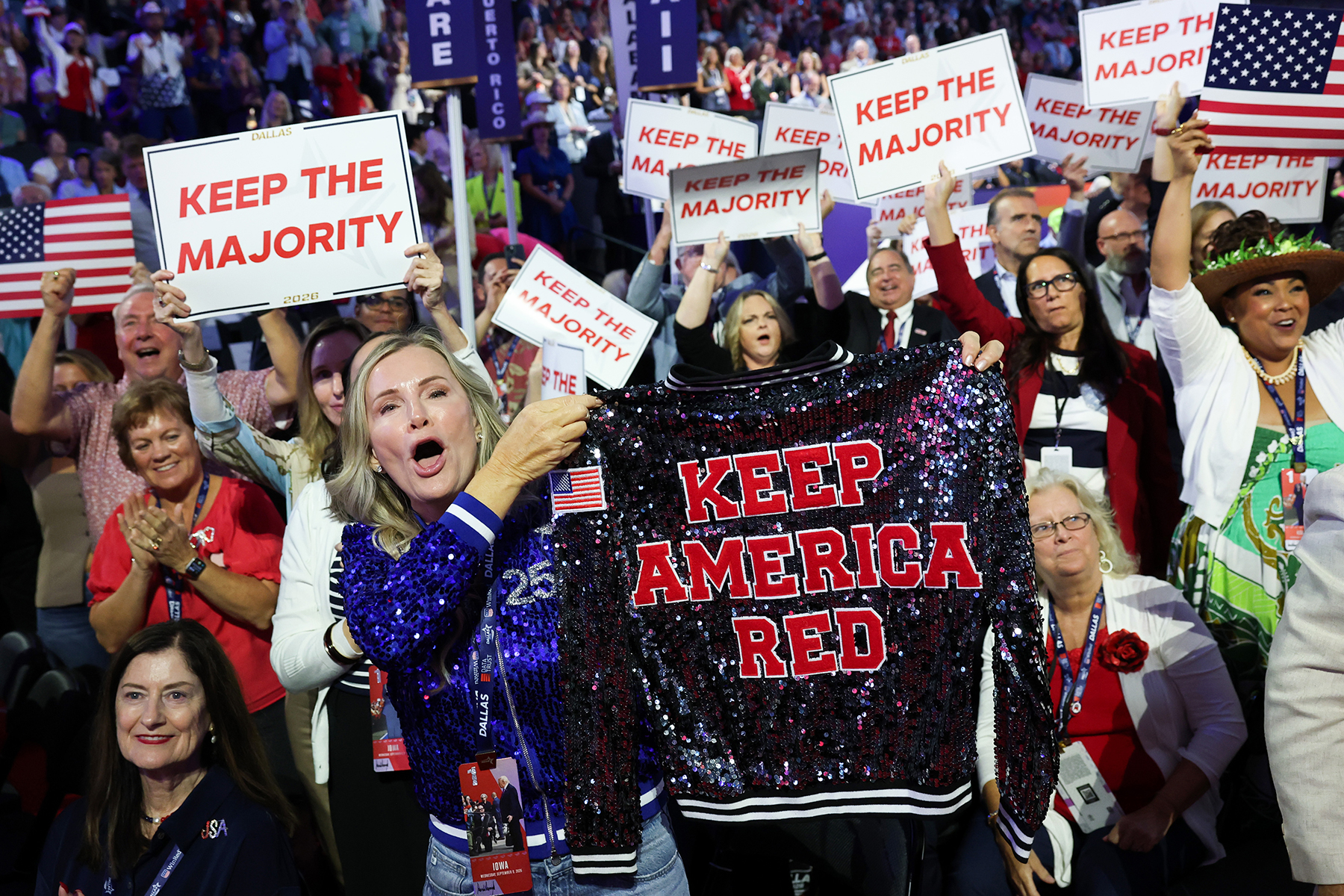
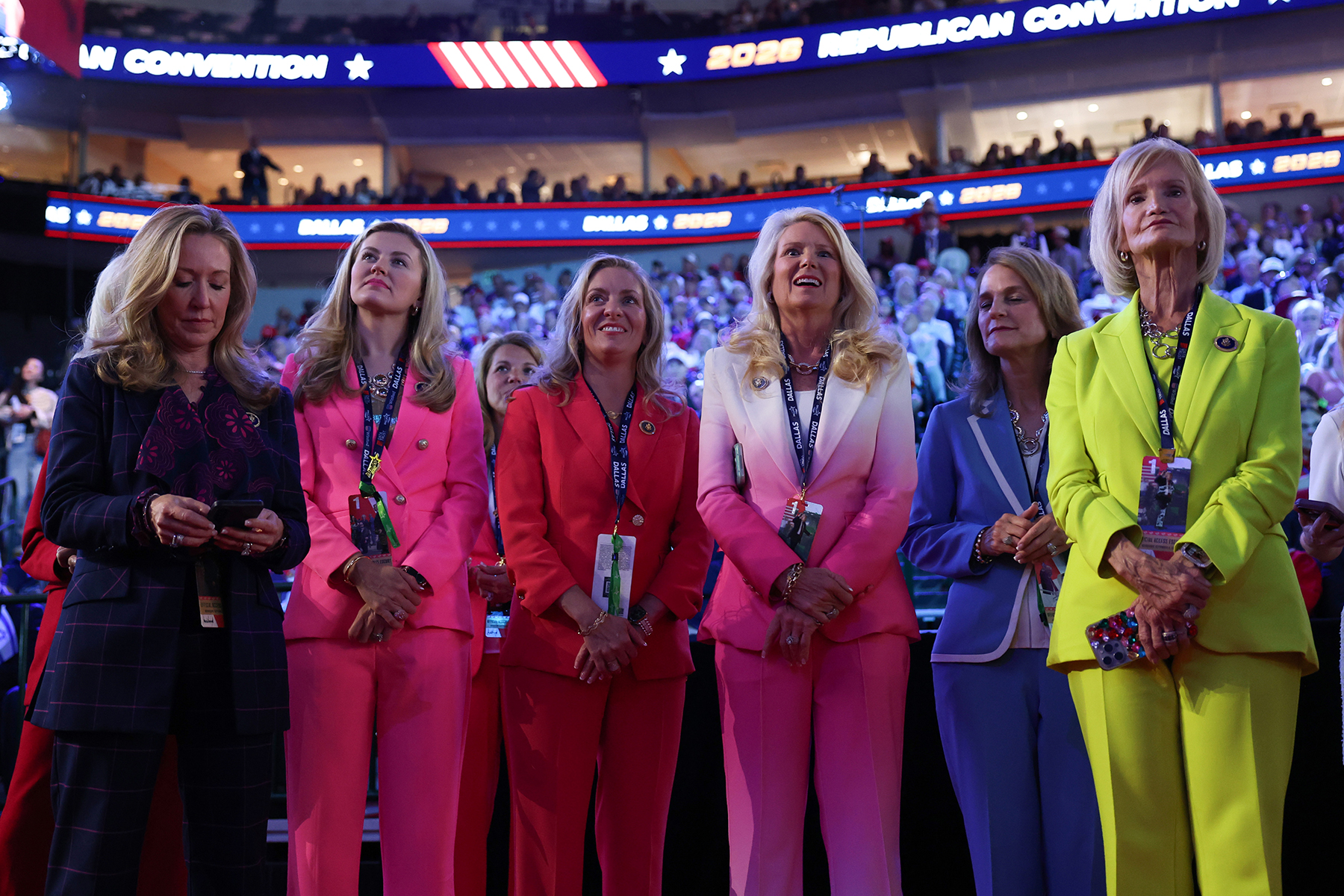
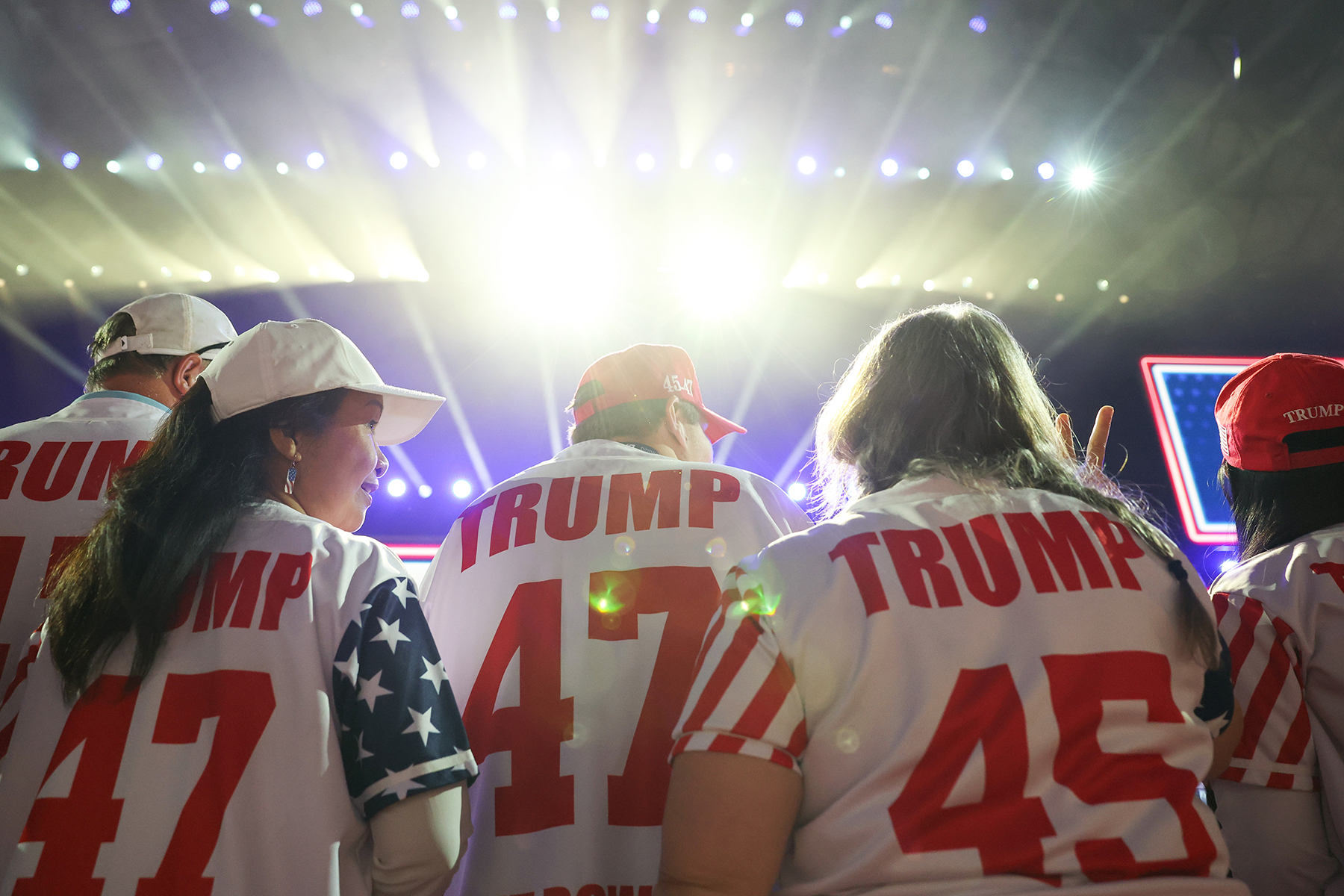
It’s 3:42 in the hot heart of Texas, and the floor of the American Airlines Center in Dallas is a blood-red miasma of dancing elephants. Under the moody crimson lights washing over the crowd at the first ever Republican (Midterm) National Convention, middle-aged peroxide blondes in sparkly American flag cowboy hats sway to the raspy belt of Bonnie Tyler’s “Holding Out for a Hero.†Men in suits and silver belt buckles and leather boots sheepishly bop the “KEEP THE MAJORITY†signs distributed by organizers. The stage is empty right now. Large, menacing images of Joe Biden, Nancy Pelosi, and Kamala Harris loom over the crowd. None of them are running this cycle.
If I look directly across the floor, toward the entrances to the still mostly empty box seats and nosebleeds, the bright white doorways catching the daylight of downtown Dallas are harsh and blinding. Outside the air-conditioned arena, there’s a fight raging. The GOP is at war with itself and its voters. The casualties of this political cycle — spiraling around Donald Trump’s war-ravaged, economically disastrous two years back in office — will likely touch every Republican state delegation.
But the president wants a party, and you can’t dance with the lights on.
Eighteen months ago Dallas would have been an auspicious location for this event. Trump, the keynote speaker for the first night of the two-day conference, made generational gains among Hispanics in 2024. Governor Greg Abbott promised to carve out five shiny new Republican House seats into the state’s electoral map. The Lone Star State had become the southern Mecca of the techno-conservative revolution looking to find roots outside of Silicon Valley. But the right’s gains among Hispanics have been erased, a Democrat is well-positioned to win a Texas Senate seat for the first time in decades, and one can’t help but notice the sense of panic permeating the GOP’s biggest party of the year.
It’s obvious what the president had in mind in pulling this party together. The scene feels like a pantomime of the 2024 nomination conference, held as Democrats scrambled to find their footing amid ever-intensifying concerns regarding Biden’s ability to govern, much less campaign, and just days after Trump narrowly survived an assassination attempt in Butler, Pennsylvania. This week, a large photo of the now-president and the bandage he was sporting over his ear during his nominating convention hangs conspicuously on one of the arena’s concourses. The one-year anniversary of the assassination of right-wing activist Charlie Kirk — which coincided with the second day of the convention — supplanted Trump’s close call with death as the avatar for leftist violence against persecuted conservatives. Republican after Republican trotted out the same lines of attack that propelled them to victory two years ago:
Killer migrants that rape and murder angelic young women. Leftist radicals looking to inflict police-free anarchy on American cities. The mutilation of children being subjected to horrific sex change surgeries. The threat of Sharia Law from Arab and Muslim Americans — like Zohran Mamdani, Abdul El-Sayed, and Hasan Piker — and the looming scourge of a communist, democratic-socialist takeover. Bread lines and authoritarianism are certain under Democratic rule, Donald Trump Jr. insisted. You may not be happy with us right now, but it could be so much worse.
“I’m not asking anybody to agree on every single policy of the administration; what I am asking you to do is to recognize the contrast with the radicals and recognize the achievements of the last 18 months,†Vice President JD Vance pleaded with the audience during his Thursday night keynote.
The president self soothes via adulation. Yet even in his own Wednesday night speech, Trump reluctantly acknowledged “it’s going to take a little bit longer than the midterms†to normalize the spike in energy prices caused by his ongoing war in Iran. He attempted to blame the ongoing affordability crisis on his predecessor and the Democratic Party. To his and the GOP’s frustration, voters — particularly independents — are not blaming it all on the opposition. They have handed Trump a historically low approval rating, and are tossing MAGA aligned Republicans out of Congress in primaries. The convention was nowhere near at capacity, despite local offers of free tickets and a lineup of MAGA favorites. In the absence of a clear argument for why voters should continue to trust the mercurial, impulsive, self-serving men dictating the direction of the party, Trump is turning to outright bribery.
“If the Republicans win, you win with us and you get $5,000. It will be called the Trump dividend. Congratulations,†Trump told the audience on Wednesday night. Vote Republican, you might get $5,000. It screams confidence in your prospects, does it not? Never mind that Republicans currently control both chambers of Congress, and that if this was about anything other than attempting to buy votes they could pass — or make a show of attempting to pass — the payments before the midterms. Never mind that Trump has repeatedly promised no-strings-attatched government checks that never materialize. Never mind that the tariffs that would supposedly fund the payments haven’t generated even a fifth of the revenue that would be required. Never mind that — as Senate candidate Ken Paxton was reminded in a live interview with Fox News’ Bret Baier — these people are supposed to be fiscal conservatives.
Even among the Trump-friendly crowd, there was a degree of skepticism. “I don’t think that a political promise should be made like that,†one woman told me. “The votes don’t come from being bought, so yeah, I’m a little disappointed.â€
Two young men — locals who said they attended the conference mostly out of curiosity — said the promise was the “stupidest thing†they’d heard from a politician.
The promise crystallized the rot at the core of the convention: the party’s total inability to respond to the concerns of the voters they need to retain from 2024, and insistence on filling the void with culture war dog whistles and cult-like devotion to Trump. Several high-profile candidates seem to realize this isn’t a recipe for success this November. Maine Senator Susan Collins — facing a tight reelection battle in Maine — was conspicuously absent, as was Alaska Senator Dan Sullivan. Several candidates in critical House races considered potential tossups also ditched the president’s festivities, including Reps. Brian Fitzpatrick (R-Pa.), Maria Elvira Salazar (R-Fla.), Rep. Zach Nunn (R-Iowa), and David Valadao (R-Calif.)..
Those who did make their way to Dallas played second fiddle to the president, vice president, and members of the administration. Paxton, a host candidate caught in an incredibly tight race to preserve the last three decades of Republican dominance in Texas, became a punchline in Trump’s monologuing.
“I don’t like the way Ken Paxton dresses. I don’t really like the way Ken talks. I don’t really like the way he looks. I don’t like it,†Trump said of the attorney general, who has been nothing but subservient and loyal to his agenda. Paxton, perpetually putty faced and on the spot, made a halfheated attempt at a forced smile. It was not reassuring. The party honored him and his service to the MAGA movement by putting him in a forgettable time slot where he delivered a forgettable speech in which he highlighted Trump’s record over his own and warned that his opponent James Talarico “wants to transition your kids.â€
Trump made fun of Paxton again while speaking on Thursday. “I said something yesterday, and I don’t know if he’ll ever talk to me again,†the president said before repeating the same insults.
Greg Abbott, who has governed the state for over a decade, promised to “fully ban Sharia Law in Texas,†a state with less than 500,000 Muslim residents within a population of 32 million. He promised to ban China, Iran, and Russia from buying land in the state — as if they were readily able to do so in the first place. “The Democrats running on the ticket in Texas, they’re gaslighting the public about affordability,†as if economic concerns and inflation aren’t the issues of top concern to Texas voters this cycle.
Republicans begged voters to preserve the Republican trifecta for just two more years. Just until 2028, then we can fight about who was at fault for the collapse of the economy, and the war in Iran, or the unraveling of our alliances. “Can we please, we’ve got to take care of business this November, then we’ll worry about what comes next,†Vance asked the audience at one point. His speech felt like the sort of address one would give once they won the nomination, the soft launch of ambitions beyond the vice presidency. But this is, and always has been, and for the foreseeable future will be, Trump’s party. No second in command will be permitted to outshine him.
Whatever glow Vance was basking in was quickly dimmed under the radioactive sun of the president. Who wrote himself into the second night of programming and — just to drive the point home — reiterated his first night demand that voters imagine that it’s him that’s on the ballot.
As Trump closed out the night, American tenor Christopher Macchio belted “Nessun Dorma†as a rain of red, white, blue, and gold balloons fell from the ceiling. The aria, performed in the third act of Giacomo Puccini’s opera Turandot, is a favorite of the president.
Trump smirked into the audience alongside Macchio as his voice arced towards its final crescendo. “Vincero, vincero, vincero.â€
“I will win, I will win, I will win.†A declaration by the prince Calaf that he will secure the hand of the princess Turandot, whether she wants it or not. The chorus surrounding his avowal is that of Turandot’s subjects, lamenting fate.
Trump was totally alone onstage as he listened.
Images from the story



End of article