yahoo Press
The Great Slop Bowl Split Is Here
Images
1 / 5
2 / 5

3 / 5

4 / 5
5 / 5
The above button links to Coinbase. Yahoo Finance is not a broker-dealer or investment adviser and does not offer securities or cryptocurrencies for sale or facilitate trading. Coinbase pays us for certain activity generated through this link. Prices displayed are informational.

Last year, all the headlines about slop bowls, or sad desk lunches, or whatever you want to call the vaguely healthy mixed greens-and-grains you eat in front of humming computer monitors in twelve minutes or less, were all doom-and-gloom.

It was the slop-cession, if you will, led by Sweetgreen’s wilted arugula and Cava’s Mediterranean misses. But then something miraculous happened: Cava started to turn things around.

Led by CEO Brett Schulman and CFO Tricia Tolivar, Cava beat estimates over consecutive quarters. The company posted record revenue for the full year last year, and forecast strong sales growth this year in its February read-out.

Not to get all macro on you, but fast casual chains are buffeted by rising supply chain costs on one side, and shrinking consumer wallets on the other. Plus, lifestyle factors like the rise in work-from-home mean same-store sales, the ever-important restaurant franchise metric, are continually fighting a dropping tide. And as the saying goes, when the macro tide goes out, the market sees which fast casual chains are actually wearing pants — or just boosted by food fads and robust consumer spending.

Cava, it appears, has expertly navigated both the supply and demand side shocks by lowering menu prices and, really, just making food people want to eat. Same-store sales rose about 0.5% in the fourth quarter, and the chain saw its strongest sales in neighborhoods with lower median incomes.

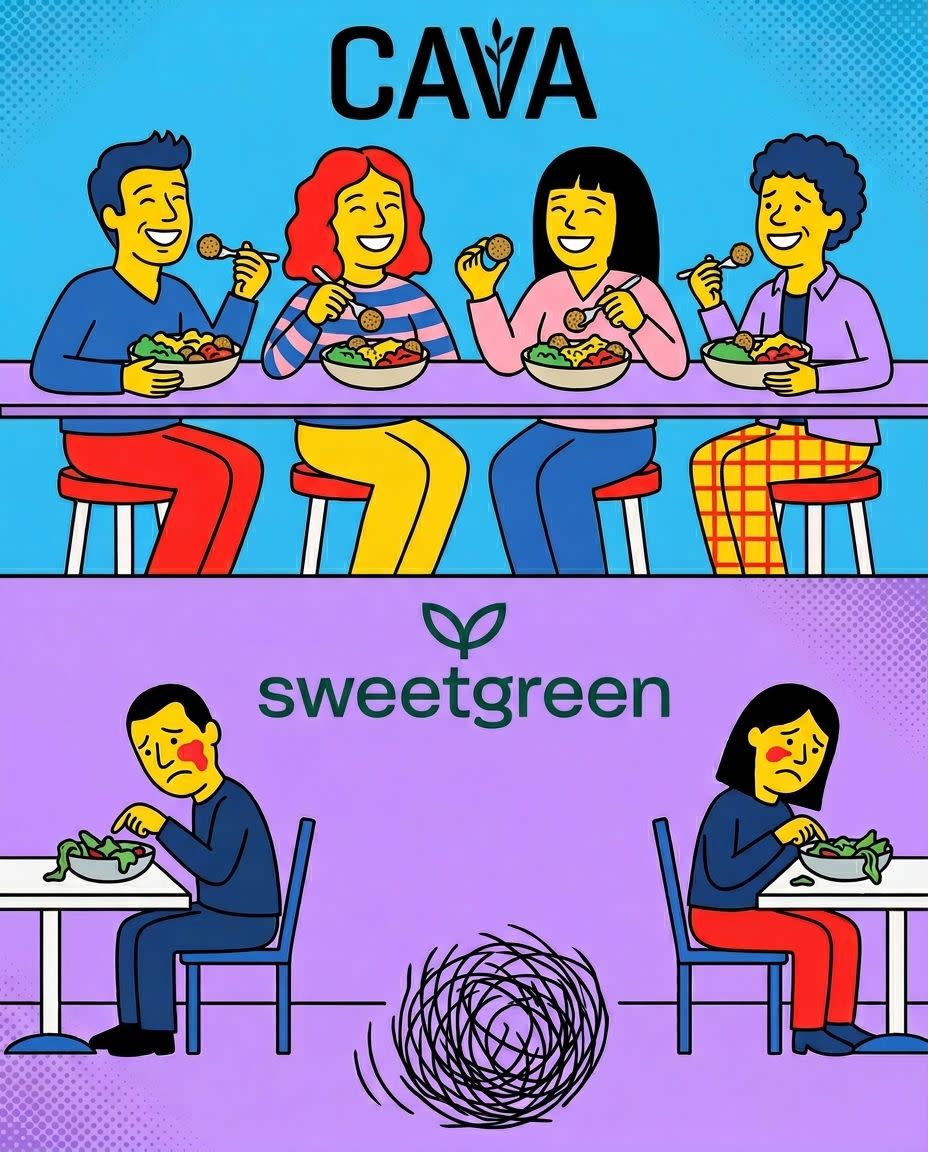
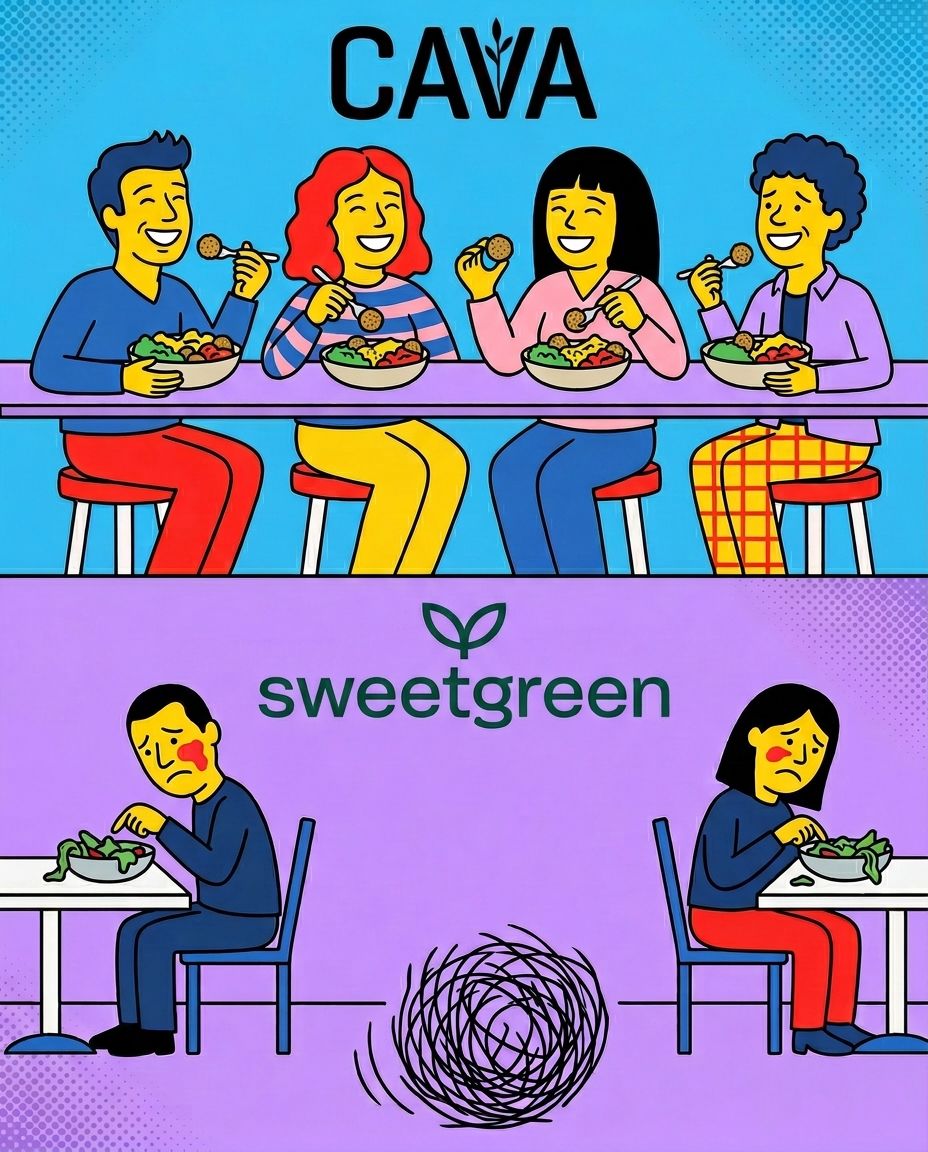
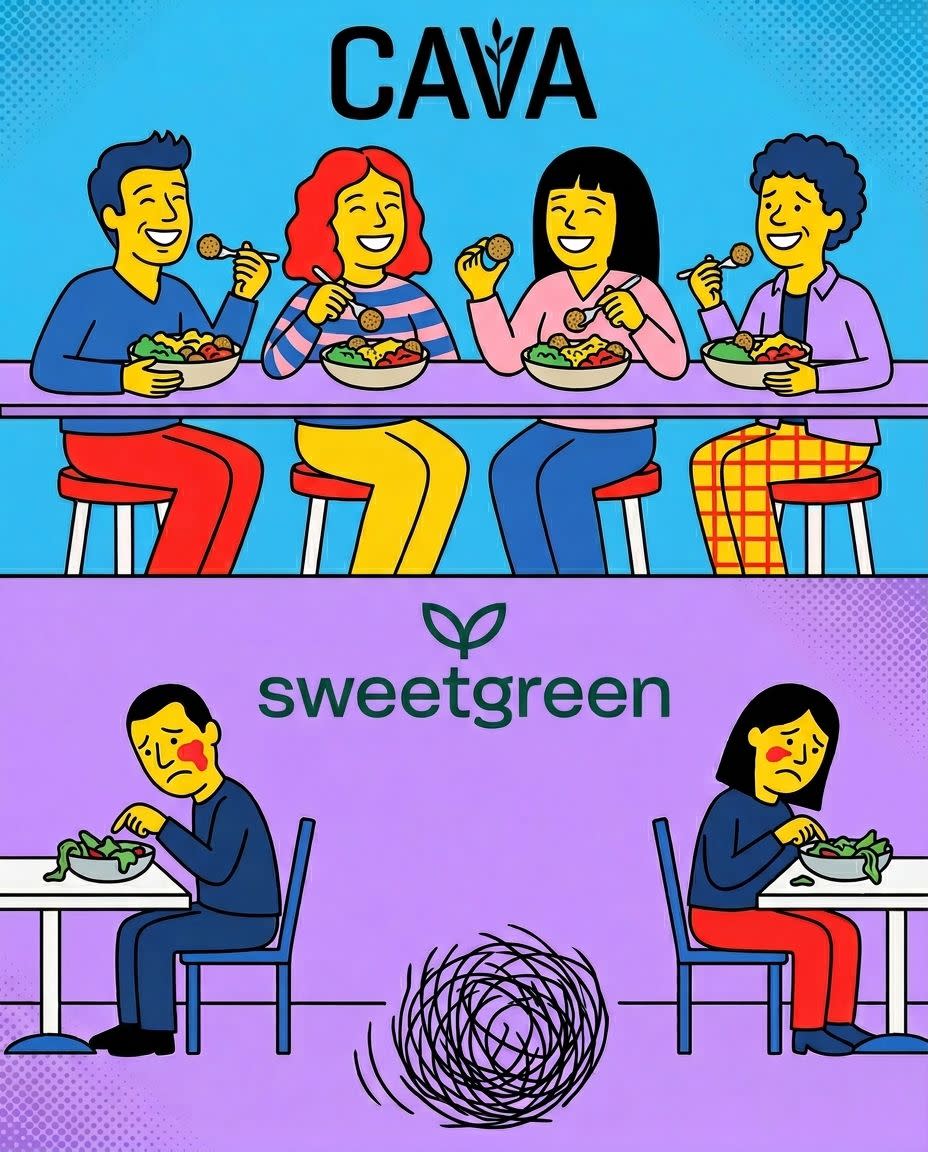
But if the broader consumer economy is K-shaped — the haves continue to spend more while the have-nots pull back — then so are the fortunes of the two most emblematic fast casual chains. Cava, thanks to its aforementioned turnaround, is up over 42% this year. Sweetgreen has wilted 16%. Same-store sales declined nearly 10% over the last quarter, thanks to a near 12% drop in foot traffic.

It’s not just that Americans are ditching salads for falafel. It’s management. The company has still never turned a profit despite slinging its first salad nearly twenty years ago. It introduced baked fries with an expensive, splashy media campaign that created so many headaches for workers that it slowed down the lunch rush.

But at the end of the day, it appears Americans are voting with their stomachs. Cava’s turning a slop-cession into a slop-boom. Sweetgreen appears to be going down with the ship.

Of course, if President Trump and Iran really do come to some sort of long-lasting, stable peace, supply chain problems will start to normalize. Costs will come down. And on the demand side, the laptop class’s wallets will start to get a little fatter, making $22 salads a little bit more attractive for lunch.

Same-store sales will, again, be the key metric to watch. That’s a reflection of foot traffic, and foot traffic increases when the economy’s good. Plus, look for Sweetgreen to make its menu more efficient. Fewer baked fries, and more combinations of the same salad, and more discounts. It’s got cash-on-hand after jettisoning Spyce, the automated kitchen startup it acquired in 2021.

But at the end of the day, it appears there are winners and losers at the slop trough. Cava appears to be the winner.

Cava Group, Inc. (CAVA) — The company has demonstrated strong financial performance, beating estimates, achieving record revenue, and successfully navigating supply and demand shocks through effective management and menu adjustments.

Chipotle Mexican Grill, Inc. (CMG) — As a well-established and often well-managed fast-casual competitor, Chipotle is likely to benefit from any overall improvement in consumer spending and could capture market share from struggling rivals.

Shake Shack Inc. (SHAK) — Similar to Chipotle, well-managed fast-casual chains that can adapt to market conditions and consumer preferences are positioned to gain from the industry's K-shaped recovery.

Fast Casual Dining (well-managed segment) — Companies with strong management, efficient operations, and appealing menus are demonstrating resilience and growth despite macro challenges, indicating a healthy segment within the industry.

Food Distribution — As successful fast-casual chains like Cava expand and increase sales, demand for their food ingredients and supplies will rise, benefiting food distributors.

Our analysts just identified a stock with the potential to be the next Nvidia. Tell us how you invest and we'll show you why it's our #1 pick. Tap here.

USA — A potential normalization of supply chain problems and "fatter" consumer wallets, as suggested by geopolitical stability, would generally boost consumer spending and economic activity.

Agricultural Products (e.g., greens, grains, falafel ingredients) — Increased demand from growing fast-casual chains like Cava will positively impact suppliers of these core ingredients.

McDonald's Corporation (MCD) — While a major player in the broader restaurant industry, its QSR model and scale may buffer it from the specific fast-casual dynamics discussed, resulting in a mixed or less direct impact.

Starbucks Corporation (SBUX) — Similar to McDonald's, Starbucks operates in a different segment (coffee/beverages) but is still subject to general consumer spending trends and supply chain costs, leading to a potentially neutral or mixed impact.

Restaurant Industry (overall) — The industry faces both significant headwinds from rising supply chain costs and changing consumer habits (WFH) and potential tailwinds from improved consumer spending, creating a mixed outlook.

Sweetgreen, Inc. (SG) — The company is experiencing significant financial struggles, including declining same-store sales, reduced foot traffic, and a history of unprofitability, exacerbated by management missteps.

Spyce — The automated kitchen startup was jettisoned by Sweetgreen, indicating a failed acquisition and a loss of investment for Sweetgreen, highlighting the risks of unproven food tech.

Fast Casual Dining (poorly managed segment) — Chains that fail to adapt to rising costs, shifting consumer preferences, and operational inefficiencies are facing significant financial distress and potential failure.

Food Service Technology (inefficient/unproven) — Solutions that create operational burdens or do not deliver clear value, as exemplified by Sweetgreen's experience with Spyce, will face skepticism and limited adoption.

Consumers (USA) — "Shrinking consumer wallets" and the potential for higher menu prices due to supply chain costs represent a negative impact on consumer purchasing power for fast-casual dining.

Short-term Divergence in Fast Casual Valuations — The market will likely continue to reward well-performing fast-casual chains like Cava with higher valuations and penalize struggling ones like Sweetgreen, reflecting investor confidence in management and operational efficiency. Confidence: High.

Medium-term Increased M&A Activity in Fast Casual — Struggling fast-casual chains, particularly those with strong brand recognition but poor financial performance, may become acquisition targets for larger restaurant groups or private equity firms seeking to implement turnarounds. Confidence: Medium.

Long-term Shift in Fast Casual Business Models — The success of Cava in navigating cost pressures and consumer demand will likely prompt other fast-casual chains to re-evaluate their menu pricing strategies, operational efficiencies, and target demographics to remain competitive. Confidence: High.

Short-term Scrutiny on Restaurant Technology Investments — Sweetgreen's jettisoning of Spyce will lead to increased caution and due diligence for fast-casual chains considering investments in automated kitchen or other food service technology, prioritizing proven ROI and operational integration. Confidence: Medium.

Medium-term Impact of Geopolitical Stability on Input Costs — A sustained period of geopolitical stability, as suggested by a potential Trump-Iran peace, would likely lead to a normalization of global supply chains and a reduction in commodity and logistics costs for the food service industry. Confidence: Medium.

↑ Consumer Confidence — If geopolitical stability leads to "fatter" consumer wallets, overall consumer confidence could improve, signaling a willingness to spend more.

↓ CPI (Food Away From Home) — Normalization of supply chain costs due to geopolitical stability could lead to slower price increases or even slight decreases in menu prices for consumers.

↑ Restaurant Sales (Fast Casual Segment) — The success of Cava and potential improvements in the broader economy could lead to an increase in overall sales for the fast-casual segment, particularly for well-managed chains.

→ Unemployment Rate — While not directly impacted, a stronger consumer economy and thriving restaurant sector could indirectly support stable or slightly decreasing unemployment, particularly in service industries.

↓ Baltic Dry Index — If global supply chains normalize and shipping costs decrease due to reduced geopolitical tensions, the Baltic Dry Index, a measure of shipping costs, would likely decline.

One stock. Nvidia-level potential. 30M+ investors trust Moby to find it first. Get the pick. Tap here.
Comments
You must be logged in to comment.