yahoo Press
Morning Brief: The S&P 500 smashes through the 7,000 mark
Images

1 / 7
2 / 7

3 / 7

4 / 7

5 / 7

6 / 7

7 / 7
The above button links to Coinbase. Yahoo Finance is not a broker-dealer or investment adviser and does not offer securities or cryptocurrencies for sale or facilitate trading. Coinbase pays us for certain activity generated through this link. Prices displayed are informational.

👋 Good morning! Two weeks into Q2, and we've got ourselves an all-time high.

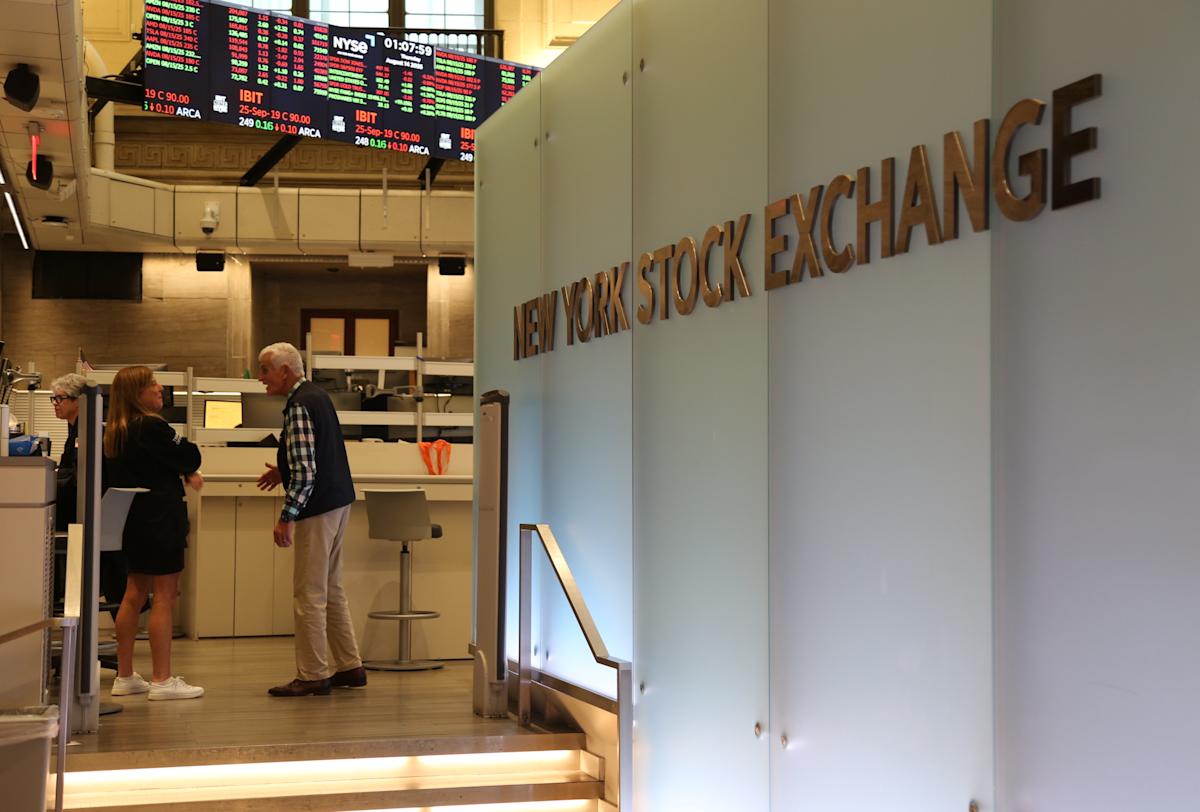
The S&P 500 (^GSPC) gained 0.8% to close at 7,023, its first time closing over the 7,000 mark. Well done, folks. I think we're all a little surprised, given where we were just two weeks ago, but that's the modern market for you.

The Dow (^DJI) missed out on the party, losing 0.2%, while the Nasdaq (^IXIC) gained 1.6%.

On the agenda this morning:

💼 AI layoff news keeps coming — but so does reassurance

🤖 We're in our 'Long Island AI era' as shoe brand Allbirds goes full AI

🏦 Trump is threatening to fire Powell again

🔨 Lowe's bets AI won't be able to fix a hole in your roof

📔 The Fed's Beige Book sets up earnings season

📆 What we're watching Thursday: Big Tech's earnings season kicks off with Netflix (NFLX) along with more banks and PepsiCo (PEP) for a check on consumer behavior and GLP-1 impact on snacking.

🍪 Micron stock takes a breather from its strong April rally. The chipmaker fell 3% but is still up around 40% over the past few weeks.

🏹 Robinhood surges after SEC removes limit on day trading activity. The 10% gains on Wednesday showed just how crucial this is for the company.

☕️ Starbucks app launches in ChatGPT. The AI shopping push continues.

💰 Refunds are up as filing deadline passes. The Treasury Dept says people are claiming the new deductions.

⚡️ Tesla surges after revealing a chip. Meanwhile, Uber says its AI budget isn't enough.

🍪 Nvidia is suddenly on a roll. The stock is out of the red and up 5% year to date.

🛢️ Phillips 66 CEO says oil supply won't just snap back after Iran conflict. Damage has been done.

💸 New retirees' top regret: Not saving more money

🏦 Bank of America joins big bank peers in reporting rising profits. It's also calling US economy 'resilient.'

🔻 ASML stock drops 6% as China segment takes a hit. The export bans are hurting.

💲 Social Security COLA for 2027 is projected to be flat. The recent jump in inflation may make things tight.

🏡 COVID-era homeowners are still hanging on to their ultra-low-rate mortgages. Must be nice!

🛻 Jeep, Ram truck maker Stellantis rises on improving Q1 sales. The turnaround strategy is working.

📈 Wall Street's biggest fear gauge is fading. That means investors may want to buy the dip.

🛰️ Why Wall Street loves Amazon's deal to buy satellite firm Globalstar.

See what else is trending on Yahoo Finance.

Snap is cutting 16% of its workforce — around 1,000 positions — due to (or thanks to, depending on who you are) AI efficiency gains.

The stock jumped 8% as CEO Evan Spiegel wrote in an SEC filing that "we believe that rapid advancements in artificial intelligence enable our teams to reduce repetitive work, increase velocity, and better support our community, partners, and advertisers."

Whether it's layoffs or simply attrition and not hiring, CEO commentary like Spiegel's seems to be ratcheting up as we've seen Oracle, Meta, Amazon, Block, and Salesforce make similar moves. At some point, we'll see it in the data.

We see this as a foregone conclusion for many companies, as better margins and efficiency are privileged over simply upping production with the same employees. (Snap clearly doesn't have the demand to have those 1,000 do way more thanks to AI.)

This is a scary proposition. But this week saw a top Fed official issue some reassurance about AI's insatiable appetite for our jobs.

"I think the nature of jobs are going to change," Chicago Fed president Austan Goolsbee told us. "There have been many changes to the nature of many jobs over a lot of decades. We have a pretty good sense that there can be short-run disruptions. And then in the long run, most of these big technologies are job creators on net, not job destroyers."

Read more.

One of the most defining moments from the "blockchain era" was when the company "Long Island Iced Tea" changed its name to "Long Blockchain" in 2017 and sent its stock upward 197% instantly.

It didn't really work out. The company was delisted, and there were some investigations. But the absurdity remains as a marker of a wild era of speculation and hype: two things that today's investors are familiar with.

This week, the AI-juiced markets got a fresh dose of absurdity: The company Allbirds, done with selling Silicon Valley's clichéd footwear, is pivoting to AI services. On the face, it makes us think of Long Blockchain, Kodak (KODK) launching an altcoin, or GameStop (GME) becoming a bitcoin treasury company.

What should we call a struggling consumer brand attempting to glom onto Wall Street's trendiest narrative? In this case, it looks like AI capital appropriation. And at least in the very short term, it's working exceedingly well.

The stock of the footwear maker surged as high as $23, or 700%, as the announcement of an AI pivot boosted the company, which was trading at less than $3 a few days ago.

Being obvious isn't always bad. And chasing investor excitement with the promises of greater returns is a sensible move. It's also patently ridiculous. But as transformative as AI technology might be, absurdity is what the day calls for — especially if you're trying to woo meme stock enthusiasts.

Completely overhauling a business and diving headfirst into a pit whose depth isn't really known is also what the tech giants are doing. So what if you don't have AI experience? At least Silicon Valley investors know your company's name and probably wore the shoes.

It would be unfair to compare Mark Zuckerberg's $1.7 trillion operation to the maker of the Men's Wool Runner, which recently sold its footwear assets to American Exchange Group for $39 million and whose stock had cratered up until Wednesday, failing to fend off rivals.

But Allbirds is riffing on the same rationale that's powered the AI trade thus far. Invest in AI infrastructure and capture some of the seemingly insatiable demand for chips and data centers.

Read more.

President Trump on Wednesday renewed his public campaign to oust Fed Chair Jerome Powell, threatening to fire him if he does not step aside when his term ends in May.

While Trump has already selected a nominee to succeed Powell, that process is looking fraught as a key senator has vowed to block the confirmation process — unless the Justice Department drops its criminal probe into Powell.

For his part, Powell said in a press conference last month that if his successor is not confirmed by the end of his term as chair, he would serve as temporary leader until an eventual confirmation takes place. The tensions have added a layer of intrigue and confusion as the Powell era was supposed to draw to a close.

Kevin Warsh, the president’s choice to serve as the next leader of the Fed, is scheduled to appear in front of the Senate Banking Committee next week for his confirmation hearing.

Trump has vowed to see the criminal investigation through, even after Powell scored a major legal victory last month, when a federal judge threw out two subpoenas the Justice Department issued to the Fed, effectively invalidating the probe.

Another wrinkle in the Fed drama: Powell has also said he won’t leave the Board of Governors while the investigation is ongoing.

Read more.

"AI can write code, but it can't climb a 12-foot ladder, and it can't fix a hole in your roof."

— Lowe's CEO Marvin Ellison

Lowe's told us this week that it was "on the leading edge of AI."

That's nice, and we're sure it's as true for Lowe's as it is for many companies that use AI for business and customer functions: sales, inventory management, and normal keeping-the-lights-on activities.

But Ellison is on to something very important here.

In addition to the real-world pleasure of driving a 16d nail with a hickory-handled Vaughan for a weekend DIY-er looking to feel something other than a keyboard, there is a wild amount of real-world work to be done.

That creaky stair. The rotting fascia. The dents in the drywall your kids made a few years ago. Ellison says 41% of construction workers will retire in five years, and the roofs won't fix themselves.

Read more.

The Fed's Beige Book, technically the "Summary of Commentary on Current Economic Conditions by Federal Reserve District," confirmed just how concerned businesses have been about the Iran war's fallout.

Pricing pressures from tariffs and the new oil shock are on corporate minds.

But while there wasn't anything groundbreaking in the anecdata, the release is a nice amuse-bouche for the meat of the Q1 earnings season, whose key themes (pricing and consumer spending) will add on to the Beige Book's narratives.

Read more.

Economic data: New York Fed services business activity, April, (-22.6 previously); Philadelphia Fed business outlook, April (18.1 previously); Initial jobless claims, week ended Apr. 11 (219,000 previously); Continuing claims, week ended Apr. 4 (1.79 million previously); Industrial production, month-on-month, March (+0.2% expected, +0.2% previously); Manufacturing production, March (+0.2% previously)

Earnings calendar:  Netflix (NFLX), PepsiCo (PEP), Abbott Laboratories (ABT), Charles Schwab (SCHW), Prologis (PLD), BNY Mellon (BK), U.S. Bancorp (USB), Marsh & McLennan (MRSH), The Travelers Companies (TRV), Infosys (INFY), Citizens Financial Group (CFG), KeyCorp (KEY), Alcoa (AA)

Friday

Economic data: No notable economic data.

Earnings calendar: Truist Financial Corporation (TFC), Fifth Third Bancorp (FITB), State Street (STT), Ally Financial (ALLY)

Hamza Shaban is a reporter for Yahoo Finance covering markets and the economy. Follow Hamza on X @hshaban.

Ethan Wolff-Mann is a Senior Editor at Yahoo Finance, running newsletters. Follow him on X @ewolffmann.

Click here for in-depth analysis of the latest stock market news and events moving stock prices

Read the latest financial and business news from Yahoo Finance
Comments
You must be logged in to comment.