yahoo Press
Stacking up SpaceX's biggest winners
Images
1 / 5

2 / 5

3 / 5

4 / 5

5 / 5
The above button links to Coinbase. Yahoo Finance is not a broker-dealer or investment adviser and does not offer securities or cryptocurrencies for sale or facilitate trading. Coinbase pays us for certain activity generated through this link. Prices displayed are informational.

Stephanie Zhu/PitchBook

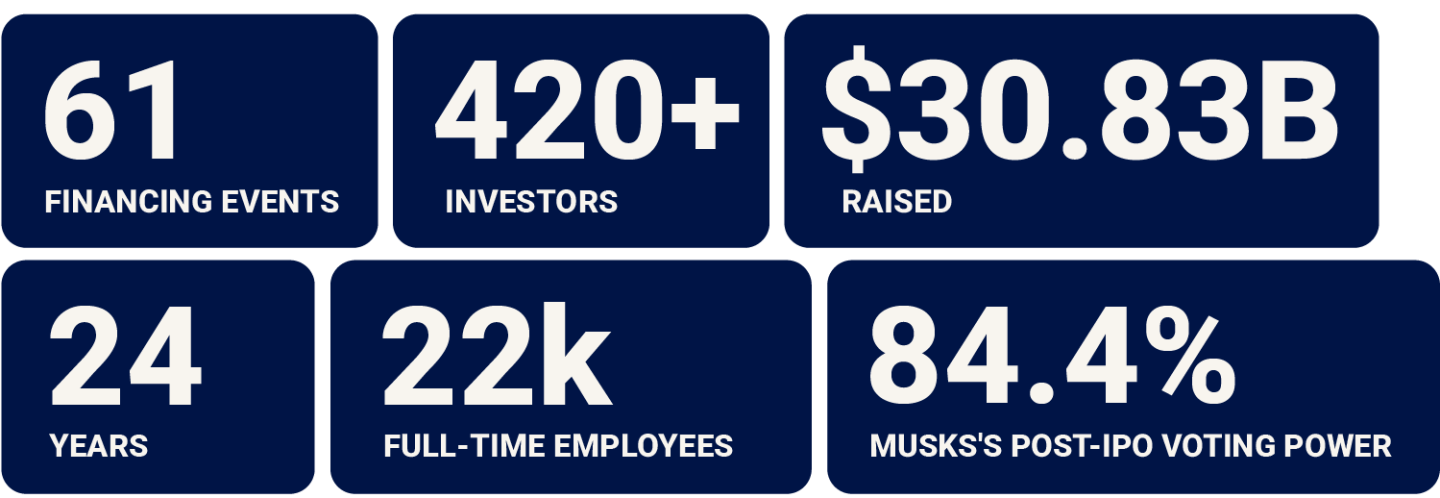
After 24 years as a private company, SpaceX became publicly traded on Friday. By the end of its first day, its stock price had settled at $160.95, bringing the company’s market capitalization to $2.11 trillion, between that of Amazon ($2.5 trillion) and Broadcom ($1.8 trillion).

At SpaceX’s IPO price of $135, Elon Musk‘s stake was worth approximately $866 billion. By the end of trading on Friday, the value of his stake jumped to $1.03 trillion.

Sign up for The Daily Pitch newsletter  Subscribe

Musk is, by far, the biggest beneficiary of the listing, making him the first trillionaire. And as the majority shareholder of SpaceX, Musk will continue to control more than 80% of the voting power.

Fund-returner? Try firm-returner

Some of Musk’s friends and early betters on SpaceX are also teed up for massive gains. The paper value of Valor Equity Partners’ stake, whose managing partner, Antonio Gracias, is a close confidant of Musk and helped him develop the initial idea for SpaceX, was valued at $81 billion at market close on Friday.

To put Valor’s gains into perspective, between SpaceX’s founding and 2021, Valor invested between $400 million and $500 million into the company, according to a trial testimony Gracias gave in 2021. Even without accounting for investments that Valor may have made since 2021, the firm is sitting on paper returns of a more than 100x multiple on invested capital. Moreover, Gracias also has significant personal holdings in SpaceX.

Founders Fund, the venture capital firm of close Musk ally Peter Thiel, is also set for major returns: at a $135 share price, its stake is worth over $50 billion. DFJ Growth, the late-stage arm of the firm formerly known as Draper Fisher Jurvetson, invested $800 million across multiple rounds, taking a more than 2% stake.

Sequoia, which first invested in 2019, has a stake worth more than $20 billion, and even Andreessen Horowitz, which led SpaceX’s Series K in early 2023, still holds a roughly $10 billion stake at a $135 share price, per Bloomberg. Investors in Cursor, which SpaceX is expected to acquire later this year, also benefit from the windfall: Thrive Capital, a major backer of Cursor and a direct investor in SpaceX, has a stake worth roughly $10 billion.

Here’s how all of SpaceX’s power players stack up:

For many investors, the SpaceX IPO is more than a liquidity event. Take Gracias: his firm’s stake is currently valued at more than the $59.3 billion in total assets under management that Valor Equity Partners reported this year.

The scale of SpaceX’s success means that those who “got in early” with the company are now on an unprecedented upward trajectory. Luke Nosek, for example, who invested in SpaceX first at Founders Fund and later at his own fund, GigaFund, held a personal stake in SpaceX at IPO at a value of $4.45 billion. The stake held by GigaFund, which first backed SpaceX in 2017 and ultimately invested more than $1 billion in the company, is almost certainly worth more.

SpaceX’s IPO will also be a liquidity event for thousands of employees across all ranks, potentially ushering more capital into next-generation startups in physical industries.

“It’s a catalyst,” said Vivin Hegde, an investor in physical industries and founding partner at Zacua Ventures. “The fight for talent just got a little bit more extreme.”

Watching and waiting

While massive, these figures are still pretty theoretical. Nearly all of SpaceX’s existing shareholders didn’t get to sell into the IPO, and won’t be able to for quite some time due to their lockups. The true test for LPs will be in SpaceX’s long-term performance.

Investors will be able to sell up to 20% of the restricted shares after the second-quarter earnings, with incremental sales scheduled between 70 and 135 days from the listing. Musk’s shares are even more restricted: under the terms of the listing, Musk will have to wait 366 days after the IPO before he can sell.

When to sell, and at what increments, will be an important decision for investors and their LPs.

Some LPs are already significantly concentrated in SpaceX. The University of North Carolina System has approximately 10% of its endowment tied up in SpaceX through its investment in Founders Fund vehicles, per the Wall Street Journal. Washington University in St Louis and Stanford University‘s endowments also have sizable holdings.

In such extreme cases, LPs may look to pare down this concentration now that it’s in a single public equity, according to Hilary Wiek, PitchBook’s principal analyst covering fund strategies. “Within a fund, they may have been at the mercy of the GP, but I would guess that LPs would be reluctant to hold that much, should they end up with shares in the company,” she said.

Once the lockups expire, these institutions will finally be free to rebalance their holdings. “LPs will likely be relieved to finally have the ability to get their portfolio back to more normal allocations,” said Wiek.

On the flip side, when SpaceX enters the Nasdaq-100 on July 7th, funds tracking the Nasdaq-100 will automatically buy a significant amount of the available stock.

As lock-ups expire for insiders, “it’s impossible to predict just how this supply and demand will shake out, and it is fair to expect it might affect volatility in the stock,” said Nicolas Owens, Morningstar’s equity analyst covering industrials.

Data visualization photo credits: Terence Lewis/Icon Sportswire via Getty Images, Scott Olson/Getty Images, David M. Benett/Getty Images for Netflix, Lluis GENE / AFP via Getty Images, Victor Decolongon/Getty Images

This article originally appeared on PitchBook News
Comments
You must be logged in to comment.