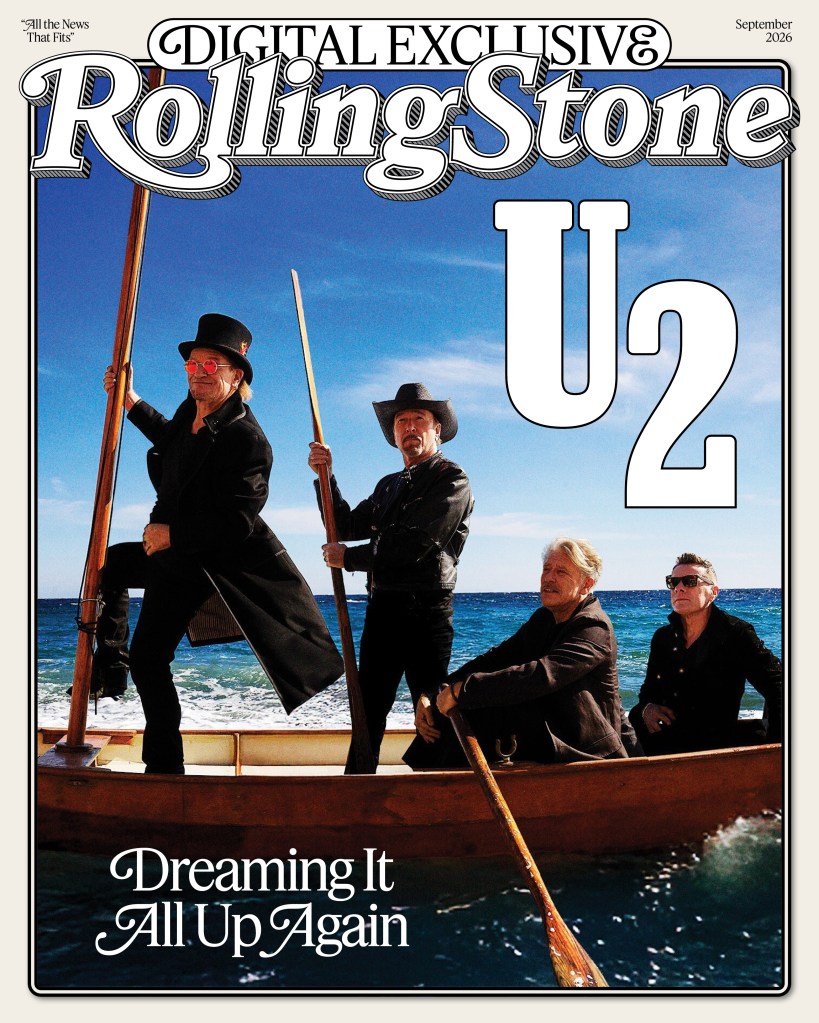
U2 Dream It All Up Again
The band goes very, very deep on how they got their swagger back on Carnaval De Luz, with help from Brian Eno, the late Dolly Parton, Rosalía, and Larry Mullen Jr.’s brave neck sur…
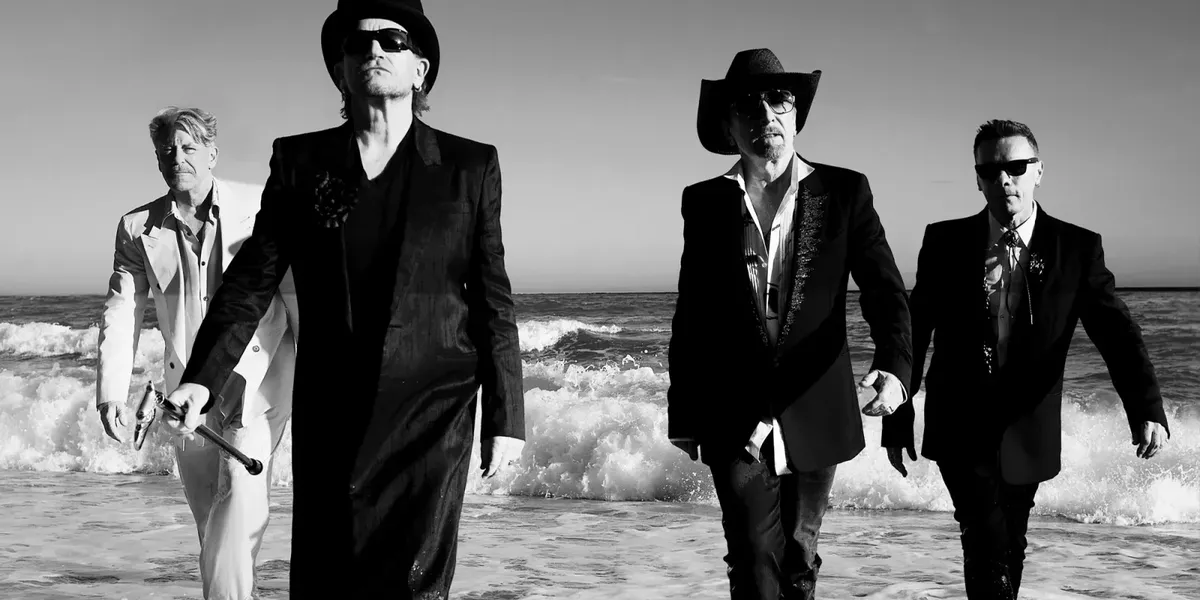
The band goes very, very deep on how they got their swagger back on Carnaval De Luz, with help from Brian Eno, the late Dolly Parton, Rosalía, and Larry Mullen Jr.’s brave neck surgeon
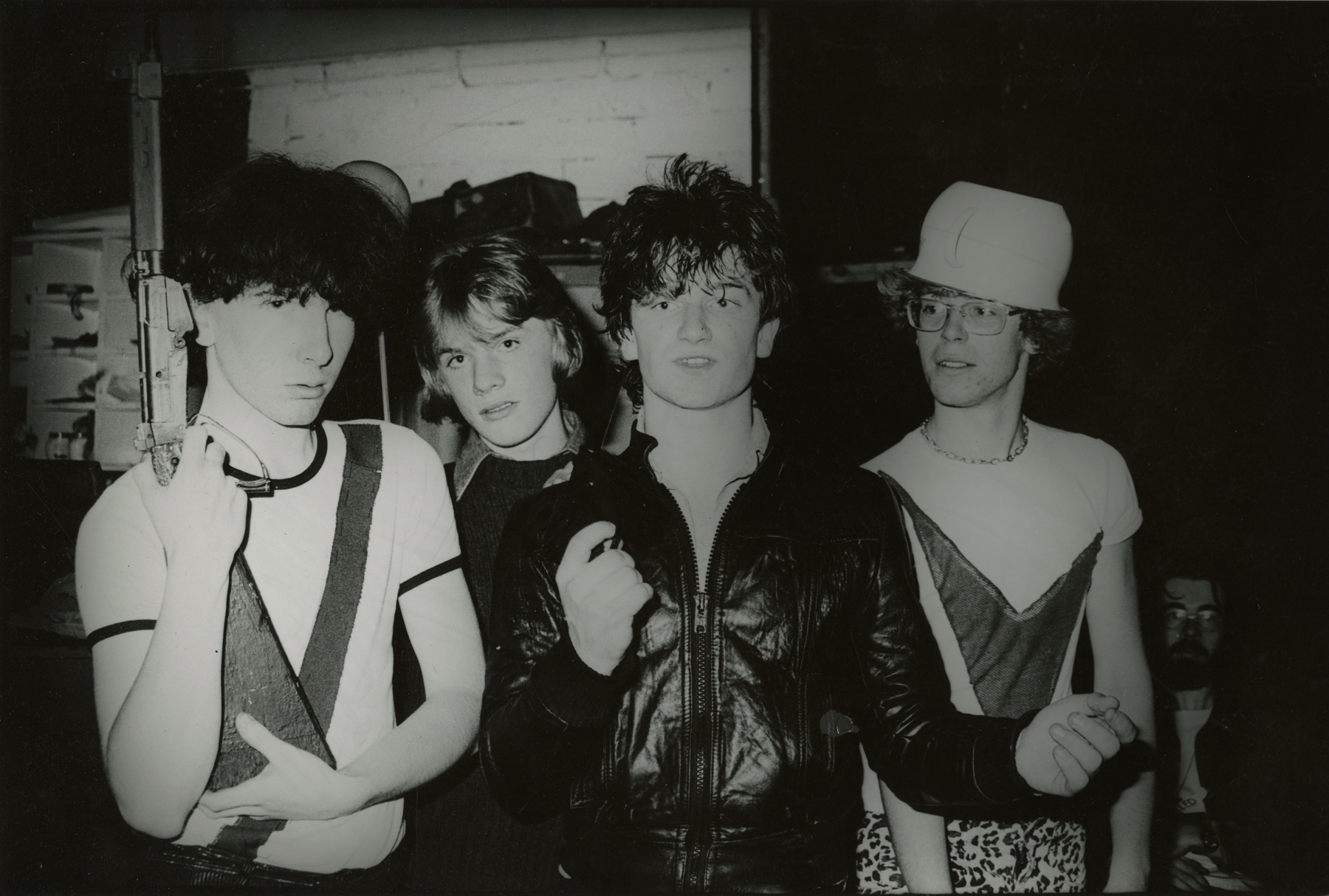
As of this afternoon, precisely 49 years and 342 days have passed since the four members of U2 first hung out together, and they still haven’t gotten sick of each other. Or maybe they have. “Look, it’s been 50 years of hell,” says Larry Mullen Jr., sitting with his three bandmates at an outdoor lunch table just a few feet from the Mediterranean’s pointillist pastels. He’s looking sleek, as usual, in a black polo and Wayfarers, his hair in its perpetual pompadour, shorn at the sides. “I mean, honestly, having to round these guys up, get them to go and do the songs — it’s been hard. And then when it comes to touring, OK, the stage sets and all that stuff, but sweet Jesus, the haircuts. And then having to watch them from behind. Honestly, it’s been hard.”
“The mullet phase must have been terrible,” the Edge says, once they all catch their breath from laughter.
“He only got the party at the back!” adds Bono.
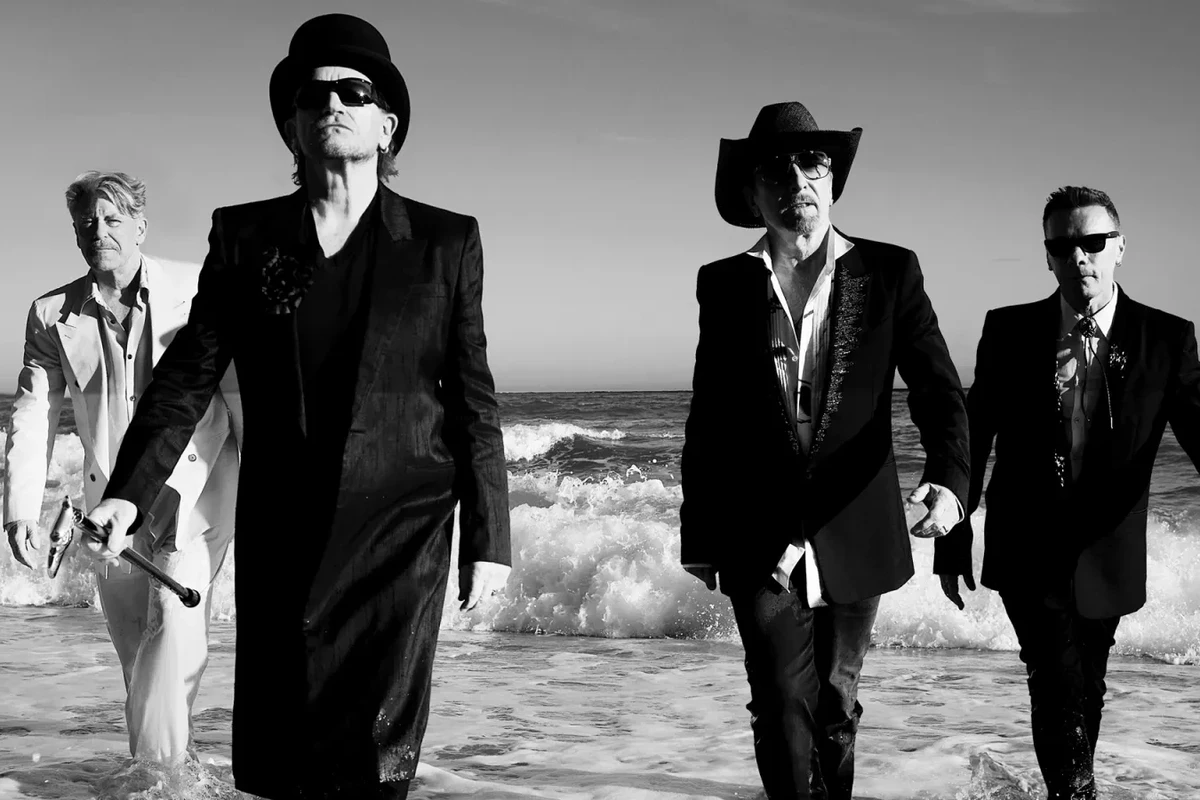
It’s a beautiful day, inevitably, here in early September on the French Riviera, a mere 900 miles or so from the band’s birthplace, Mullen’s childhood kitchen in Dublin. In three weeks, these four guys will celebrate U2’s 50th anniversary in the least retrospective manner possible, announcing their first album of new material in nine years, Carnaval De Luz, due Nov. 13. Its first single, “Street of Dreams,” turns out to have been something of a head fake, a soothing, status-quo-U2 moment on an album more inclined toward risk, ambition, and jagged energy. Its guiding theme is what the Edge calls “defiant joy” in dark times, hence the carnival setting, which brings with it way more Spanish-language lyrics than anyone might expect from a thoroughly Irish foursome.
“The record was made through, probably, the most disturbed period any of us have lived through,” says Bono, who’s begun to see the actual devil at work in the world these days. “Not personally, but globally.” He notes that a new documentary about Ukraine, Black Sunflowers, begins with a rave amid war’s devastation, and brings up the writer Dan Savage’s words on queer life during the AIDS crisis: “We buried our friends in the morning, we protested in the afternoon, and we danced all night…. It was the dance we were fighting for.”
“It’s not putting your head in the sand,” Bono continues. “It’s just saying, ‘These people can’t control our mood.’ We don’t even have to name them, because everyone has their own version of who that is.”
Summoning the spirit to make a great U2 album at this late date comes with its own brand of defiance. “The past and me have got to break up,” Bono sings on the opening track, the pleasantly jarring, Suicide-inspired, Brian Eno-assisted “Go (Carnaval De Luz),” offering a mission statement that echoes “I’m ready for what’s next” from “Zoo Station.” “More importantly,” the frontman adds at the table, piggybacking Bono-ishly onto his own line, “every time a band like U2 goes into the studio, you sort of have to break up and make up. It’s a hard thing to say, but I think part of it’s true. Or certainly there are pivotal albums where you know you have to start again.”
Stop him if you’ve heard that one before. At a Dublin concert the night before New Year’s Eve in 1989, he stood onstage in a black cowboy hat and told the crowd, “We have to go away and dream it all up again.” The band embarked on a spectacular leather-and-neon run in the decade that followed, only to fear they had drowned themselves out with electronics on 1997’s Pop (even if tracks like “Mofo” hold up). They returned to musicians-in-the-room basics with All That You Can’t Leave Behind, but not quite, because they had never before written songs quite so simple and soulful. Twenty-six years later, Carnaval De Luz feels like yet another starting point, at a moment when anyone not named Mick or Keith might reasonably be eyeing the finish line.
Their wellspring hasn’t changed. “Faith is at the very heart of this story called U2,” says Bono. Today’s hat, which he’s removed at the table, is a rustic straw model; today’s sunglasses are orange, reflective, and round-lensed, John Lennon-style. He’s wearing dark-gray linen from his head to his toes, which poke out of black leather sandals. Behind him, against the restaurant’s white fence, is a vaguely biblical lime tree. “Faith in each other, I suppose. Faith in ourselves, faith in our community that got us here. Faith that something bigger than us had a wind at our back.”
Still, the Edge went into the process with questions. He’s sitting to Bono’s right, and could almost pass for his bodyguard, his black baseball cap pulled low, gold chain draped over a black T-shirt. “‘Are we still relevant?'” the guitarist recalls asking. “‘Do we have anything to say that’s of interest to anybody?’ Whether we’re relevant or not is not up to us. But we can choose to try and be relevant, and that’s what we decided.” It wasn’t, he adds, “a burdensome thought. It was just more of a quickening. Like, gotta make this matter. And first to ourselves.”
Carnaval De Luz is of a piece with the two EPs the band released earlier this year, Days of Ash and Easter Lily. As an upcoming deluxe edition makes clear, the whole thing is essentially a double album built around the liturgical calendar, and meant to be listened to that way: Carnival, Lent, Easter. You could also hear it as an eternal cycle, since the final sounds on the Easter EP turn out to be the first notes of Carnaval. “Trying to ask a wearied world to follow the liturgical calendar might be a lot to ask,” Bono says with a smile, “even of our most fervent fans. But maybe not. It’s an art project.”
On a lyric from the second EP, Bono borrows the first half of the title of a book he loves, The Death and Resurrection Show: From Shaman to Superstar, which unearths the mythic roots of show business. If you’re in U2, of course, that’s the nature of the gig, complete with your own liturgical calendar. You keep re-creating yourself, sometimes wandering so far that you get lost. You may swing off to write songs about Spider-Man. But you always find your way home, never quite unchanged. You waver in and out of fashion, try to save a world that doesn’t seem to want to be saved, perhaps show up unbidden on a few hundred million phones, all while continually achieving transcendence and elevation in football stadiums. And you may need to learn the same lessons over and over again.
“It took us a long time to realize that the less you put into a recording, the better it sounds,” says Adam Clayton, who’s grown a rather dashing silver mustache. To match the carnival vibe, he’s chosen a tropical shirt by Casablanca, decorated with colorful graphics of boxers. “And actually, the sound of the band is good enough.”
“We’re slow learners,” says Mullen, who went through his own slow, private resurrection for this album, after suffering a neck injury that had doctors advising him to retire. “Very slow learners.”
IN EARLY JUNE, less than three months before her death, an ailing Dolly Parton made her way to a microphone and recorded the final vocal of her 70-year career. “Nothing hurts a mother more,” she sang, in a voice all the more commanding for its slight quaver, “than a family at war.” The song was “Torn,” a duet with Bono that became the final track on Carnaval De Luz. “When she got ill, she got out of her bed to sing this song,” says Bono. “And you can hear that. And I can’t even listen to it now.”
In the song’s closing moments, the Edge hears something older than country music in Parton’s voice. “It’s like keening at the end,” he says, “the Irish keening at the funeral. And she’s got that in her blood.” Her last words: “Every heart is torn.”
Bono had been pursuing Parton for months, initially for a still-in-progress Irish-roots side project. “There’s a courtship involved,” says Bono, who sent Parton bagpipes for her birthday. “There’s a chase. Dolly Parton is a sassy lady … Flirtation is part of her persona, and she doesn’t wanna grow out of it. And that’s one of the reasons I so admire her.” He played her a couple of sketches over the phone, including something called “Lifelong.” “She said, ‘That’s a little too Irish,'” he recalls.
“She wasn’t having any of it,” adds the album’s producer, Garret “Jacknife” Lee, who’s been working with U2 on and off since 2004’s How to Dismantle an Atomic Bomb. “Understandably, because the songs weren’t right.” He remembers Parton telling U2, in essence, “Yeah, I want to do a song. You just haven’t given me one that I can sing.”
So she sent one of her own, “Torn,” a tale of a woman trying to decide between two men. Bono heard potential in it, but he and Snow Patrol’s Johnny McDaid, a collaborator on the folk project, rewrote the lyrics around a mother agonizing over a divide between two sons. Bono considered retitling it “Civil War.” With his voice in the mix, he knows the song evokes divisions in Ireland, but it could be about Parton’s nation, or any number of other troubled lands. “You name the location,” Bono says, “but everyone knows what it is … People say in the U.S. now, people are scared to go into Thanksgiving.” At first, Bono wanted the track to veer toward “sci-fi folk,” a description that recalls Johnny Cash’s appearance on Zooropa, but Lee pulled him back toward a more grounded approach. “It’s Dolly Parton, and you don’t want to not have the people who love Dolly Parton listen to it,” the producer says. Daniel Lanois added pedal steel, and Mullen finished it off with an evocative, echoing drum track inspired by one of Lanois’ greatest productions, Bob Dylan’s “Most of the Time.”
It wasn’t easy for Bono to figure out how to sing alongside Parton’s performance, so he kept it understated. As he wrote to Parton, “‘I just got out of your way’…. I said, ‘What am I gonna do? I’m just gonna have to just talk, basically, and just let her do what she does.’ She sang her heart out, and I cannot believe that’s an 80-year-old woman.”
Much to the band’s relief, Parton approved the final mix. “Dolly loved it,” says Lee. “She was so proud of her vocal …We were very nervous that she would be uncomfortable with it, but she loved it.”
The Edge sees Parton representing “the radical center, which is becoming like a no-man’s-land right now … We have aspirations in that area ourselves, but things have got so polarized, it’s very, very hard to not be taken down by both sides … But she managed to get accepted by both sides and beloved by everyone. That’s an amazing thing. And she did it, as Bono pointed out today, with humor. Humor was her secret weapon. And no tyrant has a defense against humor, turns out.”
Another, very much living, female spirit presides over track four of Carnaval De Luz. It’s called “The Mirror Maker (Rosalía),” and it is, in fact, about the Spanish singer. “We normally just write songs about people in jail or dead people,” Bono says. “You know, dead heroes, or trying to get them out of jail. This is just celebrating somebody just because they’re an extraordinary artist.” Like most serious music fans, Bono is obsessed with Rosalía and her 2025 masterpiece, Lux, which beat him to many of the themes he was hoping to explore, down to the Lux/Luz/light title. “She’s arrived at the same point just before us, which is annoying and also really inspiring,” says Bono, who believes she shares a goal of “the re-enchantment of the world” via art.
The song, which kicks off with a massive, Pete Townshend-worthy acoustic guitar riff, began around 2017 as an Edge demo called “Kuti Rocker,” denoting a Fela Kuti influence. At various points it was also called “Delilah” and “Child of the Age.” “The version that we’re using on the album is the 196th version,” says Lee. “With completely different lyrics. That was a very difficult one to do, because it started off as a rock & roll song with electric guitars, and we just kept on trying to bring it back to Ziggy Stardust or something, the acoustic guitars…. Rock & roll can be quite masculine, and it’s off-putting when it’s too masculine. So you gotta have a bit of femininity, which is why I think Bowie works and T. Rex works … It’s just not cock rock.”
About halfway through those 196 versions, by Lee’s reckoning, the song acquired its subject. “Why are we singing about Rosalía?” Lee remembers the band asking. “How is it relevant?”
Bono’s answer goes back to The Death and Resurrection Show, which he first read in the Nineties. (“The ‘magic’ of showbiz is real magic,” author Rogan P. Taylor argues, linking performers to shamanism. “It draws its power from an immensely well-stocked religious bank.” The book also states that ancient shamans tended to lose a parent at a young age, which surely raised Bono’s eyebrows.) “We all have some narcissism to contend with,” Bono says. “Just the act of writing, or thinking somebody should be interested in your ideas — it’s very easy to get lost in the mirror there. Or just what’s reflected behind you as you look in the mirror, the world that’s behind you.” As he speaks, I catch a glimpse of myself in his sunglasses. “But there are artists who want to go through the mirror and see what’s on the other side of the mirror. Patti Smith was one for me when I was growing up. There’s many. Not enough … Certainly Rosalía is one of them. And it’s this idea that we’re body, soul, and spirit. This rather old-fashioned, quaint idea. And she approaches it with great courage and great self-effacing humor … There’s not just physics, there’s metaphysics.”
“It’s just a little embarrassing that she became so popular before we put out the song,” he adds. “But that doesn’t matter to me. Everyone knew about Martin Luther King too.”
He didn’t feel remotely comfortable releasing the song without the artist’s permission, so he reached out to a mutual friend, Penélope Cruz, in something of a panic. “I called Penélope: ‘What am I gonna do?'” he says. “‘Just call her’ … I’m like, ‘I look like a stalker.'” Rosalía, he says, was playful about it, and has “been really encouraging, and made me laugh a lot”; they’ve texted, and talked about their mutual fandom for the poet Federico García Lorca. He still hasn’t met her. “I sort of don’t think I could meet her now. I’m just working up courage to send her the final mix.”
The song starts out with Bono’s falsetto, “impersonating her soprano,” as he puts it. “The idea was to try and convince Rosalía to do it,” says Lee. “And then we realized, why would somebody sing on a song about them? Doesn’t make any sense. ‘Listen to me sing how great I am!’ I thought he sounded great doing it, so I thought, why would we replace it?”
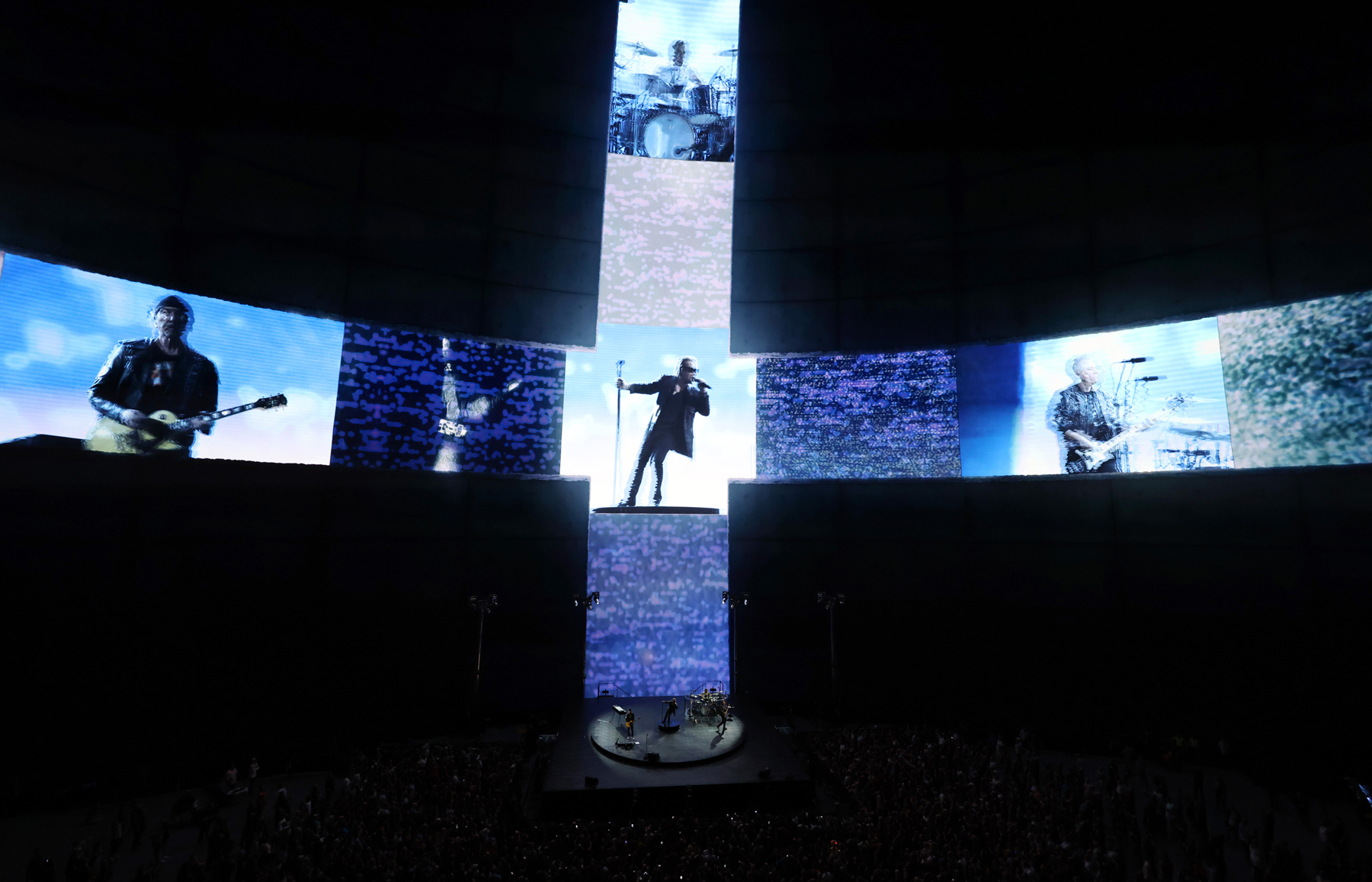
IN MARCH 2024, Larry Mullen Jr. attended his first U2 concert as a member of the audience. It was, at that point, entirely unclear whether he would ever be able to play again. For their 40-date run at the Sphere in Las Vegas, his bandmates recruited a substitute drummer, Bram van den Berg. Mullen waited until the 39th show to see them. “I just didn’t want to draw attention,” he says, but that wasn’t his only hesitation.
Mullen’s personality is as intense as his drumming; even when he’s cracking jokes, the sheer force of his eye contact can be intimidating. Lee admits he was once “afraid of Larry as an individual,” wondering if Mullen might punch him for some errant remark. That all changed this time around, with the two men staying late in the studio together for hours, trying out different percussive approaches on their own, something Mullen had never done before for any other album.
In his infirmity, Mullen turned all of that energy inward. “There’s a certain amount of humiliation when you get injured and you can’t get over it, and I felt humiliated,” he says, sitting at the same beachside lunch table the following afternoon, ready to talk in depth for the first time about his journey back to U2. “And it’s my own — that’s my own shit.”
The idea of suddenly standing outside a collective you had always been at the heart of seems nightmarish, but “it wasn’t as bad as you’d think,” says Mullen. “ The band were doing what the band needed to do. Those drum parts are mine, those parts that I played when I was a kid, a lot of them not really knowing what I was doing. And I was hearing those parts played very well by Bram, and I was grateful for that. It’s an odd thing to say, but I was. ‘Cause I had no sense of having been left behind. All those feelings were my own — they were personal feelings of humiliation. But they weren’t to do with the band. They were directed at myself.”
For years, Mullen was all too aware of a problem with his neck, a congenital fusion in a facet joint. He would’ve been fine if he wasn’t continually aggravating it by hitting things, hard, for a living. “If you don’t do my job, you wouldn’t really notice,” he says, “and I got away with it for years.” By the 2019 leg of U2’s Joshua Tree tour, that was starting to change. He was in pain, and the medical treatment he needed each night to be able to play was harming him in the long run. “By the time I came off the road, I was really in a bad way.”
He was exhausted after relentless years of touring, but still assumed he’d recover. “I just thought I always bounce back,” he says. “I always make it back…. I did need time away. I just would’ve preferred to have booked a flight somewhere as opposed to booking the trolley in the hospital.” When Covid arrived, Mullen stopped playing altogether. “I wasn’t playing drums in the bunker, ’cause it was too sore. It was through COVID that I realized that I was physically damaged beyond repair… I shut down, everybody had, and my body just went, ‘You’ve had enough.'”
Even so, Mullen initially agreed to the Sphere residency when it first came up, circa 2022. “ I signed up to do it,” he says. “And then a couple of weeks later my physio said to me, ‘You won’t make it through rehearsals. So you need to undo that,’ which was very difficult, very complicated to undo it, ’cause I’d made a commitment.”
He had no issue with his bandmates continuing without him. “I absolutely understood,” he says. “Business is business, and nothing can get in the way of the process, and I accept that 100 percent. So the unspoken rule” — that a band member could be replaced onstage — “applied to me in that case. It could apply to somebody else in another case. And that’s the cost of doing business. It is complicated being friends, being friendly, being in business. So yeah, we all have feelings. So I’m not gonna lie that it wasn’t difficult, but nobody imposed it.”
Watching U2 play without him, he did think about musicians who’d been swapped out of bands “at a singer’s whim.” “I thought about … how that must feel,” he says. “I didn’t have that feeling.”
Around the start of the Sphere run, Mullen joined his bandmates in the studio to record the one-off single “Atomic City” and appear in a music video. “We were at that point of not knowing if this was the last time he would play with us,” says Clayton. Bassists and drummers share a unique link, and Clayton sees his relationship with Mullen almost as a marriage. Playing with a different drummer “felt very promiscuous,” he says, as much as he admired van den Berg’s musicianship.
The band’s future felt uncertain. “We didn’t know if Larry was gonna come back,” Clayton says. “Could we keep going? Would we wanna keep going? That’s still an open question.” But the Edge says Carnaval De Luz only exists because Mullen did return. “I don’t think we would’ve made an album if Larry hadn’t been able to play,” he says. “We would’ve just gone, ‘Why? Why make an album without Larry Mullen on it? Doesn’t feel right.'”
BACK AT THE LUNCH TABLE, the members of U2 are sharing some of the whole grilled fish Clayton ordered, and talking, at startling length, about progressive rock. Bono has for years presented prog-rock, or a vague caricature of it, as a musical boogeyman that represents everything U2 were trying to avoid. In his mind, it was less an actual genre that veers from greatness (King Crimson, Rush) to ridiculousness (Tales From Topographic Oceans, Rick Wakeman’s infamous Camelot-on-ice thing) than a shorthand: atmosphere, pretension, and self-indulgence over hooks and immediacy.
“We grew up on the rock & roll 45,” he told me in 2009. “It is by far the most difficult thing to pull off, and it is the very life force of rock & roll: vitality, succinctness, and catchiness, whether it’s the Sex Pistols, Nirvana, the Pixies, the Beatles, the Who, the Rolling Stones … And when rock music forgets about the 45, it tends toward progressive rock, which is like a mold that grows on old, burnt-out artists who’ve run out of ideas. We have a soundtrack/Pink Floyd side of our band, and it has to be balanced by fine songwriting.” Later, Bono decided that the very album U2 were making while we had that discussion, No Line on the Horizon, suffered from a prog infestation. He sent the band back to what he’s described as “songwriting school” for its next two albums, 2014’s Songs of Innocence and 2017’s Songs of Experience.
The Edge, as it turns out, actually likes prog, particularly Yes, a band he worshipped to the point of writing their name on his jeans in high school. And Bono has something to tell him. He’s talking about how much U2 owe their producers, which brings him to Brian Eno. During the making of The Unforgettable Fire, Eno insisted the band listen to Donna Summer’s masterful, Quincy Jones-produced “State of Independence” on repeat until it “turned into a prayer, which is what it really is,” Bono says. The song took up residence in the singer’s head for the next 40 years, but he only recently went online and learned that former Yes lead singer Jon Anderson co-wrote it.
So Bono listened to some Yes songs, for the first time in his life. In Steve Howe’s chiming guitar harmonics, he recognized a kindred spirit to the Edge, another player determined to avoid rock’s blues cliches. Then Bono was reminded of the title of the band’s fifth album. “It’s Close to the Edge,” he says. “The Edge’s name comes out of this moment that I’ve been fighting with!” (At the table, the Edge doesn’t dispute this assertion, but he’s previously cast doubt on this version of his nickname’s origin story.)
Bono turns to the Edge. “I owed you an apology,” he says, citing “my long-held, and probably hurtful, campaign to accuse you and others of suffering from a lurgy” — a Britishism for malady — “called progressive rock on your worst moments.”The Edge grins, his neat, dark goatee crinkling. “I just wanted to point out that Bono is totally pro prog-rock when it suits him,” he says, citing the chords and arrangement of “The Tears of Things,” from Days of Ash, as “progressive rock in its best iteration.” He also reveals that Bono wrote an alternate intro to the new album’s opening track that’s “heavily influenced by Yes.”
(Mullen, for what it’s worth, sees all his roots in glam rock, and the closest he’ll come to prog is Blind Faith’s only album. As for Clayton: “I didn’t seek out music played by men in tights,” he says. “I knew there was nothing there for me.” That said, he is a Tool fan.)
The whole discussion was less of a wild digression than it seemed. Part of the excitement of U2’s newest music is that it’s slipped the bonds of the 45. Easter Lily ends with the striking, hypnotic track “Coexist (I Will Bless the Lord at All Times?),” which happens to be nearly seven minutes long. It began as some gently pulsing synth chords from Eno in a file he’d labeled “Melancholic Space Grandeur.” Bono improvised over it, taking some inspiration from “State of Independence.” This song, too, is a prayer. The original version ran for 17 minutes, and Bono seriously considered putting it out that way. Lee convinced him to pull back: “I was going, ‘It’s very good, but people will only ever listen to it once.'”
There are plenty of pop hooks on the new album, from the downright sexy “Glorify” (“As the heavens fall/Baby don’t we all?”) to the rollicking “La Reina” (“Let’s hear it one more time/For the face of the future”) to the falsetto earworm of “Superficiality” (“Freedom is a feeling/It’s a feeling that I have around you”). But Bono acknowledges that after Songs of Experience, he’s finally let go of the idea that U2 could still have a chart-dominating smash. “I guess when the pop charts get fed up with you, you defend yourself by saying, ‘Oh, I wasn’t really interested in them in the first place,'” he says. “When you know that’s not true … I wanted to hear our songs on the radio. Nothing still thrills me more … When there was a shot at that, I really wanted to carve a perfect pop song. I really did. Nearly got there, but didn’t quite get there. Met some incredible people, learned from them but could not distill it into that one song. The one. Just couldn’t.”
“Now,” he says, “the song is its own reward.” Whatever happens with the new album, he adds, “I’m not holding it against the songs. It’s just the moment we’re in … It’s just for the few, not for the many.” He remembers reading a late-period Bob Dylan interview where the bard accepted that his music wasn’t for the masses anymore, and said he’d simply double down on being himself. “No one’s better at being Bob Dylan than Bob Dylan,” Bono says. “No one’s better at being in U2 than Edge, Adam, Larry, and me. They might want to be in U2, but we’re actually not bad at it.”
All that said, the band is trying to come up with a radio edit of Bono’s favorite new track, the five-and-a-half-minute “The Greatest Show on Earth.” “It’s maybe our greatest song in a very long time,” he says. “That was a reason to stay in the band.” The slow-burning, IMAX-sized epic takes on a shattered love affair, with some shots at Christian nationalism along the way (“Is this a church of love or fear?/Have we made God feel like a stranger here?”). It aims to capture some of the ecstatic, crooning heartbreak of “You’ve Lost That Lovin’ Feelin’,” with a hint of Bertolt Brecht: “Love is a business that works at night/I sold myself for less than was right.” Bono had the title for a long time, but catching Elvis Presley sing “Lovin’ Feelin'” in his friend Baz Luhrmann’s recent concert film helped him crack the elegiac concept for the song: “We were once the greatest show on earth.” “There may be,” he says, unable to help himself, “a version of it that we can get on the radio.”
Mullen and Clayton are just glad that the band changed its ways from the Innocence/Experience period, when they would ping-pong songs between wildly different producers and co-writers. “It was very hard when we had so many producers involved,” Mullen says. “So what is the band? What does the band do? How does it function? … I didn’t know what I was meant to be doing. So the studio environment was sit back and watch. I’m not used to sitting back.”
During that period, Clayton adds, “the sound of the band got very cloudy, got very muddy. You know, keyboard overdubs and what have you. And this was very definitely a record based on wanting the band to sound like they’re in a room playing together.” It’s also full of huge, song-propelling bass lines. Clayton is quick to credit the Edge with composing some of them, but the guitarist throws the praise back at him. “The thing I always know is when Adam plays, it’s a different thing altogether,” says the Edge. “So I might throw an idea at him, but it’s amazing how, when Adam and Larry play, everything goes up 50 percent just in terms of the depth and intensity and personality.”
Lee, who worked on the last two albums, watched songs get passed among far-flung collaborators until “you end up with these kind of Frankenstein monsters, and bits of things, and they don’t add up to much.” He doesn’t exempt himself. “I, shamefully, didn’t understand the power of Larry and Adam,” he says.
The Edge thinks the band overcorrected twice. No Line, he argues, is where the band “lost sight of songwriting as a discipline.” On the next two albums, they “almost came the exact amount off the path in the opposite direction,” ending up “a little too technical … a little too precise.” This time around, “nothing was sacred. Nothing was finished till it was finished.” But he still loves the last two albums. “I think it came at a moment where U2 were maybe not as in vogue as we had been, so some of the work possibly has been slightly overlooked,” he says.
Mullen now realizes that all of that creative struggle, however frustrating, had a purpose. “The contrarian in me would go, ‘Told you, we don’t have to work that hard,'” he says. “The problem is that’s not correct. The correct thing is you have to push and take the risk to get to the other side.” The lesson, as he sees it, is less about songcraft than about identity. “U2 can’t be like everybody else. We just can’t. We don’t have the skills to do that. We always will be and have to be outliers … The circuitous route to this record is just that. It’s the recognition that the band is not malleable in the way that maybe we would have hoped … It took a lot to get to this place. And it’s a recognition of 50 years.”
AT ONE POINT DURING the sessions, Barack Obama came around, and why wouldn’t he? “We were having a good time, just talking about music and Kendrick Lamar and lots of films,” says Lee. “He’s got good taste.” Bono played the former president an in-progress song, “The Tears of Things.” “A lot of times he’s not looking for somebody’s take on it,” Lee adds. “He’s looking at how they feel when it’s being played, and you can tell when a line doesn’t land.” Obama had more than a take; he had notes. “He pointed something out to Bono about the halfway pivot,” Lee says. “He had an observation that was valid. He’s very good.”
The song is, to say the least, a big swing, Bono’s elliptical take on the thousands of years that led up to Gaza, with an empathetic look at the history of the Jewish people, all narrated simultaneously by the biblical David and the statue Michelangelo made of him. By the end, he’s pleading, “Everybody is my people/Let my people go,” and wondering, “Who would choose to be chosen?”
“It’s an attempt to try and grasp what’s going on in a world where we never needed the moral force of Judaism more than now,” Bono says. “And yet, what is happening?” Not for the first time, he condemns Hamas’ Oct. 7 attack, calling it “an unholy offense.” But he’s particularly horrified by the words of Itamar Ben-Gvir, Israel’s far-right minister of national security, comparing his rhetoric about Gaza — “there are people there who are not worthy of life. They shouldn’t live. They’re not even people” — to Himmler.
“As a person who has stood by Israel,” Bono says, “and standing by Israel — as I stand with the Palestinian people, by the way, that they have a Palestine — there’s all this semantic back and forth over genocide, and it’s a legal term, and the ICC and the ICJ will rule on it eventually. But here’s a guy, a minister in the government, and he’s not being locked up … and this guy Netanyahu says, ‘Well, I need him to keep my majority.'” He shakes his head. “So many of the people that have expanded my mind, changed my consciousness, made me laugh, broken my heart with their songs, lifted my spirits, are Jewish. And this guy’s putting their religion in the shade … It’s just outrageous.” Israel, he adds, has “to fix the situation. They have to put what happened at the Nakba right, by making some compromise that some of these people don’t wanna make, and do the just thing. Justice is at the heart of Judaism.”
“The quietness of ‘Tears of Things’ is boiling rage,” Bono concludes. It was also a powerful song that didn’t seem to belong on the album they wanted to make, and it wasn’t alone. U2 had, by Clayton’s count, “25, 30, 35, 40 pieces that were being worked on, that were being considered, and it just seemed like an awful lot to fit through the gate.” The band members were targeting the Carnival-Lent-Easter cycle early on, but initially thought of it as somehow all working on the same album.
Early this year, they changed their minds. “Amongst the body of work we had was stuff that really just didn’t fit in the countervailing, joyful, carnival, celebration-of-the-physical-self idea,” says the Edge. “So I said, ‘Let’s just put out a few songs now. We’ve got these songs finished that probably won’t see the light of day, and they make sense.’ Then Bono says, ‘Yeah, they make sense around this part of the calendar.'” Ash Wednesday was weeks away. “It makes perfect sense. Let’s do it. I thought one or two songs. He’s like, ‘No, let’s do, like, six.'”
Lee was about to go home to his family for some time off. Instead, he and the band began working with nearly crazed intensity. “You think, ‘Oh, this could be a terrible idea.’ Because it’s so disruptive, and we only have a few days to get this done, and we haven’t written two songs. So this is a lot of jeopardy here, and we really have to start doing 18-hour days, seven days a week, for the next two weeks to get it done.”The Edge started the music for “American Obituary,” which mourns the death of Renée Good at the hands of an ICE agent, only four weeks before it came out. Before Bono finished the lyrics, he arranged a Zoom call with three generations of Good’s family, “the best people you could ever meet.” “As chief lyricist, I just wanted to make sure people were OK with it,” he says. “And the father, when I got to the bit about ‘America will rise against the people of the lie,’ he asked me where that came from. I said, ‘It’s a book that Edge gave me, by M. Scott Peck, back in the Eighties.'” Good’s dad pointed to the same book on his shelf. “And what was so extraordinary about these people was they were trying to make me feel at ease.” Good’s partner told Bono she prays for the ICE officer who shot Good, which inspired his lyric “I love you more than hate loves war.”
They released the Days of Ash EP with no advance word and zero fuss, essentially just slipping it onto streaming services. It was the precise opposite of dropping an album onto every iPhone in the world. ”We’d had a very big accident a few years ago,” Clayton says with a smile. “And we didn’t wanna repeat that mistake. We liked the idea of putting them out in a way that didn’t make people think that this was a substitute album.”
“We’re hiding our new album,” Bono says. “I was surprised everyone went with it.”
They had barely recovered when the frontman suggested a second EP for Easter. The scramble began anew. “Another kind of emergency happens,” says Lee. “And then we go, ‘We can’t do it again.’ But I think we did, and I think potentially better. When everyone’s pulling in the same direction, it can be a very powerful thing, especially with U2, because Bono’s like a juggernaut when he gets this energy.”
Lately, more than ever, Bono’s been thinking about evil. He was struck by Simon McBurney’s recent stage adaptation of The Master and Margarita (the book that inspired Mick Jagger to write “Sympathy for the Devil”), where Satan thrives in a Moscow where no one believes in his existence. “Whatever it is, you call it whatever you want. I don’t know what it is,” Bono says. “But something entered the air. Everything that you and I hold sacred — because we probably would’ve gone to the same concerts, we might have argued over Rush, but not really — most of what you hold sacred is under threat.”
The devil, “a thief at large in a carnival of souls,” is also a character in the album’s fiercest song, which just dropped as a single. After the EPs, the band members suddenly realized that they had used up some album tracks and needed more. One of the final tracks they created was “Silencio.” Lee was worried that the album was “potentially a little low-key,” and the Edge dug out a nasty, fire-breathing guitar riff he had left over from the Songs of Innocence era. “We genuinely were like, ‘We need something of that energy,'” the Edge says. “And everyone just went, ‘Wow, let’s work on it.’ And it came through really quickly.”
“In the silence,” Bono sings, “the devil rock and rolls.” But the lyrics distinguish between two kinds of silence. “There’s a beautiful silence, which is, you know, when you’re in that reflective place — nothing wrong with that,” says the Edge. “But there’s the other form of silence, which is a kind of censorship, self-censorship, which is where things can get very dangerous.”
“You would know the essay by Hannah Arendt on the banality of evil,” Bono says. “So in the silence, that is it. That’s literally what that’s about.”
ONCE HE BACKED OUT of the Sphere, Mullen became determined to pursue surgery on his neck. But doctors wouldn’t even discuss it with him, let alone agree to perform it. There was no guarantee the surgery would work, but that was the least of it. There was a small but real chance that it could leave Mullen paralyzed. “People don’t want to take a risk,” he says. “Most people were, ‘You know what? You’ve done incredibly well. Just retire. Sail off into the sunset. Why would you do this to yourself?'” Mullen’s family was against the idea, as well. I ask how he responded to them, and he shrugs: “Override it.”
Call it heroic, or foolish, or the most extreme of the band’s many leaps of faith, but Larry Mullen Jr. was willing to take the chance. That’s how much U2 means to him. “There wasn’t a moment that I questioned, bizarrely,” he says. “This is somebody who thinks things through. If you’ve got the head and the heart, I’m a head guy. I’ll do the calculation, the logic. But my desire to play again overwrote that…. It’s only when you are faced with the possibility that you may not be able to do the thing that you love, that you’ve done for most of your life… It’s funny what your brain will do, and your body. It goes into a different mode.”
Eventually, a young neurosurgeon in Dublin agreed to perform the operation. Mullen was grateful, though taken aback when she told him she’d take the risk on the grounds that he was “a national treasure.” “I thought, ‘Shit, OK. It’s really all going wrong now,'” he says. “‘Might be an out-of-work national treasure.'”
The surgery went well, and after three or four months, Mullen sat down at a drum kit. “And I realized that I was playing differently,” he says. “Everything was different. My body didn’t work the same way as it used to.” He knew drummers like Max Weinberg had sought out lessons after injuries to reshape their technique, but couldn’t imagine taking that path. His only drum teacher, a Dublin jazz player, briefly tried to show a young Mullen how to play like the virtuoso Steve Gadd. It didn’t work. “I think I broke the man,” he says. “I’m unteachable.”
Instead, he went back to basics, returning to the “most efficient” way of playing everything. “Over the years, you get ahead of yourself,” he says. “All you need is a neck injury to bring you back to that place. Because now you don’t have all those things you learned, all those little flicky-dee-dos, all the little skills. You now can’t rely on those.”
When he felt ready, he texted his bandmates. (Oddly, there’s no full-band U2 group chat. “ We haven’t done that yet,” Mullen says. “Definitely should get one of them.”) They gathered for a session in their friend Julian Lennon’s studio, not far from the vacation house Bono and the Edge own here in the South of France. “I sat behind the drum kit,” Mullen recalls. “Literally, it was like I got into a car, and I just put it in first gear. And I just started to drive … I haven’t played for a few years. I don’t know if it still happens, that creative thing. Has that died in me? I didn’t know.” He threw everything he had at the track. “And I looked into the studio, and I could see the band kind of going, ‘OK, that’s not what we expected.’ And I’m going, ‘Not for me either.'”
A second session there yielded “Street of Dreams,” with the version on the album ending up as “pretty much what we played together,” according to Clayton. “So it was a very positive first step,” he says.
“Once we got Larry in the room, it really all started to make sense,” says the Edge. “All my questions and insecurities, everything started to just fall into place.”
“I certainly was very aware from the first sessions with Larry back that he was playing differently,” Bono says. “With more authority, if that makes sense to you. But it was playful. Very playful.”
On Days of Ash, a drum performance or two was swapped out for a drum machine. “In the past, I might have said, ‘Shit,'” Mullen says. “This time I went, ‘That really worked. That was the right thing to do.’ … I don’t need to be on everything.”
“Old Larry would’ve been more of a veto merchant,” says Clayton. “This new Larry … he’s much softer. He’s much gentler. He’s much more respectful of other people’s commitment to something.”
“I’m working on the positive ‘no,'” Mullen jokes, but he knows the old role had its risks. “The contrarian can get miscast as a villain, and I felt that. I felt I was always walking the plank. I think people have roles … You’re the guy, the Bono character, who wants to push it: ‘This is how it’s going to be.’ You need some of that. And I recognize that now. That without that, there’s no need for a contrarian or a peacemaker or an aesthetic guy.”
The band is planning an as-yet-unannounced stadium tour, and they just began rehearsals, with Mullen playing the old songs for the first time since the surgery. Clayton thinks Mullen is approaching them differently, but that may be nothing new. Before attempting “Pride (In the Name of Love),” the drummer compared the studio version to various live performances, only to realize that it was never quite the same from year to year. Then, when he listened back to a recording of the recent rehearsals, he “was pleasantly surprised that it wasn’t sounding old.”
He isn’t sure how long he can play each night on tour, or how he’ll hold up. “Even if I can’t play for two and a half hours, if I can play for an hour, that’s enough,” he says. “I’ve had it so good that I’ll accept that.”
“I just pray that we are all well,” Bono says. “And that Larry, of all of us, keeps hold of his fitness.”
THE MORNING AFTER the group lunch, the Edge was already working on another new song. “It’s sort of what I do,” he says with a shrug. “When I play guitar, I’m just seeing where the chords will take me, and I’m going, ‘This could be a song.’ Not necessarily, ‘Can I do my scales?’ That doesn’t interest me so much.” He’s sitting under an umbrella on the terrace of the spectacular summer home he shares with Bono, not far from the restaurant. He’s chosen a gray T-shirt today, with the same black baseball cap and chain. Terracotta tiles are at his feet; behind him is a gnarled pine tree, arching toward the sea.
Today’s song-in-progress has a lot of company in his archives. His phone holds over 11,000 voice memos, many of them musical ideas. ”It’s actually a bit of a challenge to keep tabs on the really promising ones,” he says, “but it’s funny how most of the time you do remember them — or remember to keep them.”
Collectively, U2 are sitting on a trove of music that’s far closer to completion. Even with all the released tracks, there are still Carnaval outtakes they loved, including “Get Back to Now,” with lyrics inspired by time Bono spent in Hanoi. Lee describes the Edge maintaining two whiteboards during recording sessions, one for the project at hand, and another listing “another five albums, and you’re going, ‘Let’s just finish this one first!’ … There could be an acoustic record, there could be an electronic record … There’s always songs coming.” On his computer, the Edge says he has “about eight folders of different projects or side projects,” including one labeled Songs of Ascent, the reflective, acoustic album the band has been teasing since Bono first told me about it in 2009. “There are a bunch of songs in there that we definitely could resurrect,” the Edge says.
Near the beginning of this album process, Bono and the Edge spent five days with Brian Eno in a one-room demo studio in Enniskerry, south of Dublin, with Lee engineering. They came out with 40 pieces of music, which sparked three songs on Carnaval, as well as “Coexist” from Easter Lily. “It was just really wild,” says Lee. “Brian works very quickly, or arguably not at all. He just appears and then you get something.”
The original idea was to resurrect their side project with Eno, which produced a single album in 1995. “We talked about it as a Passengers album,” the Edge says. “But we weren’t sure where it would end up. We felt Brian would really like it if these pieces ended up on a U2 album, which he turned out to be delighted about.” He and Bono still expect to release the rest of the Eno music in some form (the singer is particularly excited about a track known as “The Clapping Song”), and the acoustic Celtic side project as well.
But when it comes to the top-secret stadium tour they’re planning, they already have too much music. The Edge has “about 11” new songs from both the album and the EPs in his planned set list. Bono is more wary of overemphasizing the new material in stadiums, and he hints at a vague idea of setting up separate, smaller venues on the road where they could spotlight it — “a way of meeting our fans in the city in another teatro, which I can’t tell you about either.” Mullen, in turn, thinks the teatro thing is “great in theory. The practice might be a little harder to pull off.” They have a good sense of a unique concept for the stage design, and Bono even knows what he’d like the opening song to be.
In 2010, Clayton told me he had trouble picturing himself playing rock past age 65. He’s 66 now, and at his own holiday house, a striking ultra-modern structure built from scratch a few miles away along the coast, he says he’s still thinking about age and limitations. “I feel like I’ve been blessed with tremendous good health,” he says. “But you look at the passing of Dolly recently at the age of 80 — and when this cycle is finished, I’m probably gonna be 70. That time of good health is valuable. It’s probably the most valuable time you have in your life.”
I mention the obvious point that the Rolling Stones are still going in their eighties. “I think these people are an aberration within the blip of the music business,” he says. “There’s a certain Peter Pan-ness to Jagger and what the Stones do. I don’t think we convey the same thing. I think we ultimately are more age-appropriate. And I mean that in the nicest possible way.” Lately, he says, he and many of his friends have been thinking about “downscaling. We’ve all had these busy lives with lots of stuff. Now it feels like it’s the time to shed.”
So can Clayton picture U2 playing in their eighties? “Well, you can’t say never … Perhaps we’re all playing things differently. And because of the chemistry and the history of those 50-odd years, we’ll move and adapt to that. Do I imagine this is something we would be doing in our 80s? I don’t know. I don’t know.”
The Edge has no such doubts. “I don’t see why not,” he says. “I’d make the distinction between age and biological age.” He smiles when he learns of Clayton’s hesitation. “I think Adam always considered himself a young old person,” he says. “And I always now think of myself as an old young person … That’s the dangerous thing about this band. Our next song, our next album could be our best ever, and we sense that.”
Mullen, again, is in no mood to be a contrarian. “After this record, and the experience of it, I think it’d be something to look forward to,” he says. “I think it will be an amazing thing to have that in your sights: that we will always, no matter what the circumstances are, come together somewhere and build the church … I think we’ve all grown, and we’ve all changed, and we all now understand something that we didn’t understand before, and that was that there is real value to U2 in its original form. It’s worth fighting for. And it’s also worth compromising for.”Our conversation is winding down, but Mullen has a question of his own. “So, did Bono say any nice things about me?”
He did.
“OK, that’s good,” Mullen says, and smiles. “I was just checking.”
Tegan and Sara, Felix Cartal and Lights star in the video for ''Our Year''
Canadian sister duo Tegan & Sara are back with new music. Today, the day of their birthday, the twins released “Our Year,” their first new single since 2022’s Crybaby. The single is a collaboration with fellow Canadian artist Lights and Vancouver producer Felix Cartal.
The track started as an early demo that Tegan Quin sent to Cartal, who was drawn to its combination of humour and more candid observations. “Our dream was to get Lights on the record,” Tegan says in a statement. “When she agreed to get involved, I felt immediately that we were making something special.”
A longtime fan of Tegan and Sara, Lights also has a longstanding creative relationship with Cartal.
The song itself doubles as a love letter to Vancouver and a tongue-in-cheek take on the realities of the current economy. Beneath the jokes about money and the frustrations of trying to get ahead, “Our Year” is ultimately about starting over, accepting that plans can fall apart and continuing to move forward anyway.
“We wanted to share a tongue in cheek approach to more or less bitching about the economy while still celebrating that we made it this far,” Lights says, “and that there’s always hope to keep striving for.”
The accompanying video was filmed in Vancouver and arrives alongside the single.
Tegan and Sara will also join Hilary Duff for select dates of Duff’s 2027 the lucky me tour throughout the USA.
It’s been 25 years since Britney Spears stormed the VMAs stage with a snake on her shoulder to perform “I’m a Slave 4 U,” but new Spotify data shows a majority of the track’s listeners weren’t even born when the song came out.
While millennials grew up with Spears, Spotify says the majority of recent streams for “Slave 4 U” were from Gen Z listeners — e.g. those born between 1997 to 2012. More than 55 percent of global streams in the past month came from the cohort. Perhaps more surprisingly, Spotify tells Rolling Stone that 27 percent of streams for the track were from listeners who were born in the years after Spears debuted the song on MTV.
What’s more, Spotify says there have been over 40 million “discoveries” of Spears’ catalog on the streaming platform this year, denoting people who are streaming her songs for the first time or “re-streaming” for the first time in six months or more. Sixty percent of these “discoveries” have come from Gen Z listeners.
The data shows the continued staying power of “I’m a Slave 4 U,” which was produced by the Neptunes and marked a departure from Spears’ heavily-produced teen pop sounds on previous releases. Spotify says streams of the single spike each year around this time to celebrate the song’s anniversary, and they are likely to spike again ahead of the 2026 MTV Video Music Awards this weekend.
“Slave 4 U” was the first single from Spears’ third studio album, Britney, which celebrates its 25th anniversary this October. Spears became the first female artist to have her first three studio albums debut atop the Billboard 200 chart when Britney hit number one. The album has gone on to sell more than 10 million copies worldwide.
Québec superstar Céline Dion has teamed up with French electronic duo Bon Entendeur for a new remix of “Bonjour, Pardon, Merci,” out now. The release comes on the same day Dion returns to the Plénitude Arena in Paris for another performance in her massive comeback residency.
Dion launched the 26-show Paris engagement on September 12, marking her first full concert in more than six years. The opening night drew roughly 30,000 fans and was an emotional milestone in the singer’s return to live performance. The residency currently runs through October, with additional performances scheduled for May 2027.
According to the Bon Entendeur’s representative, her team approached them toward the end of August about reworking “Bonjour, Pardon, Merci.” Once the demo was delivered, Dion’s camp quickly approved the proposal, particularly its more electronic, French Touch-inspired direction.
Bon Entendeur came to prominence in the last decade thanks to their remixes of classic French chanson. Arnaud Bonet and Pierre Della Monica have previously reworked songs associated with French artists including Françoise Hardy, Nino Ferrer, Marcel Mouloudji and Isabelle Pierre.
“Bonjour, Pardon, Merci” was released earlier this year following “Dansons,” and arrived as Dion prepared for her return to the stage.
Pop artist Jonita.
India-born, Canada-raised and Mumbai-based pop artist and singer Jonita Gandhi has spent over a decade proving that language is no bar and in fact, her strength.
The Indo-Canadian singer, who’s lent her voice to hits in Hindi, Tamil, Punjabi, Telugu and beyond, recently added a new dimension with acting, making her debut as a schoolteacher in Aakash Baskaran’s romantic drama Idhayam Murali, alongside Atharvaa Murali and Fahadh Faasil.
On the music side, she’s just dropped “Broken Parts,” a tender, multilingual duet with Grammy-nominated Canadian singer-songwriter JP Saxe — a collaboration two years and one pandemic-viral moment in the making. We caught up with Jonita from Dallas — mid-tour with South Indian hitmaker Anirudh Ravichander and mid-scramble to learn an unreleased Telugu song for that night’s show — to talk about crossing over into acting, the pressure of singing in languages that aren’t her own, and why she’s not done being “unapologetically” herself just yet. Excerpts below:
Rolling Stone India: You’re in Dallas right now, and I hear you were up late learning a brand new song for tonight’s show. What’s that process usually like when it’s a language you don’t speak?
Jonita: Honestly, I feel like it’s luck at this point. Sometimes it feels so easy — it’s words I’ve sung before, I’m familiar with the pacing, so I have time to think and sing. But sometimes it’s so fast, and if you don’t already speak the language, it still feels like gibberish to a certain extent — it’s just sounds, you know what I mean? I just kind of assess it, song to song, and spend time accordingly. Some happen really fast, some take forever. I don’t think I have a really good hack, but the more I do it, it definitely gets easier. What I will say is singing in languages that are foreign is way easier than speaking or doing dialogue, because you have a melody to stick to — it programs your brain to remember how the vowels or words sound, because it’s glued to a melody. Even when someone’s trying to teach me how to say something normally, I’ll subconsciously end up putting a little melody to it. Otherwise, it’s impossible.
You’ve talked about the pressure of performing songs, sometimes not even your own, in front of massive audiences who know every word. What’s that like?
It’s a lot of work, especially on shows like this, where it’s massive audiences, big venues, and there are people there who know the song word for word. So I have to match that energy of knowing it too, even though for me it’s foreign — that’s their language. Everybody in the audience is ready to nitpick — not that they do, touch wood, so far so good — but I just don’t want to let them down. Even at A.R. Rahman concerts, when I have to sing his repertoire from the Nineties and early 2000s — songs that are ingrained in us — I’ll have to sing it in a different language, so I’m like, now I have to relearn or unlearn it the way I know it, and relearn the phonetics, the scanning, as they call it. That pressure is what motivates me to put in the extra time and effort beforehand that nobody sees.
When you get to make a song your own, through a cover, does it feel different?
Sometimes it’s very spontaneous, and it just flows out in a unique way — one of my friends, who’s actually from Dallas, calls it the “Jonita-fied” version, which is really funny. When that happens organically, great. But sometimes when I’m doing covers I remember intentionally thinking, “Okay, how do I make this my own?” On stage, though, I kind of let it happen spontaneously.
Let’s talk about your acting debut in Idhayam Murali. How did that come about?
It’s funny, because I’ve always been interested in acting, but I always felt singing was my forte — I’d had way more training in it. When I was younger, I used to do acting camps, and I always thought maybe I’d do musical theater, but that’s not really a big thing in India the way it is in the West. So I went hard on the singing, and I’m still going hard on it, but now opportunities are coming for acting, and I thought, maybe this is my chance to live out that dream, at least in small ways for now. I’ve done three acting workshops already — expensive ones, ten days, seven days — because I didn’t want to step on screen before I’d put in some work. Even though I’ve been on camera for years as a performer, acting is a very different skill, and I’m still new at it relative to how new I am at singing. If people know me to be of a certain caliber as a singer, I felt that pressure once this opportunity came my way.
Honestly, the director was more convinced than I was that I could do this. He was initially playing with the idea of casting me in a longer role, and I said no. I was nervous; I had shows, and I didn’t want to half-ass it. So that idea kind of fell away because it was too much of a commitment for where I was at. Then he came back with a much shorter part. Earlier in my career, I was mostly asked to audition for roles where singing was involved — playing a musician, or someone from the music world — but this had nothing to do with music. I play Geetha, a schoolteacher in Trichy. It’s a story within a story — most of my part is a flashback to when the hero is a child, and it’s about the first time he falls in love, which is with his teacher. That’s so relatable — it’s never going to materialize when you’re a kid in love with your teacher — and I thought it was such a sweet story, written in a way that really resonated with me.
- YouTube youtu.be
Are more acting offers coming in now? How are you thinking about them?
Right now, honestly, I’m just training. I’d love to do something meaningful — let’s see, it’s tough. It’s a whole other world when it comes to choosing acting projects versus music projects. It feels a little heavier, and it’s more of a time commitment, because when you’re shooting, you’re out for a stretch, and that’s a different calculation than deciding whether to sing a playback song or write a track.
You had “Broken Parts” with JP Saxe come out recently. How did that collaboration happen?
I first discovered him during the pandemic, when his song “If The World Was Ending” [2019] — the one that goes “you come over, you stay the night” — went crazy viral. It was everywhere, and I was obsessed. I used to do this thing called Sunday Singstagrams, little singing clips every week, and I think I did two of them for that one song because I loved it so much and resonated with the lyrics. Then I looked him up and realized what a good songwriter he is, and what a beautiful voice. From then on I kept an ear out subconsciously. His name came up again about two years back — he was performing in the Middle East, and a mutual friend from the music world was with him. I said, “If you’re with JP, tell him I love him.” He sent me this really sweet video message through his phone. We started following each other, and then he was working on his new album and sent me one or two songs, saying, ‘Let me know if I wanted to jump on any of them.’ Both were beautiful, but “Broken Parts” especially.
I resonated with it and felt it would sound so beautiful as a multilingual duet. The melody of the existing version, the way it was arranged, so acoustic — it lent itself so well to some Hindi. The second verse was completely bare, so I composed a new melody for it, brought in Shayra, a lyricist I work with, to help fill in the words, and sent it back. He loved it. The song’s been “done” — the writing, at least — for almost a year now, maybe half a year at minimum. I kept pushing to know when we’d put it out, and we finally found the right moment. I also met up with him in Toronto a couple of months ago to record a live version, which we shot and put out on YouTube as well.
You’re both from Toronto — did that shared background make the collaboration easier?
I feel like you can resonate with fellow Canadians a hundred percent. I don’t know what it is, but Canadians get on really well with other Canadians, especially when we’re both traveling a lot, which we both do. When we first met in person, I realized how easy and fun it was to be around him. It’s like, we can just WhatsApp each other and decide things. But in person, in the studio, there was a new kind of magic, because we’d done everything remotely up to that point — he’d recorded his bits, I’d recorded mine. In person, I realized there was a bridge section I wanted to extend so I could add another part, and he loved the idea — but said I had to sing it with him. So the same day we shot the live version, I taught him four lines of the Hindi bridge and made him sing it. He sounds so good — he has a real knack for languages, he does a lot of cross-collabs with Spanish artists too, so I felt like he’d be a natural, and he was.
I think it comes from growing up in Toronto, in that melting pot of cultures — we’re both used to having friends from everywhere, experiencing food from everywhere. So it’s normal for us to want to incorporate that into the music, because that’s what we grew up around.
We’re seeing a lot more of this — Indian languages crossing over globally, whether it’s Punjabi meeting English, or artists like Ed Sheeran incorporating Indian adaptations of their songs, which you’ve been part of. What’s your take on that wave?
For me, the number one priority in any of these opportunities is authenticity — you should never have to manufacture that. It’s cool that it’s happening, but the best way for it to happen is organically; you shouldn’t force it, because it sounds forced otherwise. There’s actually a song I can’t even remember the name of because it never came out — they wanted me to sing Punjabi on an otherwise English ballad, and I just felt it’s not how I think. I think in English, but I speak more fluent Hindi than Punjabi. If I’m the one co-writing, unless we start completely from scratch on the lyric, it’s not going to feel natural to me specifically — not that it would sound bad, but it wouldn’t be authentic for me. It just needs to feel authentic and not forced, and then you have something magical. On “Broken Parts,” I preferred doing Hindi because it flowed with the melody and I could contribute more, since I speak it. But the possibilities are endless — it all depends on what the song represents for you.
Where are you at right now in terms of saying yes or no to things — whether that’s film song offers or your own music?
I’m in a place right now where I’m trying to do more things led by where I want to go, versus waiting for opportunities to fall in my lap and running with those. I’m trying to be more actively involved in creating opportunities for myself, and I want to focus on the projects that genuinely excite me. I’ve been here over ten years now — how did time fly? I’ve gotten a lot of great experience, and I feel like people can tell the difference — when I’m promoting something I really love versus something I’m just putting up a customary post about. I put out a song called “Beparwai” that’s about being unapologetically yourself as a woman, not having to define yourself by being in love with a man. That’s a topic I really believe in — I’m a Punjabi girl with roots in Delhi, raised in Canada, and everything about that song felt very me. We even shot it with me doing full choreography, which I love — dancing is my favorite thing.
The way I promoted that song, I felt so happy, so unbothered about spamming people with it, because I was proud of it. That feeling was addictive, and I want to be that excited about everything I do — which doesn’t really happen when people just hand you a finished song, and you’re only there to sing it.
- YouTube youtu.be
You played Lollapalooza too — what was that experience like?
That was the most stressful, but also the most rewarding show of my life.
There’s this idea now of artists moving through “eras” — do you feel pressure to constantly reinvent, especially in this attention-deficit age?
Every time you say “era,” I think of Taylor Swift, because of her Eras Tour. But I do think it makes sense. As humans, forget artists, we go through phases. It’s normal to feel something really strongly, like in relationships — you think this is right for you, and if you break up two years later, people ask what’s wrong with you, but perspective changes. I guess an era is just a way of categorizing the phases of your life. My problem is my eras change fast. They’re very short-lived sometimes, but I do think it’s a good way to take your audience on the journey with you. After my EP Love Like That, I put out two or three back-to-back songs — “Channa,” “Noorie” — that were a softer, more feminine visual era, so I’m guilty of doing it too, I just never called it that.
I must’ve been in my “baddie era” when I put out “Beparwai,” and honestly, I still think I’m in that “baddie era.” All my new singles, other than the JP one, fit that — though the JP song was actually written before that phase started, which is the funny thing: when you write and make a song isn’t always in line with the era you release it in. You have to accept that, and that everyone has different sides coexisting at once. I can’t fully commit to just one era, especially when I’m collaborating with someone else whose schedule doesn’t follow my “baddie era” timeline. But I do like the idea of taking the audience with you through a phase, letting them in, staying consistent in it — I think it helps people understand who you are a little better.
What can we expect next from this “baddie era”?
I’m still being picky right now, but there are a few songs I’m really excited to put out. It’s hard to define what “baddie era” even is, but I mean a little more bold, and dancing is a big part of it for me — I’m hoping to put out music that makes people dance in the coming days. I’m still finalizing things, and we’ll be shooting videos very soon — lots of singles in store. But you never know with me — I might throw in a sad song too. Life’s full of sharp turns. You’ve just got to roll with them.
Madonna and Charli XCX released "Danceteria Afterhours."
Madonna and Charli XCX guide us through nightclub lore on their collaborative new single, a reworked rendition of the acclaimed Confessions II track “Danceteria.”
Produced by Madonna, Andrew Watt, Cirkut, and Stuart Price, “Danceteria Afterhours” delves into Madonna’s nights in New York City at the legendary club Danceteria, which opened its doors in midtown Manhattan before settling at its 21st Street location in 1982. (Madonna is said to have handed DJ Mark Kamin her “Everybody” demo at Danceteria, who played the single for the first time to a packed crowd; the club is also where she gave her first live performance.)
Alongside Madonna’s verses name-dropping her fellow clubmates like Fab 5 Freddy, Basquiat, Rock Steady Crew, and more are Charli’s own club recollections. In “Danceteria Afterhours,” Charli looks back at being “sweet 15 in a weird outfit” and performing in London before fast-forwarding to hanging out with with A.G. Cook and Sophie in Los Angeles, where she finds “different DJs, flavored cocaine.”
The result is a collaboration that spans nearly 50 decades — with each verse simultaneously nostalgic and timeless.
Madonna is slated to take centerstage for her first performance at the MTV Video Music Awards in 23 years on Sunday, Sept. 27. The icon leads the night with 11 nominations, thanks largely to the short film she crafted for Confessions II — the film is up for Video of the Year, as well as a swath of other categories including Best Direction, Cinematography, and Choreography.
Images from the story




End of article