yahoo Press
We have 4 fundamental forces of nature. 'Quantum gravity' could help lead us to a mysterious 5th
Images
1 / 7
2 / 7

3 / 7

4 / 7
5 / 7

6 / 7

7 / 7
When you buy through links on our articles, Future and its syndication partners may earn a commission.

For decades, scientists have searched for a fifth fundamental force of nature that can explain mysterious aspects of the universe such as dark energy and dark matter. These are pieces of our cosmos that simply can't be accounted for by the four fundamental forces we know of: gravity and electromagnetism as well as the strong and weak nuclear forces.

In addition, while the hunt for this force has been ongoing, researchers have also been desperately hunting for a theory of quantum gravity. That's because quantum gravity can unite the best description we have of the universe on large scales — Albert Einstein's theory of general relativity — and the physics of the subatomic, aka quantum mechanics. Both theories emerged at the start of the 20th century and have been experimentally confirmed time and time again, yet they steadfastly refuse to overlap in a single unified theory.

But now, these two scientific quests have overlapped. New research built a quantum gravity framework — finding that it actually offers clues about potential fifth fundamental forces of nature.

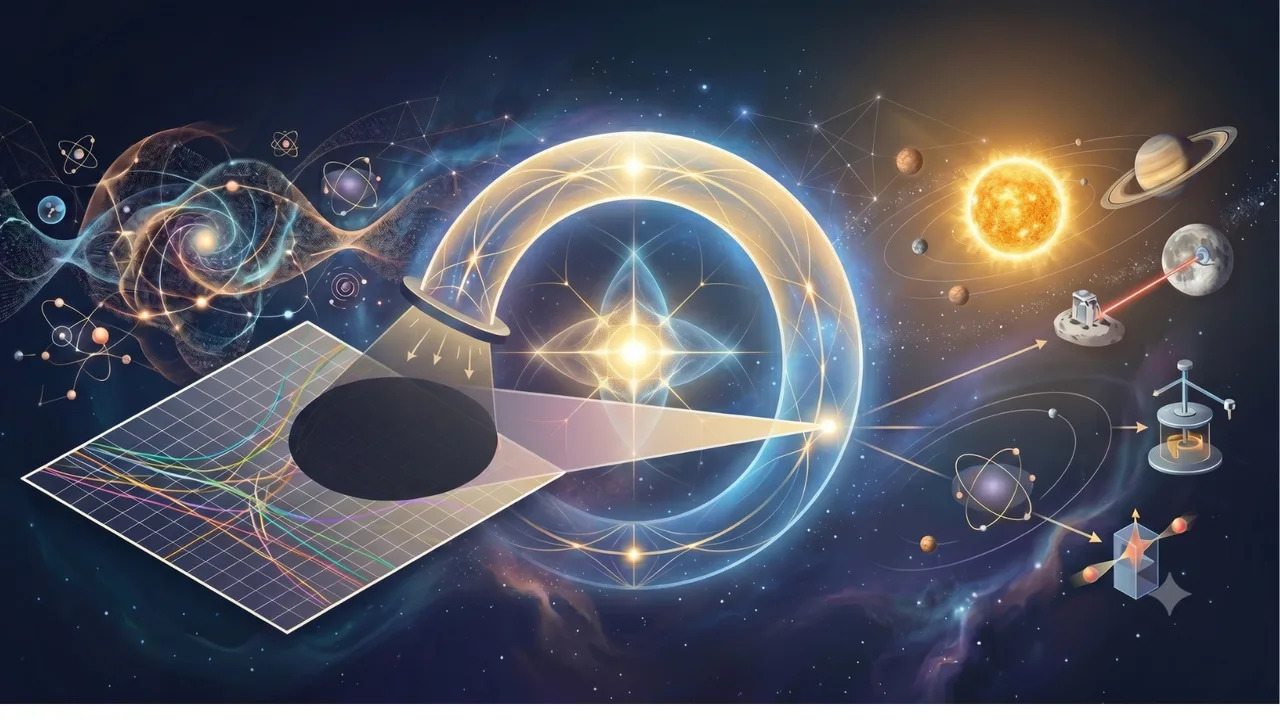
The team's findings reveal that not all potential suggestions for a fifth fundamental force, which would manifest as a small deviation from Isaac Newton's law of gravitation at very small distances and would be described by two parameters: its strength and the range it acts over. In essence, the research could narrow down the search for a fifth fundamental force.

"One of the main challenges was overcoming a primarily conceptual obstacle: quantum gravity is often seen as an extremely abstract topic, almost impossible to connect to observable phenomena," Alfio Bonanno of the National Institute for Astrophysics (INAF) said in an emailed statement translated from Italian. "In some ways, it's like standing in front of a mountain face that everyone considers unscalable. The first step isn't technical, but mental: convincing yourself that a possible path actually exists. This work stems precisely from this idea: seeking a concrete connection between the physics of infinitesimally small scales and phenomena potentially observable in the real world."

The framework of quantum gravity explored by the team is called "asymptotic safety," which asserts that gravity can remain consistent and controlled even at high energies thanks to a halting in the strength of gravitational pull. If this theory is to remain valid at high energy levels, Bonanno and colleagues found that the range and strength of a fifth fundamental force were limited, resulting in an excluded region of these parameters.

"The most exciting aspect is that part of the theoretically excluded region has not yet been explored experimentally," Bonanno said. "This means that future high-precision measurements of gravitation could directly test — and potentially falsify — this class of quantum gravity-inspired models."

Usually, physicists hypothesize new forces and then determine if they could be detected by experiment; this research takes a different approach by ruling out certain possibilities for the characteristics of a proposed force. The fact that much of the region excluded by the team hasn't been explored experimentally lays the groundwork for making precise measurements of gravity to test quantum gravity.

"Our study shows that quantum gravity may not only be a valid theory at extreme and unattainable energies, but may also have concrete and testable consequences at much larger scales," Emiliano Glaviano of the INAF said in the statement. "The physics of infinitesimally small distances could leave observable traces in the macroscopic world: some possible new forces of nature would be ruled out not by experiments, but directly by the fundamental laws of the theory."

This research applies to physics on the tiny scales of quantum physics, where quantum gravity should emerge, to the scales of planetary objects. Thus, traces of this quantum gravity theory or a fifth fundamental force appearing as deviations from Newton's laws should be testable with a wide range of experiments. That includes using a technique called atomic interferometry or quantum sensors to make measurements across the solar system, such as lunar laser ranging, or on wider astronomical scales such as measuring the dynamics of planets.

The team's research was published in the May edition of the journal Physical Review Letters.
Comments
You must be logged in to comment.